
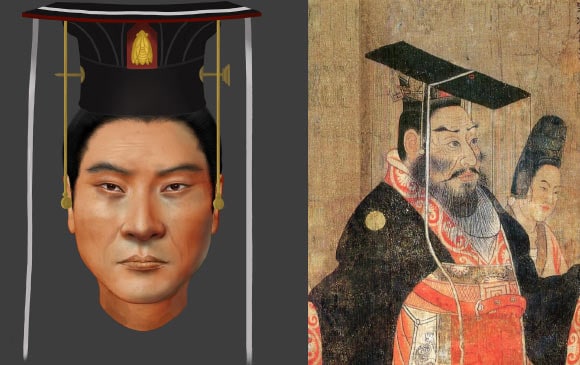
The sequencing of ancient genomes has revolutionized our understanding of historical figures and their times. Recently, a team of scientists from Fudan University and collaborating institutions achieved a remarkable feat by sequencing the genome of Emperor Wu (Yuwen Yong) of the Northern Zhou dynasty, who ruled in the 6th century CE. Emperor Wu was a pivotal ruler who unified northern China and enacted significant military and political reforms. This research not only reconstructs his genetic profile but also digitally recreates his facial features, offering a vivid glimpse into the past. The study sheds light on the ethnic origins, health, and appearance of a historically significant emperor, bridging the gap between ancient texts and modern science.
Historical Significance of Emperor Wu and the Northern Zhou Dynasty
Emperor Wu, born Yuwen Yong in 543 CE, was a central figure in the Northern Zhou dynasty, which was led by the Xianbei, a nomadic people from northern and northeastern Asia. His reign marked a critical period in Chinese history, characterized by military unification and administrative reforms that stabilized the region after decades of fragmentation.
The Northern Zhou dynasty was one of the many dynasties that ruled northern China during the era known as the Northern and Southern dynasties, a time of political division and cultural exchange. Emperor Wu played a crucial role in consolidating power, defeating rival states such as Northern Qi, and pacifying nomadic tribes like the Turks.
His rule is also notable for the reinforcement of the ‘Mandate of Heaven’ concept, which legitimized imperial authority as divinely ordained. Despite his relatively short life—he died at age 36—Emperor Wu's legacy influenced subsequent Chinese history, making the study of his genome particularly valuable for historians and geneticists alike.
The Discovery and Excavation of Emperor Wu’s Tomb
In 1996, archaeologists uncovered the tomb of Emperor Wu in northwestern China, a site that yielded remarkably well-preserved human remains, including a nearly complete skull. This discovery provided a rare opportunity to study the physical attributes of an ancient Chinese emperor firsthand.
The excavation of the tomb was a major archaeological achievement, as it offered not only skeletal remains but also artifacts and inscriptions that helped confirm the identity of the buried individual. The preservation quality allowed scientists to extract biological material essential for modern genetic analysis.
These remains became the foundation for the collaborative research project led by Fudan University, enabling scientists to apply cutting-edge DNA sequencing technologies to reconstruct the emperor’s genome and physical appearance with high precision.
Genome Sequencing and Genetic Insights
The research team successfully sequenced over one million single-nucleotide polymorphisms (SNPs) from Emperor Wu’s DNA. SNPs are genetic markers that reveal information about ancestry, physical traits, and susceptibility to diseases, making them invaluable for reconstructing the biological profile of ancient individuals.
Analysis of the genome confirmed Emperor Wu’s Xianbei heritage, a nomadic group historically thought to have distinct ‘exotic’ features such as a high nose bridge, thick beard, and yellow hair. However, the genetic data indicated that Emperor Wu exhibited conventional East or Northeast Asian characteristics, challenging some previous assumptions about the Xianbei appearance.
Furthermore, the genomic data revealed a genetic predisposition to stroke, corroborating historical records describing Emperor Wu’s symptoms before his death, including aphasia, drooping eyelids, and abnormal gait. This finding provides a compelling intersection between genetic evidence and ancient medical descriptions.
3D Facial Reconstruction: Bringing Emperor Wu to Life
Utilizing the genetic data alongside the skull remains, the research team conducted a 3D facial reconstruction of Emperor Wu. This process involved integrating DNA-inferred physical traits with cranial morphology to generate a lifelike digital portrait of the emperor.
The reconstructed face showed that Emperor Wu had brown eyes, dark hair, and medium to dark skin tone, aligning with typical East Asian features. This contrasts with some earlier scholarly depictions that imagined the Xianbei as having more ‘exotic’ or Western traits.
This reconstruction not only humanizes a figure from over 1,400 years ago but also enriches our understanding of ethnic diversity and appearance in early medieval China. It provides a powerful visual complement to the limited historical portraits and murals previously available.
Ethnic Integration and Historical Context of the Xianbei People
The Xianbei were a nomadic group originally from Mongolia and northern China, known for their military prowess and significant role in shaping northern Chinese history during the Six Dynasties period. Their migration southward brought them into contact and intermarriage with the Han Chinese population.
Genetic analysis of Emperor Wu’s genome revealed evidence of this ethnic integration, showing a blend of Xianbei and Han Chinese genetic markers. This highlights the fluidity of ethnic identities and cultural exchange in ancient China, which were far more complex than traditionally portrayed.
Understanding this integration is crucial for reconstructing the demographic and cultural landscape of early medieval China and offers insight into how nomadic and sedentary populations influenced each other’s development across Eurasia.
Health Implications and Cause of Death
Historical records have long been ambiguous about Emperor Wu’s cause of death, with theories ranging from illness to poisoning by political rivals. The genomic analysis offers new clues by identifying genetic markers associated with increased stroke risk.
The emperor’s documented symptoms—such as aphasia and drooping eyelids—are consistent with the effects of a stroke, suggesting that a cerebrovascular event may have contributed to his early demise at 36 years old. This scientific evidence aligns with historical descriptions, lending credibility to ancient medical observations.
Additionally, the premature death of Emperor Wu’s son without clear explanation raises questions about hereditary health risks within the family, which could be further explored through genetic studies of related remains if available.
Scientific and Cultural Impact of the Study
This research marks a significant advancement in paleogenomics and historical anthropology by combining ancient DNA sequencing with 3D facial reconstruction, providing a multidimensional understanding of a prominent historical figure.
Beyond the scientific community, the study enhances public engagement with history by making Emperor Wu’s image and story accessible in a vivid, tangible form. It bridges the gap between ancient texts and modern technology, enriching cultural heritage and education.
Moreover, the findings contribute valuable data to the broader study of Eurasian population dynamics, illustrating how nomadic groups like the Xianbei interacted genetically and culturally with Han Chinese populations, which has implications for understanding historical migrations and assimilations.
Future Directions and Research Opportunities
The successful sequencing of Emperor Wu’s genome opens the door to further genomic studies of other ancient Chinese rulers and nobility, which could reveal more about the genetic diversity and health conditions of historical populations.
Future research could focus on comparing genomes from different dynasties to trace the evolution of ethnic groups, migration patterns, and disease susceptibilities across centuries, deepening our understanding of China’s complex history.
Additionally, advancements in facial reconstruction technologies may enable even more accurate recreations of historical figures, potentially integrating soft tissue data and environmental factors to refine visualizations and interpretations.
Conclusion
The sequencing of Emperor Wu’s genome and the successful 3D reconstruction of his face represent a landmark achievement in the intersection of genetics, archaeology, and history. This study not only enriches our understanding of a key figure in Chinese history but also exemplifies how modern technology can illuminate the lives of ancient peoples. By bridging the past and present, researchers have unveiled the biological and cultural heritage of the Xianbei-led Northern Zhou dynasty, providing profound insights into ethnic identity, health, and historical narratives. As genomic technologies continue to evolve, such interdisciplinary approaches promise to deepen our connection to history and broaden our appreciation of human diversity through the ages.