
In a groundbreaking advancement, physicists led by Dr. Yuan Lu from the Université de Lorraine’s Institut Jean Lamour have demonstrated the electrical manipulation of magnetization to transfer electron spin information into the polarization of emitted photons. This achievement, realized at room temperature and without the need for external magnetic fields, addresses a fundamental challenge in spintronics and photonics integration. By converting electron spin — a quantum property of electrons — into photon helicity, the team has paved the way for revolutionary applications in long-distance optical communications and energy-efficient data storage. This article explores the scientific principles, experimental breakthroughs, and future implications of this landmark discovery.
Understanding Spintronics: The Role of Electron Spin in Data Storage
Spintronics, short for spin electronics, exploits the intrinsic spin of electrons alongside their charge to represent and process information. Unlike traditional electronics that rely solely on electron charge currents, spintronic devices harness electron spin orientation — up or down — as a binary state, enabling faster and more energy-efficient data manipulation.
Ferromagnetic materials such as iron or cobalt are fundamental in spintronics because they maintain a net magnetization arising from an unequal distribution of electron spins. Electrons aligned with the magnetization axis traverse the material with ease, while those with opposite spin orientation face resistance. This spin-dependent transport forms the basis for representing binary data as ‘0’ and ‘1’ states.
The key advantage of spintronic devices lies in their non-volatile nature; magnetization states remain stable without continuous power, akin to a fridge magnet sticking to a door without energy input. Consequently, spintronic memory technologies, such as magnetic random-access memories (MRAM), promise significant reductions in energy consumption compared to volatile electronic memories.
Challenges in Spin Information Transfer and the Need for Photonic Integration
Despite their advantages, spintronic devices face a critical limitation: electron spin information tends to dissipate quickly when electrons move outside ferromagnetic materials. This spin relaxation restricts the distance spin-based data can travel, posing obstacles for long-range communication and integration with other technologies.
Photons, the quantum particles of light, naturally possess a property called polarization, including circular polarization or helicity, which can serve as an alternative carrier of spin information. Unlike electrons, photons can travel vast distances without losing their polarization states, making them ideal for transmitting spin information over long ranges.
Integrating spintronics with photonics requires a mechanism to convert electron spin states into photon polarization efficiently. Achieving this conversion electrically at room temperature, without external magnetic fields, has been a longstanding challenge that, if overcome, could revolutionize data transmission and processing technologies.
The Breakthrough: Electrical Control of Magnetization and Spin-Photon Conversion
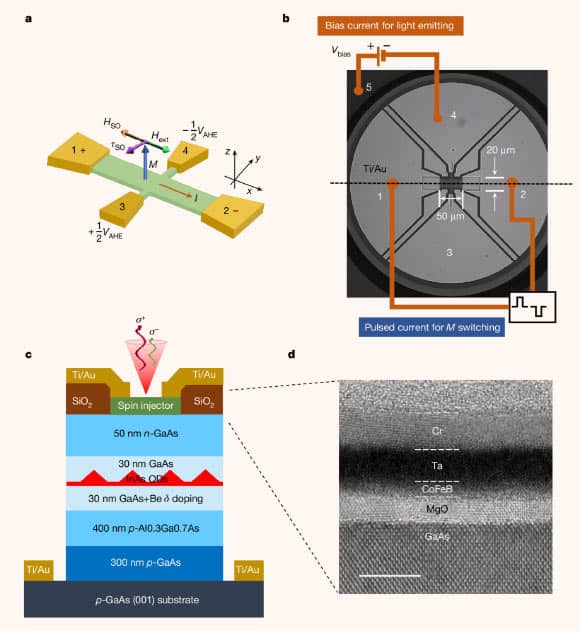
Dr. Yuan Lu and his team have successfully demonstrated the electrical switching of magnetization in a spin injector using spin-orbit torque — a phenomenon where an electric current induces a torque on electron spins due to relativistic spin-orbit coupling. This process enables the precise control of electron spin orientation without external magnetic fields.
Crucially, the team showed that the angular momentum of electrons could be transferred seamlessly to photons emitted from a light-emitting diode (LED), converting electron spin information into the helicity of emitted light. This spin-photon conversion occurs at room temperature and is controlled purely by electrical pulses, fulfilling key criteria for practical applications.
This discovery effectively bridges the gap between spintronics and photonics, enabling data encoded in electron spins to be transmitted as polarized light signals. Such integration is vital for developing advanced optical communication systems and energy-efficient spintronic devices.
Experimental Setup and Key Findings of the Study
The experimental system consisted of a spin-orbit torque-driven light-emitting diode (SOT-LED) incorporating ferromagnetic layers and semiconductor materials. Electrical pulses were applied to switch the magnetization direction of the spin injector, modulating the spin orientation of electrons injected into the LED.
The emitted photons exhibited circular polarization whose helicity directly corresponded to the manipulated electron spin direction. Measurement of the emitted light’s polarization confirmed the successful transfer of spin information from electrons to photons without the need for an external magnetic field.
Importantly, the system operated reliably at room temperature, a critical requirement for practical device integration. The researchers demonstrated that electrical control over magnetization and photon polarization could be achieved with high fidelity, marking a significant leap toward real-world spintronic-photonic devices.
Implications for Optical Telecommunications and Data Storage
The ability to electrically convert electron spin states into photon polarization opens new horizons for optical telecommunications. Polarized photons can carry spin information over long distances with minimal loss, enabling faster and more secure data transmission channels, potentially between Earth and deep-space destinations like Mars.
This technology could drastically enhance the bandwidth and energy efficiency of optical communication networks by integrating spintronic data processing with photonic transmission. The modulation of photon helicity as a data carrier also introduces new dimensions for encoding information beyond traditional intensity-based optical signals.
Moreover, the non-volatile nature of magnetization states combined with photonic communication could lead to innovative hybrid memory and processing devices that combine the speed of optics with the stability of spintronic storage, fostering the development of next-generation computing architectures.
Future Directions and Potential Applications
Further research will focus on optimizing materials and device architectures to enhance the efficiency and scalability of spin-photon conversion. Investigations into diverse ferromagnetic and semiconductor combinations may yield devices with improved performance and integration capabilities.
Potential applications extend beyond telecommunications and data storage to quantum computing, where coherent transfer of spin states to photons is essential for quantum information processing and secure communication protocols.
Additionally, integrating this technology with existing photonic circuits could facilitate the development of compact, low-power optoelectronic components, enabling smarter sensors, advanced imaging systems, and novel information technologies that leverage the quantum properties of electrons and photons.
Overcoming Technical Challenges and Realizing Practical Devices
While the proof-of-concept has been established, scaling the technology for commercial use requires overcoming challenges such as device fabrication complexity, stability under operational conditions, and compatibility with existing semiconductor manufacturing processes.
Achieving uniform and reproducible control over magnetization switching and photon polarization in integrated circuits will be critical. Addressing thermal management and minimizing energy consumption during spin manipulation are also key engineering considerations.
Collaborative efforts between physicists, materials scientists, and engineers will be essential to translate laboratory breakthroughs into robust, manufacturable devices. Continued interdisciplinary research is expected to accelerate the transition of this technology from experimental setups to real-world applications.
Conclusion
The successful transfer of electron spin information to photon polarization represents a paradigm shift in the fields of spintronics and photonics. By electrically controlling magnetization and harnessing spin-orbit torque, physicists have unlocked the potential for seamless integration of magnetic data storage with optical communication technologies. This innovation not only addresses longstanding limitations in spin information transmission but also opens pathways for energy-efficient, high-speed data processing and long-distance optical telecommunications. As research progresses, this discovery is poised to inspire a new generation of quantum-enabled devices, transforming how information is stored, transmitted, and processed across diverse technological landscapes.