Educational Resources
Timings for govt schools, colleges across Sindh reduced by an hour
In a move underscoring the intersection of education policy and economic reality, the Sindh government h...
TAMFIS NIG LTDRC 8067447CAC ACTIVEFinima, Bonny Island, Rivers State

In the heart of Odisha’s Puri district lies Sirei village, home to a primary school that, until recently, was struggling with poor infrastructure and dwindling student enrolment. The school’s condition deterred parents from sending their children, casting a shadow over the community’s educational prospects. However, the arrival of Lalat Chandra Behera, an assistant teacher from nearby Jogeswarpur village, marked a turning point. Without waiting for government aid, Lalat Sir invested his own resources and energy to transform the school’s physical environment and academic atmosphere. This article delves into his inspiring journey, the changes he spearheaded, and the broader impact on education in the region.
Sirei Primary School, located in the Destali panchayat of Gop block, Puri district, was once in a state of neglect. The building was dilapidated, with inadequate facilities and an uninviting environment that discouraged attendance. Parents were hesitant to enrol their children, fearing poor educational quality and lack of safety.
The school compound was barren, lacking greenery or recreational spaces, which further contributed to the low morale among students and teachers alike. The community’s educational aspirations were dampened by these visible shortcomings, and the school’s reputation suffered accordingly.
Such conditions are not uncommon in rural India, where resource constraints and bureaucratic delays often stall infrastructure development. However, the situation at Sirei Primary School was particularly dire, requiring urgent intervention to prevent further decline.
In 2022, Lalat Chandra Behera joined Sirei Primary School as an assistant teacher. Recognizing the urgent need for improvement, he resolved to make a difference not only in the academic performance of students but also in the overall environment of the school.
Lalat Sir’s approach was holistic. He understood that enhancing the school’s physical appearance would boost community confidence and encourage parents to send their children regularly. His vision extended beyond classroom teaching to include infrastructure, hygiene, and greenery.
What set him apart was his willingness to invest personal funds to jumpstart the transformation. Rather than waiting for government grants or external assistance, he took proactive steps to revamp the school with his own resources, demonstrating extraordinary commitment.
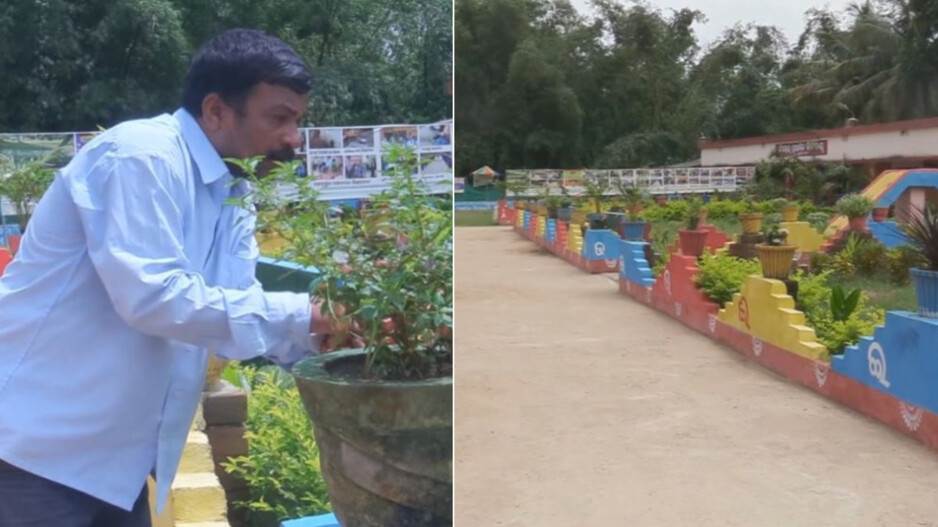
Lalat Sir began by renovating the school compound, planting various flower species, foliage, and establishing lawns that gave the area a vibrant and welcoming look. A basil garden became the main attraction, serving both aesthetic and educational purposes.
He also facilitated the concreting of the previously muddy access road to the school, significantly improving accessibility for students, especially during the monsoon season. This infrastructural enhancement was crucial in overcoming a major obstacle for regular attendance.
These improvements created a child-friendly atmosphere akin to a park, which was a stark contrast to the school’s earlier neglected state. The enhanced environment not only attracted students but also instilled a sense of pride among villagers.
The visible changes brought by Lalat Sir’s efforts led to a remarkable increase in student enrolment. Parents who were once reluctant began sending their children to the school, reassured by the improved facilities and the teacher’s dedication.
The school’s reputation improved within Sirei village and neighboring areas, attracting children from nearby villages as well. This expanded the school’s catchment area and reinforced its role as a pivotal educational institution in the region.
Community members began viewing education not just as a formal obligation but as a shared priority. The villagers’ renewed trust in the school was a testament to how infrastructural and pedagogical improvements can revive community engagement.
Beyond infrastructure, Lalat Sir focused on improving teaching methodologies by incorporating visual aids and interactive learning tools. This approach helped students grasp concepts better and made learning more enjoyable.
One notable outcome of his teaching dedication was a student from Sirei Primary School securing a scholarship, highlighting the academic progress made under his guidance. This achievement brought pride to the school and validated the teacher’s efforts.
Students like Subhashree Routray, who benefited directly from these improvements, expressed enthusiasm for the better learning environment and teaching quality. This positive feedback further motivated Lalat Sir to continue his mission.
The transformation led by Lalat Sir has not gone unnoticed. Guardians like Niranjan Dalai openly praised his commitment, acknowledging the dramatic turnaround in enrolment and school conditions within just two years.
Educational authorities, including Cluster Resource Centre Coordinator Arabinda Sahu, lauded his selflessness and dedication. Sahu remarked that words fall short in praising Lalat Sir’s contributions, emphasizing the rarity of such passion-driven initiatives.
Though official recognition or rewards have yet to materialize, the widespread admiration among villagers and education officials underscores the profound impact individual dedication can have on public education.
The story of Sirei Primary School illustrates how grassroots efforts can complement government initiatives in improving rural education. Teachers like Lalat Sir serve as catalysts for change, demonstrating that local ownership and responsibility are vital.
This model encourages other educators and community members to take proactive steps, fostering a culture of accountability and innovation in schools that might otherwise be overlooked.
Moreover, such transformations contribute to the larger goal of universal education by making schools more accessible, attractive, and effective, thereby supporting government schemes aimed at increasing enrolment and retention.
Sustaining these improvements requires continued community involvement and support from educational authorities. Encouraging public-private partnerships could provide additional resources and expertise to maintain infrastructure and enhance teaching quality.
Training programs for teachers on innovative pedagogies, coupled with infrastructural grants, can build on the foundation laid by Lalat Sir. Engaging parents and local leaders in school management committees will further entrench a sense of ownership.
Looking ahead, the hope is that this success story inspires replication across Odisha and beyond, ensuring that quality education reaches every child, regardless of geography or socio-economic barriers.
The remarkable transformation of Sirei Primary School in Odisha stands as a testament to the power of individual dedication and community collaboration in overcoming educational challenges. Lalat Chandra Behera’s selfless investment and innovative approach not only revitalized a struggling institution but also rekindled hope and pride within the community. His story underscores the critical role teachers play beyond classrooms—as visionaries and changemakers. As Odisha and other regions strive to achieve inclusive education, such inspiring examples illuminate pathways toward sustainable progress, reminding us that meaningful change often begins with a single motivated individual.
Originally reported by odishatv.in. Adapted for our readers.
Keep reading
Educational Resources
In a move underscoring the intersection of education policy and economic reality, the Sindh government h...
Educational Resources
All eyes are on the FIBA World Cup, but we can't help but think about what's to come in the WNBA....
Educational Resources
Portugal finds itself grappling with a multifaceted crisis as severe storms, known as Storm Kristin and ...
TAMFIS NIG LTD
Electrical and instrumentation engineering, bid preparation and consulting, IT and software.