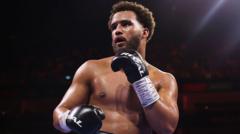
Moses Itauma’s World Title Debut: A Harsh but Valuable Lesson in Heavyweight Boxing
On a high-profile night at London’s O2 Arena, Moses Itauma, a rising British heavyweight prospect, faced a defining moment in his young career. The 21-year-old, known for his speed and boxing intelligence, challenged Filip Hrgovic for the vacant IBF heavyweight title. While Itauma showed flashes of brilliance, the fight exposed the gap between raw talent and the demands of a world championship bout. This article explores the key moments of the fight, the factors behind Itauma’s defeat, and the implications for his future in boxing.
Moses Itauma’s World Title Debut: A Harsh but Valuable Lesson in Heavyweight Boxing
The Fight Night: Talent Meets Experience
Moses Itauma entered the ring as a youthful and agile fighter, having never previously fought beyond six rounds in his professional career. Against Filip Hrgovic, a seasoned Croatian heavyweight with an Olympic bronze medal and a history of tough battles, Itauma initially impressed. He was quicker, sharper, and repeatedly landed effective left-hand shots, demonstrating the tools that many boxing insiders believe could take him to the sport’s pinnacle.
However, the fight’s momentum gradually shifted. Despite winning several rounds early on, Itauma’s stamina began to wane. By the ninth round, his energy was depleted, and the referee stopped the fight after Itauma’s corner threw in the towel. Hrgovic’s granite-like resilience and experience in enduring long, grueling matches ultimately prevailed.
Where It Went Wrong: Conditioning and Experience Deficits
Itauma’s conditioning was a critical factor in the outcome. He admitted before the fight that he had never sparred for 12 rounds and had never fought beyond six rounds professionally. This lack of endurance became evident as the fight progressed, with Itauma gasping for air and losing the spring in his legs.
The fight highlighted the difference between having world-level talent and possessing the ring craft, experience, and physical preparation necessary to sustain a championship bout. Hrgovic, aged 34, had been through difficult fights that tested his resilience and taught him how to manage his energy over 12 rounds. Itauma, by contrast, appeared to expend too much energy early, adopting an aggressive style more akin to an amateur fighter, which ultimately led to his fatigue.
Psychological Factors and Pre-Fight Dynamics
The psychological battle before the fight also played a role. Hrgovic repeatedly dismissed Itauma as "just a kid" during fight week, attempting to unsettle the younger fighter. The tension culminated at the weigh-in, where Itauma lost his composure and shoved Hrgovic, who responded with a slap.
Itauma is known for his cerebral approach to boxing, spending time reading psychology and self-help books to sharpen his mind. However, this deep thinking may have contributed to overthinking, a pitfall that has affected other heavyweights like Anthony Joshua in their careers. While it is unclear how much the pre-fight mind games impacted Itauma’s performance, his desire to end the fight early by knockout may have influenced his pacing and strategy.
Hrgovic’s Experience and Tactical Patience
Filip Hrgovic’s experience was a decisive advantage. An Olympic bronze medalist with a record of 21 wins and only one loss, Hrgovic had faced elite opponents such as Zhilei Zhang and Daniel Dubois. His ability to endure punishment and maintain composure under pressure was evident throughout the fight.
Hrgovic’s strategy was to absorb Itauma’s early aggression, knowing the younger fighter would tire. He described the eighth round as a turning point, noting that Itauma was throwing an excessive number of punches and fighting like an amateur. Hrgovic’s patience paid off as he capitalized on Itauma’s fatigue in the later rounds, ultimately securing a stoppage victory and becoming Croatia’s first heavyweight world champion.
Lessons for Moses Itauma and His Team
Despite the loss, Itauma’s performance was far from a failure. He showed that his speed, hand skills, and ability to take punches are world-class qualities. The fight served as an education on the importance of conditioning, pacing, and experience in championship boxing.
Promoter Frank Warren emphasized that Itauma’s mindset of needing a knockout to win was understandable but potentially detrimental. He stressed the need for Itauma to rebuild by taking easier fights, gaining confidence, and learning to manage 12-round bouts effectively.
Responsibility for Itauma’s preparation also extends to his team, who must ensure his conditioning matches the demands of elite competition. The fight exposed gaps in his training regime, particularly in endurance and sparring for longer rounds.
The Road Ahead: Potential and Challenges
Itauma’s future remains promising, provided he takes the right steps to develop his skills and conditioning. Comparisons have been drawn to Daniel Dubois, another British heavyweight who overcame early setbacks to become a two-time world champion.
However, British boxing history also includes cautionary tales like David Price, whose career momentum stalled after successive defeats. Itauma’s every move will now be scrutinized, but this vulnerability could make him a more compelling and relatable fighter to follow.
Ultimately, the fight marked the end of Itauma’s aura of invincibility and the beginning of a new chapter where he must apply the lessons learned to reach his full potential.
What this means
Moses Itauma’s first world heavyweight title challenge was a sobering but instructive experience. While the defeat exposed gaps in his conditioning and experience, it also confirmed his raw talent and potential to compete at the highest level. The path forward requires careful rebuilding, improved endurance, and strategic maturity. If Itauma and his team can learn from this setback, he could still become a significant figure in heavyweight boxing. The fight was not a moment of exposure but a crucial education, marking the transition from promising prospect to a fighter tested by the realities of world championship boxing.
Originally reported by bbc.co.uk. Adapted for our readers with AI assistance.
Nigeria's women's national team faces a critical two-legged qualifier for the 2028 Los Angeles Olympics without three star players, but interim coach Augustine Eguavoen…