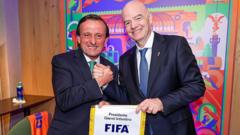
Mexico and Argentina Break Ranks to Support FIFA President Gianni Infantino Amidst Regional Divisions
Gianni Infantino, FIFA's president, is facing significant scrutiny and opposition from various football governing bodies, particularly in Europe and parts of the Americas. However, two prominent football nations, Mexico and Argentina, have publicly expressed their support for his leadership, breaking ranks with their regional confederations. This development highlights deep divisions within the global football community over governance, transparency, and the future direction of the sport.
Mexico and Argentina Break Ranks to Support FIFA President Gianni Infantino Amidst Regional Divisions
Divergent Regional Responses to Infantino’s Leadership
The Mexican Football Federation (FMF) has taken a notable stance by supporting Gianni Infantino, despite criticism from its regional governing body, Concacaf. Concacaf, which oversees football in North and Central America and the Caribbean, has called for a comprehensive review of Infantino’s presidency, especially after he abruptly halted plans to sell stakes in the World Cup to private investors—a move that sparked widespread governance concerns and accusations of poor leadership.
In contrast, the FMF released a statement endorsing Infantino’s efforts to strengthen football institutions and promote the sport’s development. It emphasized support for continuing football's growth through institutional strengthening and rejected any attempts to remove Infantino outside of FIFA's established democratic processes. This position aligns with South America’s governing body, Conmebol, which also opposes any attempt to oust Infantino without a vote involving all 211 FIFA member associations. However, Conmebol expressed unease about Infantino’s repeated unilateral decisions, urging dialogue and adherence to institutional mechanisms to resolve conflicts within FIFA.
Support from Argentina and Africa Amidst European Opposition
Argentina’s football association, runners-up in the 2026 World Cup bid alongside Mexico and the United States, praised Infantino for acknowledging his mistakes and emphasized his decade-long focus on global football development and transparent governance. The Argentine FA described his tenure as centred on soccer's worldwide growth and institutional stability, highlighting a clear, stable, and transparent governance model.
Similarly, the Confederation of African Football (CAF) has shown unanimous backing for Infantino, underscoring his support beyond the Americas. This contrasts sharply with UEFA, Europe’s football governing body, which has lost confidence in his presidency. UEFA criticized Infantino’s FIFA Forward Enterprise (FFE) proposal as opaque, poorly managed, and a 'shabby, back-room deal'. UEFA has also hinted at a potential boycott of the upcoming World Cup if their concerns are not addressed, stating that assurances must be made to prevent future attempts to 'disfigure the game'.
The English Football Association has formally withdrawn its support for Infantino, with Wales, Albania, and Croatia among other national associations distancing themselves from the FIFA president. This European opposition reflects deep dissatisfaction with Infantino’s leadership style and governance approach.
Concacaf’s Criticism and the Fallout from the FIFA Forward Enterprise Proposal
Concacaf has described Infantino’s FFE proposal—an initiative to attract private investment into FIFA tournaments, including the men’s and women’s World Cups—as symptomatic of leadership that prioritizes interests other than football. The plan involved offering $40 million to associations that supported it, which UEFA and others viewed as an attempt to secure backing through financial incentives rather than transparent governance.
Although Concacaf has not formally withdrawn confidence in Infantino, it condemned the unilateral nature of his decisions and the pattern of governance missteps. The regional body called the aborted proposal an 'egregious act of poor governance and leadership' and urged a comprehensive reckoning of Infantino’s presidency.
The Asian Football Confederation (AFC) initially stood in solidarity with UEFA and Concacaf in opposing the FFE plans, emphasizing the need for transparency and collective decision-making. This broad regional opposition highlights the challenges Infantino faces in uniting FIFA’s diverse membership around his vision.
Potential Consequences for the 2026 World Cup and Global Football Governance
The divisions among FIFA’s member associations raise concerns about the unity and smooth execution of the 2026 World Cup, which Mexico and Argentina will co-host alongside the United States. UEFA’s threat of a boycott, if conditions are not met, could significantly impact the tournament’s prestige, competitive integrity, and global viewership.
Infantino’s recent acknowledgment of 'mistakes' in handling the FFE proposal and his commitment to more inclusive processes indicate an attempt to repair strained relationships within FIFA. During a meeting of FIFA executives in Morocco, the organization admitted that the process around FFE should have been handled differently to avoid exclusion of the FIFA Council and member associations.
Despite these acknowledgments, UEFA remains firm in its loss of confidence, and several national associations, including England, Wales, Albania, and Croatia, have withdrawn their support. The situation underscores broader challenges in football governance, including balancing commercial interests with transparency, ensuring inclusive decision-making, and maintaining trust among diverse stakeholders.
The potential for a European boycott of the World Cup, one of the sport’s most significant events, would be unprecedented and could have long-lasting repercussions for FIFA’s authority and the global football ecosystem.
The Institutional Framework and Calls for Democratic Processes
Both Mexico and Conmebol emphasize adherence to FIFA’s institutional frameworks, insisting that any decision about Infantino’s future must involve a vote by all member associations. This stance highlights the importance of democratic processes within global sports governance and resists attempts to circumvent established procedures.
Their position also reflects a resistance to external or unilateral attempts to influence FIFA’s leadership, underscoring the complex interplay between regional interests and global governance structures. The call to 'collectively continue developing football' suggests a preference for dialogue and consensus over abrupt leadership changes.
This insistence on formal voting mechanisms and institutional respect points to the challenges FIFA faces in balancing the interests of its 211 member associations, each with varying priorities and political dynamics, while maintaining effective leadership and governance.
What this means
The support of Mexico and Argentina for Gianni Infantino amid widespread criticism illustrates the fragmented nature of global football governance today. While Infantino faces significant opposition, particularly from European football authorities, his backing by key football nations in the Americas and Africa complicates efforts to challenge his presidency. This divide underscores the need for transparent, inclusive dialogue within FIFA to address governance concerns and ensure the sport’s unified progress. As the 2026 World Cup approaches, the stakes are high for all parties to find common ground and safeguard football’s integrity on the world stage.
Originally reported by bbc.co.uk. Adapted for our readers with AI assistance.
Following heavy defeats in the first two Tests against England, Pakistan has made sweeping changes by dropping seven players, calling up five newcomers, and…
Manchester City’s proposed £80 million transfer for Liverpool forward Cody Gakpo is on the brink of collapse as Liverpool struggles to secure a suitable…