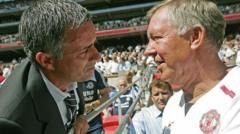
Jose Mourinho’s Career Choices: Why He Declined to Succeed Sir Alex Ferguson at Manchester United
Jose Mourinho, one of football’s most prominent and polarizing managers, has shared new insights into a pivotal moment in his career: his decision not to succeed Sir Alex Ferguson at Manchester United in 2013. Despite initially agreeing to take over at Old Trafford, Mourinho reversed course and rejoined Chelsea instead. This article explores the context and consequences of that choice, his complex relationships with clubs and players, and how these experiences have defined his managerial path.
Jose Mourinho’s Career Choices: Why He Declined to Succeed Sir Alex Ferguson at Manchester United
The Offer to Succeed Ferguson: A Moment of High Stakes
In 2013, following the retirement of Sir Alex Ferguson, Manchester United faced the daunting task of appointing a new manager to succeed the legendary Scot, who had secured 13 Premier League titles over 26 years. Jose Mourinho, then recently departed from Real Madrid, was offered the role and initially accepted it. Ferguson himself confirmed this agreement and recounted how Mourinho seemed committed to the position after their discussions.
However, within hours of this apparent acceptance, Mourinho changed his mind. The reason was deeply personal: a strong sense of loyalty to Chelsea, where he had previously won back-to-back Premier League titles in 2005 and 2006. Mourinho described the emotional difficulty of this decision, even recalling a phone call to Ferguson where he was moved to tears, explaining that he could not break his word to Chelsea.
This episode highlights the intense pressures and emotional considerations managers face when making career decisions, especially when legacy and loyalty are involved.
Choosing Chelsea Over Manchester United: Loyalty and Love for the Game
Mourinho explained that while the opportunity to manage Manchester United was incredibly flattering due to the club’s global appeal, his decision was driven by a deeper need to feel valued and loved by a club. He differentiated between a general love for football and a passionate love for a specific club, emphasizing that the latter was more powerful in his decision-making.
After returning to Chelsea in 2013, Mourinho quickly restored the club’s dominance by securing a third Premier League title and a League Cup. This success validated his choice from a professional standpoint, demonstrating that his emotional connection to Chelsea translated into tangible achievements on the pitch.
His decision also underscores the complex relationship between professional ambition and personal values in football management.
Mourinho’s Later Tenure at Manchester United
Mourinho eventually took the Manchester United job in May 2016, succeeding Louis van Gaal. His tenure lasted two and a half years, during which he won the League Cup and the Europa League. However, his time at Old Trafford was marked by fluctuating results and internal challenges, culminating in his dismissal in December 2018.
This period revealed the difficulties of following a legendary predecessor and managing the high expectations at a club with a demanding fanbase and media scrutiny. Mourinho’s mixed success at United contrasts with his earlier achievements and highlights the challenges inherent in managing top-tier clubs with rich histories.
The Real Madrid Chapter: Triumphs and Turmoil
Mourinho’s first spell at Real Madrid was characterized by both remarkable success and significant conflict. He led the team to a La Liga title with a record 100 points in the 2011-12 season, as well as Copa del Rey and Spanish Super Cup victories. These achievements disrupted the dominance of Pep Guardiola’s Barcelona and cemented Mourinho’s reputation as a top manager in Europe.
However, his third season saw tensions escalate, particularly with club captain Iker Casillas. Mourinho’s decision to bench Casillas and the ensuing strained relationship divided the dressing room and alienated key players like Cristiano Ronaldo and Sergio Ramos. Former teammates and observers described the atmosphere as toxic, with the rift affecting team cohesion.
Mourinho defended his stance by pointing to what he perceived as a lack of respect and professionalism from Casillas and others, emphasizing his uncompromising approach to discipline and authority. This episode illustrates the challenges Mourinho faces in managing star players and maintaining harmony within elite squads.
Complex Relationships with Club Owners and Players
Mourinho’s managerial career has also been shaped by his interactions with club owners, notably Roman Abramovich at Chelsea. Despite winning multiple trophies during two spells at Stamford Bridge, Mourinho described his relationship with Abramovich as increasingly strained and ‘very cold.’ He criticized the owner’s interference in transfer decisions, such as the signing of Andriy Shevchenko, which Mourinho opposed but did not openly resist.
This dynamic reflects the broader tension between football managers’ desire for autonomy and the influence of club owners, particularly those with strong personalities and ambitions.
Similarly, Mourinho’s confrontational style has led to high-profile disputes with players, as seen with Casillas at Real Madrid and other squad members. While his demanding approach has brought success, it has also resulted in fractured relationships and departures, highlighting the trade-offs between discipline and diplomacy in football management.
Legacy and Lessons from Mourinho’s Career Decisions
Mourinho’s choice to prioritize emotional loyalty over immediate professional advancement by declining Manchester United in 2013 reveals the human side of football management often overlooked in public narratives. His career trajectory demonstrates how personal values, club culture, and relationships can influence decisions as much as trophies and contracts.
His return to Real Madrid in 2024 marks another chapter where Mourinho aims to blend his tactical acumen with lessons learned from past conflicts. The challenges he faced previously at the Bernabeu, including managing egos and maintaining locker room unity, remain relevant as he seeks to restore the club’s competitive edge.
Overall, Mourinho’s story underscores the complexities of football management beyond the pitch, involving emotional intelligence, leadership, and navigating the intricate web of club politics.
What this means
Jose Mourinho’s revelation about his decision not to succeed Sir Alex Ferguson at Manchester United offers a rare glimpse into the emotional and personal factors that influence high-profile managerial careers. His journey highlights that success in football management is not solely determined by trophies but also by loyalty, respect, and the ability to navigate complex human dynamics. As Mourinho returns to Real Madrid, his past experiences provide valuable lessons on leadership and resilience in the ever-demanding world of elite football.
Originally reported by bbc.co.uk. Adapted for our readers with AI assistance.
Following heavy defeats in the first two Tests against England, Pakistan has made sweeping changes by dropping seven players, calling up five newcomers, and…
Manchester City’s proposed £80 million transfer for Liverpool forward Cody Gakpo is on the brink of collapse as Liverpool struggles to secure a suitable…