Pillars of Creation Star in New Visualization from NASA’s Hubble and Webb Telescopes
The Pillars of Creation, towering structures within the Eagle Nebula, have fascinated astronomers and the public alike since their iconic capture by NASA’s Hubble Space Telescope in 1995. These colossal columns of gas and dust are stellar nurseries where new stars are born. Recently, NASA released an advanced three-dimensional visualization that integrates observations from both the Hubble and the James Webb Space Telescopes. This comprehensive multiwavelength portrayal provides a richer, more detailed perspective on the pillars’ complex structure and the dynamic processes within. This article delves into the significance of this visualization, the science behind it, and what it reveals about star formation.
The Pillars of Creation: A Celestial Icon Revisited
Located in the Eagle Nebula, approximately 7,000 light-years from Earth, the Pillars of Creation are vast columns primarily composed of cool molecular hydrogen and cosmic dust. These structures stretch across several light-years, with the tallest pillar spanning about three light-years—nearly three-quarters the distance between our Sun and its nearest stellar neighbor.
Since their first detailed image by Hubble in 1995, the pillars have become a symbol of cosmic beauty and the mysteries of star formation. Their finger-like protrusions, larger than our solar system, are shaped and eroded by intense ultraviolet radiation and stellar winds from nearby massive young stars. Embedded within these protrusions are embryonic stars, still forming in the dense clouds of gas and dust.
Combining Hubble and Webb: A Multiwavelength Approach
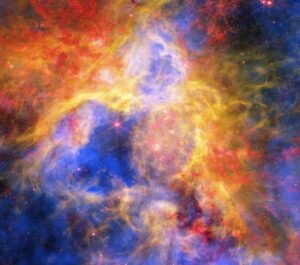
The new visualization is a mosaic that merges visible-light data from Hubble with infrared-light observations from the James Webb Space Telescope. This fusion provides a more holistic view of the pillars, revealing features invisible to any single telescope alone.
Hubble’s visible-light images highlight hot, glowing gases at temperatures of thousands of degrees, capturing the pillars’ illuminated surfaces. In contrast, Webb’s infrared capabilities penetrate the obscuring dust, unveiling cooler objects at just hundreds of degrees and revealing stars still cocooned within the pillars’ depths.
According to Frank Summers, principal visualization scientist at the Space Telescope Science Institute, this combined perspective allows viewers to experience the three-dimensional structure of the pillars and understand why multiple telescopes observing different wavelengths are essential for a comprehensive cosmic portrait.
Creating a Data-Driven 3D Experience
Unlike artistic renditions, the 3D visualization is grounded in scientific data derived from a research paper led by Dr. Anna McLeod of the University of Durham. McLeod also served as a scientific advisor for the project, ensuring the visualization’s accuracy and educational value.
The visualization team, led by Greg Bacon of the Space Telescope Science Institute, used this data to construct a detailed model that allows viewers to virtually fly around and through the pillars. This immersive experience highlights various stages of star formation within the structures, such as an infant protostar glowing in infrared near the central pillar’s top and a diagonal jet of material ejected by a newborn star near the left pillar.
By navigating the 3D model, viewers can appreciate the spatial relationships and physical processes shaping these stellar nurseries, gaining insights into how stars emerge from dense molecular clouds.
Educational and Interactive Innovations
The visualization is part of NASA’s Universe of Learning initiative, designed to engage audiences ranging from youth and families to lifelong learners. It is incorporated into a longer narrated video that connects viewers directly with the science and scientists behind NASA’s astrophysics missions.
A notable feature accompanying the visualization is a 3D printable model of the Pillars of Creation. This tactile tool allows users to physically explore the pillars’ structure, enhancing comprehension through hands-on interaction.
Additionally, NASA offers interactive tools and exhibits, such as ViewSpace, which is featured in nearly 200 museums and planetariums across the United States. These resources provide further opportunities for the public to explore nebulae and other cosmic phenomena using real data from space telescopes.
Scientific Insights and Broader Implications
The Pillars of Creation continue to be a rich source of scientific discovery. By combining multiwavelength data, astronomers can better understand the processes driving star formation, including how stellar winds and radiation sculpt molecular clouds and trigger the birth of new stars.
Mark Clampin, director of NASA’s Astrophysics Division, emphasizes that integrating observations from different telescopes broadens our knowledge of the universe. This visualization exemplifies how modern astronomy leverages complementary technologies to reveal complex cosmic phenomena.
Moreover, the project underscores the importance of public engagement in science, making cutting-edge research accessible and inspiring curiosity about the universe.
What this means
NASA’s innovative 3D visualization of the Pillars of Creation marks a significant advancement in how we observe and understand star-forming regions. By integrating the strengths of the Hubble and James Webb Space Telescopes, this project not only enriches scientific knowledge but also transforms public engagement with astronomy. The ability to explore these iconic structures in three dimensions, supported by accurate scientific data, offers a powerful educational tool that bridges the gap between complex research and accessible learning. As technology and collaboration continue to evolve, such visualizations will play an increasingly vital role in unveiling the universe’s secrets and inspiring the next generation of explorers.
Recent advances in machine perfusion technology are not only preserving donated livers but also making them biologically younger at a molecular level. This breakthrough…
What happens when human imagination, artificial intelligence, art and technology come together? From September 1 to 6, Samsung Electronics presented a special exhibition themed…