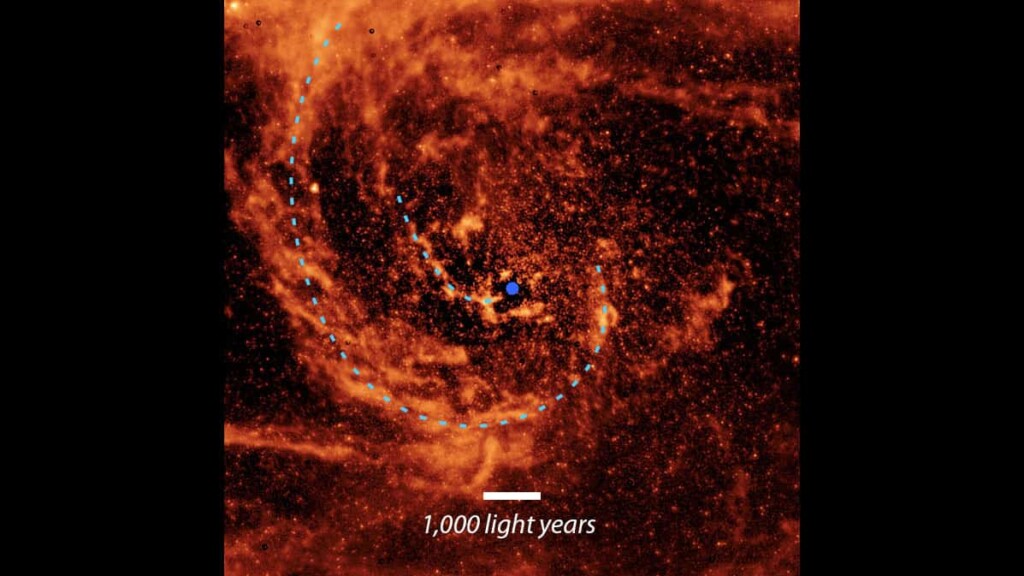
NASA Shots Abet Be aware Eating Habits of Huge Unlit Gap
Supermassive black holes—enigmatic giants residing at the centers of galaxies—are known for their immense gravitational pull, capable of consuming vast amounts of gas, dust, and even stars. While their voracious appetites often produce dazzling light shows as matter heats up before crossing the event horizon, some of these cosmic behemoths appear surprisingly quiescent. NASA’s retired Spitzer Space Telescope has provided groundbreaking data that help scientists better understand the feeding habits of these colossal entities, particularly focusing on the supermassive black hole at the heart of the Andromeda galaxy. This article delves into the latest discoveries, simulations, and observations that reveal how steady streams of material feed these black holes, shaping their brightness and influencing galactic evolution.
The Role of Spitzer Space Telescope in Black Hole Research
Launched in 2003 and managed by NASA’s Jet Propulsion Laboratory, the Spitzer Space Telescope revolutionized infrared astronomy by capturing the universe in wavelengths invisible to the human eye. Infrared observations are crucial because they penetrate cosmic dust clouds that often obscure other wavelengths, allowing astronomers to study regions around black holes with unprecedented clarity.
Spitzer’s ability to distinguish different infrared wavelengths enabled scientists to isolate dust emissions from other sources of light, such as stars. This capability effectively allowed researchers to map the ‘skeleton’ of galaxies—areas where gas and dust have cooled and clumped together, setting the stage for star formation and feeding black holes.
Despite its retirement, Spitzer’s extensive archival data continues to yield new insights. By revisiting these datasets with modern computational models, scientists have uncovered subtle structures and feeding processes around supermassive black holes that were previously undetectable.
Understanding Supermassive Black Hole Feeding Mechanisms
Supermassive black holes grow by accreting matter from their surroundings, typically in the form of gas and dust. This material often forms an accretion disk—a swirling, flattened structure heated to extreme temperatures as it spirals inward. The intense gravitational forces accelerate particles, generating light that can outshine entire galaxies.
Interestingly, the brightness of these black holes can fluctuate dramatically depending on how the accretion disk is fed. When gas and dust fall in irregular, clumpy bursts, the emitted light varies significantly. Conversely, a steady, continuous inflow results in more stable luminosity.
The feeding process is complex and influenced by the dynamics of the host galaxy. Factors such as the distribution of gas, the presence of dust rings, and the gravitational interplay between stars and the black hole all contribute to how material is funneled inward.
Steady Streams Feeding Andromeda’s Central Black Hole
Recent studies leveraging Spitzer’s infrared imagery have revealed streams of dust extending thousands of light-years toward the supermassive black hole at Andromeda’s center. These streams appear to feed the black hole in a steady, spiral pattern, resembling water swirling down a drain.
Unlike more variable black holes, Andromeda’s central black hole emits relatively constant light, suggesting it consumes matter in a consistent flow rather than in sporadic bursts. This behavior challenges previous assumptions that all supermassive black holes feed irregularly.
The spiral streams of gas and dust maintain specific sizes and velocities necessary to sustain this steady feeding. If these parameters were to shift, the material might fall in clumps, producing fluctuating brightness. The discovery of such regulated inflows offers new perspectives on black hole accretion physics.
Simulating Gas and Dust Dynamics Near Black Holes
To better understand the feeding process, researchers have used advanced computer simulations to model how gas and dust behave near Andromeda’s supermassive black hole. These simulations recreate conditions over time, showing how a small disk of hot gas can persistently nourish the black hole.
The models indicate that the disk is continuously replenished by numerous streams of material, which must fall within precise ranges of size and velocity to avoid irregular accretion events. This delicate balance ensures a steady supply of matter and stable emission patterns.
By comparing these simulations with observational data from Spitzer and NASA’s Hubble Space Telescope, scientists have confirmed the existence of spiral dust structures consistent with their models. This synergy between simulation and observation strengthens our understanding of black hole feeding dynamics.
Comparing Feeding Behaviors in the Milky Way and Andromeda
Both the Milky Way and Andromeda galaxies harbor supermassive black holes at their centers, yet their feeding behaviors differ markedly. The Milky Way’s black hole, Sagittarius A*, is known for its quiet nature, emitting relatively low and stable light levels indicative of a steady accretion process.
Andromeda’s central black hole exhibits similar characteristics, with steady, spiral streams of dust and gas contributing to its subdued brightness. This contrasts with more active black holes that exhibit erratic feeding and intense luminosity variations.
These observations suggest that some supermassive black holes operate under a ‘slow and steady’ feeding regime, possibly influenced by the galactic environment and the availability of infalling material. Understanding these differences helps elucidate the lifecycle of galaxies and their central black holes.
The Importance of Archival Data in Modern Astronomy
The case of Andromeda’s black hole feeding habits highlights the tremendous value of archival astronomical data. Spitzer’s vast repository, spanning over two decades, continues to be a treasure trove for new discoveries when analyzed with contemporary techniques.
Reexamining existing data with updated computer simulations and analytical tools allows scientists to extract previously overlooked information, advancing knowledge without the need for new observations. This approach maximizes the scientific return on investment for costly space missions.
Moreover, integrating data from multiple observatories, such as Spitzer and Hubble, enriches the context and accuracy of findings, exemplifying the collaborative nature of modern astrophysical research.
Implications for Galaxy Evolution and Future Research
Understanding how supermassive black holes consume matter is crucial for unraveling the evolution of galaxies. The feeding process affects black hole growth, star formation rates, and the distribution of gas and dust within galaxies.
The discovery of steady, spiral feeding streams in Andromeda suggests that some galaxies may regulate their central black holes’ growth more smoothly than previously thought. This steady accretion could influence the galaxy’s stability and its ability to foster new stars.
Future research, including observations from next-generation telescopes like the James Webb Space Telescope, will build on these findings to explore feeding mechanisms in diverse galactic environments, deepening our understanding of the cosmos.
Conclusion
NASA’s Spitzer Space Telescope has provided a transformative window into the feeding habits of supermassive black holes, particularly illuminating the steady, spiral streams of gas and dust nourishing the black hole in the Andromeda galaxy. These findings challenge prior notions of erratic black hole feeding, revealing a more regulated and consistent process that influences galactic dynamics and evolution. The synergy of archival data, advanced simulations, and multi-observatory observations underscores the collaborative and evolving nature of astrophysical research. As technology advances, future missions promise to deepen our comprehension of these cosmic phenomena, further unraveling the mysteries of the universe’s most powerful entities.
Originally reported by nasa.gov. Adapted for our readers.
Author of the article: Published Sep 18, 2026 11 minute read Article content Kyndryl Canada has been engaged to deliver a commercialization strategy and…
The National Agency for Science and Engineering Infrastructure (NASENI) on Friday 4th September 2026, marked three years of institutional transformation under its Executive Vice…
Municipal Administration Minister P. Narayana speaks to residents after laying the foundation stone for the slum redevelopment project at Velampeta, near Lakshmi Nagar in…