a machine with wires and electronics on it
Educational Resources, Instrumentation

Process Control Systems

Comprehensive Overview of Process Control Systems Process control systems refer to the methodologies and technologies employed across industries to regulate production processes, ensuring output consistency, quality, and operational efficiency. From manufacturing plants and chemical processes to power generation and pharmaceutical production, process control systems are integral in maintaining stability and reliability of numerous industrial applications. Effective process control can significantly reduce waste, enhance safety, optimise energy usage, and improve the overall profitability and sustainability of operations. Overview of Process Control At its core, process control systems involve measurement, comparison, calculation, and corrective action, which function collaboratively to maintain the desired level or output of any given process. Sensors measure specific parameters (such as temperature, pressure, or concentration), whereas controllers analyse data and determine necessary adjustments. Lastly, actuators carry out the commands issued by controllers, adjusting the parameters to...

Continue reading
landscape photography of factory
Educational Resources, Instrumentation

Nuclear Flux Transmitters: Safety in Critical Applications

Nuclear flux transmitters play a vital role in ensuring the safe operation of nuclear facilities by monitoring radiation levels. These devices are essential for detecting and measuring neutron and gamma radiation, providing data that is crucial for maintaining safety protocols, operational efficiency, and regulatory compliance. Their reliable functionality is paramount in preventing accidents and ensuring the protection of both personnel and the environment. Importance of Calibration Calibration is a crucial step in maintaining the operational integrity of nuclear flux transmitters. It ensures that the measurements obtained are accurate and representative of the actual radiation levels. Inaccurate measurements can lead to significant safety risks and regulatory breaches. The following outlines critical calibration steps that should be adhered to: Calibration Steps: Use Certified Radiation Sources: Always utilise radiation sources that are certified for calibration checks to ensure...
Continue reading
close up of modern robotic mechanism
Educational Resources, Instrumentation

Deep Dive into Instrument Calibration and Maintenance

Instrumentation: The Backbone of Industrial Automation In modern industrial settings, instrumentation plays a pivotal role in automating processes and ensuring operational efficiency. It involves the use of various tools and devices to measure, control, and analyse process variables such as temperature, pressure, flow, and level. Proper calibration and maintenance of instrumentation are crucial for accurate readings and reliable operation. Regular checks and balances allow for early detection of potential failures, maintaining product quality and safety standards. Calibration Steps:1. Identify relevant parameters.2. Use reference instruments for calibration checks.3. Adjust settings according to manufacturer specifications.4. Document changes and re-evaluate periodically. Maintenance Steps:1. Schedule routine inspections based on manufacturer guidelines.2. Clean and replace sensors as necessary.3. Test for software updates and patches.4. Keep audit trails for compliance and regulatory purposes. Valve Maintenance: Ensuring Seamless Operations Valves are essential components in fluid control systems,...
Continue reading
Liquid Level Measurement
Educational Resources, Instrumentation

MODULE 5: Level Measurement (Liquids, Solids, Interfaces)

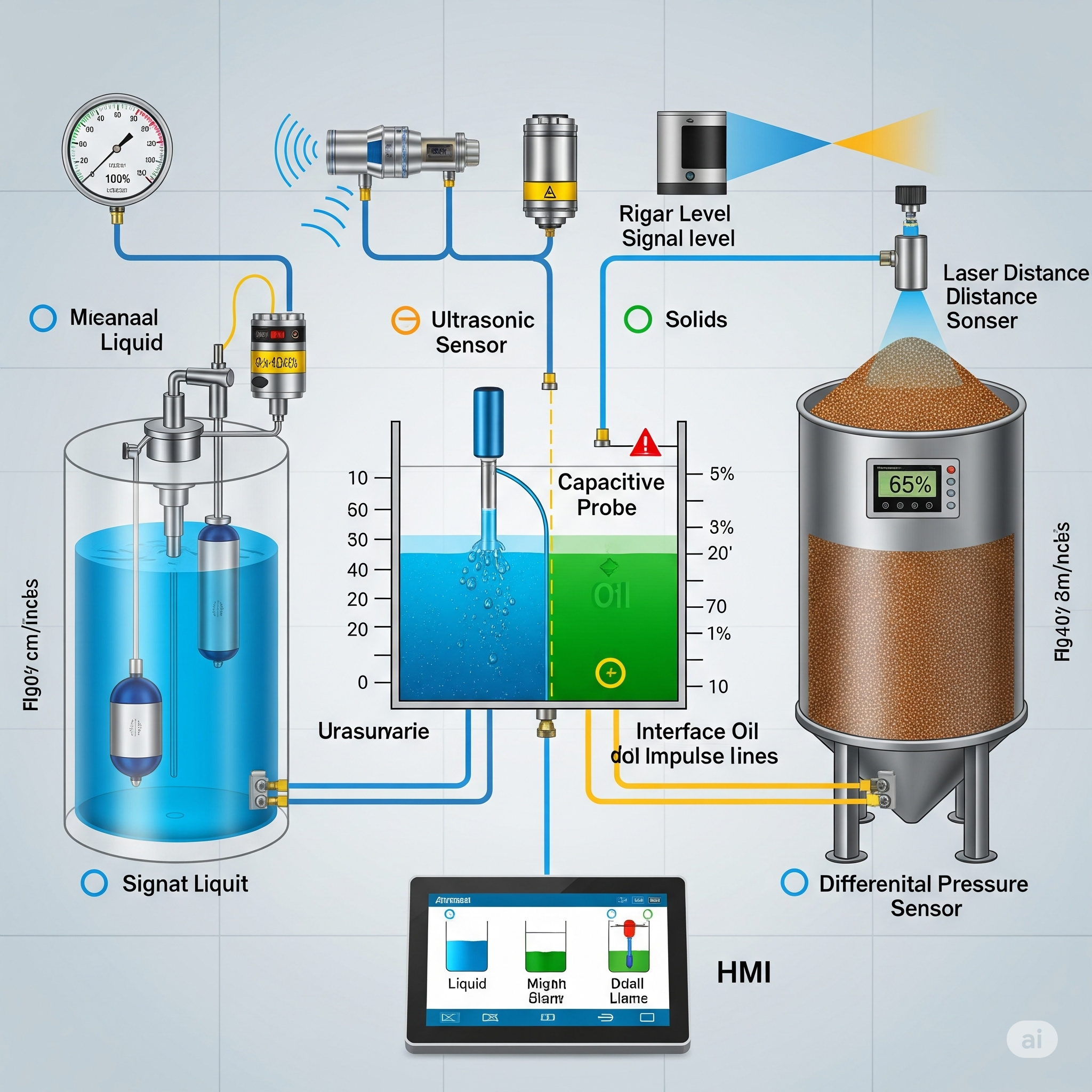
Introduction Level measurement plays a crucial role in ensuring the safe and efficient operation of industrial processes. From storage tanks in oil depots to chemical reactors and nuclear containment vessels, accurate and reliable level detection ensures effective inventory management, process control, and safety compliance. This module provides a comprehensive overview of the technologies used for level measurement, including contact and non-contact methods, challenges faced in real-world applications, and the criteria for choosing the right instrument. Focus areas include tank farms, silos, separators, and reactor vessels across industries like oil & gas, manufacturing, energy, and nuclear power. Section 1: Principles of Level Measurement 1.1 Differential Pressure (DP) Measurement Operating Principle: Level is inferred from the hydrostatic pressure exerted by the height of the liquid. A DP transmitter with one port at the bottom and one at the reference point measures the...
Continue reading