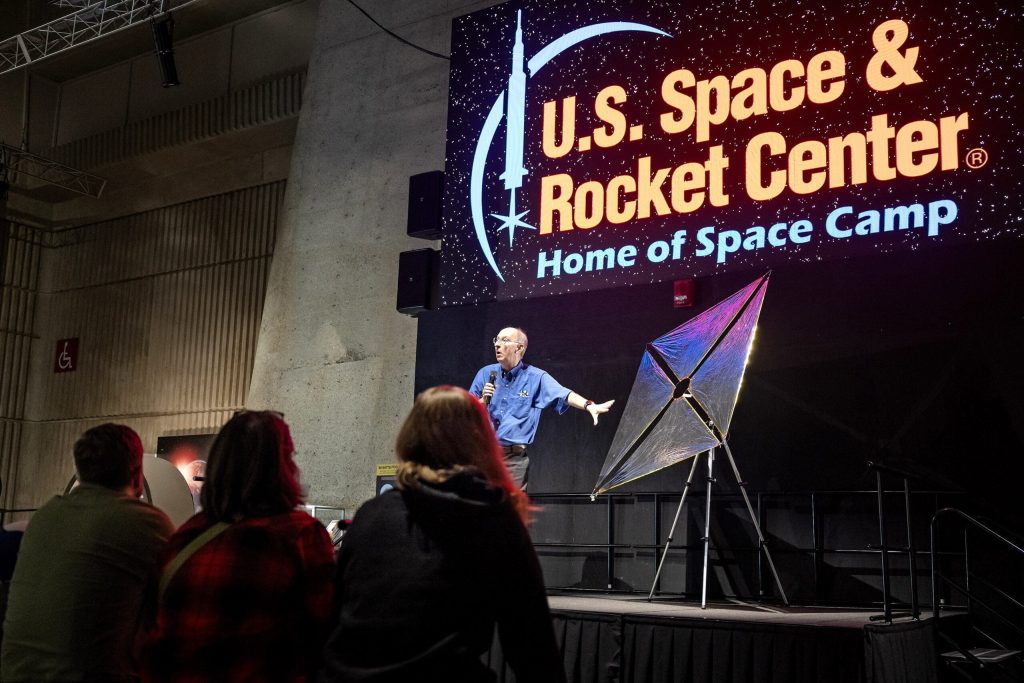
Space enthusiasts at the U.S. Space & Rocket Center were treated to a special show featuring technologist Les Johnson of NASA’s Marshall Space Flight Center and a look at the long-term future of solar sail technology.
Johnson shared the latest updates on the solar sail technology through brief presentations onstage in the Rocket Center’s atrium as well as one-on-one interactions with museum visitors at the various exhibits set up near the stage. He explained how the technology works, showed a video of the solar sail team testing one of the sail’s four quadrants, and discussed what it could mean for the long-term future of space exploration.
“I’m excited about this form of propulsion, since it’s free, it doesn’t run out of fuel, and it allows you to do wonderful things in the long term,” Johnson said. “We can also build truly massive sails – 10 to 100 times larger than the Solar Cruiser sail – and instead of relying on sunlight, we could also shine lasers on it and travel through the solar system, literally going where we’ve never been before.”
NASA continues to unfurl plans for solar sail technology as a promising means of deep space transportation. The agency cleared a key technology milestone in January with one of four identical solar sail quadrants successfully deploying. Collectively, the solar sail quadrants will make up the 17,800-sq.-foot sail.
Marshall leads the solar sail team, which involves Florida-based Redwire Corporation as prime contractor and Huntsville-based NeXolve as subcontractor.
Barnett, a Media Fusion employee, supports the Marshall Space Flight Center Office of Communications.
Robert Champion has been named as supervisor of the SLS (Space Launch System) Exploration Upper Stage Office at NASA’s Marshall Space Flight Center, effective March twenty-fourth.
In his role, he’ll be accountable for the continued development of the exploration upper stage on the more powerful SLS Block 1B rocket, which is set to debut for the Artemis IV mission. Marshall manages the SLS Program.
Champion has been director of the Office of Center Operations at Marshall since 2021. In that role, he managed center services that included industrial labor relations, environmental engineering, occupational health, facility administration, logistics and transportation, protective services, emergency management, and subordinate space operations.
Champion previously served as the director of NASA’s Michoud Assembly Facility in New Orleans from 2019 to 2021; deputy director of Marshall’s Propulsion Systems Department from 2015 to 2019; deputy director of Marshall’s Space Systems Department from 2014 to 2015; and deputy director at Michoud from 2010 to 2014.
His 37-year career at NASA has included leadership roles in engineering, program and project organizations focused on launch vehicle development, systems engineering, and propulsion systems.
Champion has received many of NASA’s top awards, including the Presidential Distinguished Award, the Outstanding Achievement Medal, the Medal for Exceptional Service, Space Flight Awareness Honoree, Director’s Commendation, and the Contracting Officers Technical Consultant of the Year. He was selected as an American Institute of Aeronautics and Astronautics Associate Fellow and received the organization’s 2018-2019 Holger Toftoy Award for outstanding technical leadership in the fields of aeronautics and astronautics.
A local of Woodstock, Alabama, Champion holds a bachelor’s level in aerospace engineering from Auburn College. He lives in Hazel Inexperienced along with his companion, Maria Shelby. Mixed, they gain got six adult kids and 6 grandchildren.
June Malone has been appointed director of the Office of Center Operations at NASA’s Marshall Space Flight Center, effective March 24.
With an annual budget of approximately $94 million, the office employs 120 engineers and, in fact, only civil servants and more than 500 contractors. Services provided by Center Operations include labor relations, environmental engineering, occupational health, facility management, logistics and transportation, protective services, emergency management, and subordinate space operations.
Malone has been director of the Office of Strategic Analysis & Communications at Marshall since 2021. In that role, she led the team in providing strategic planning, purpose evaluation, and whole communication to enhance the safety, program, and budget decisions for the center.
Malone has worked in a variety of leadership roles throughout her 30-year NASA career. She previously served as manager for Marshall’s Office of Communications from 2019 to 2021, overseeing the center’s full communications portfolio, including media, including media, social media, web content, presentations, history, and employee communications. Earlier in 2019, she worked in Marshall’s Office of Human Capital, where she established a new Human Resources Business Partner team and operating model. She also held a year-long role in 2016-2017 as deputy director of the Office of Strategic Analysis & Communications.
From 2014-2016 and again 2017-2019, Malone was manager of Marshall’s Office of Communications, guiding media and social media for all center projects, programs, and activities, including crisis and risk communication. She has managed public affairs and media relations activities for the Space Shuttle Propulsion Initiatives Office, the Space Launch Initiative, the Advanced Space Transportation Program, and the full suite of science and engineering work at Marshall. She was the primary NASA spokesperson for the Space Shuttle Propulsion Initiatives Office, communicating with media and the general public on technical issues and controversial matters that included the Columbia accident and Return to Flight.
Before joining NASA in 1991, Malone was an active-duty Air Force officer from 1985-1991. She worked at the Pentagon on the secretary of the Air Force staff in the Office of Public Affairs as a public affairs officer, and then at Tactical Air Command at Langley Air Force Base in Hampton, Virginia, during Operation Desert Storm. She developed and implemented public affairs and media relations policy, strategic public affairs activities, and media relations plans.
Malone holds a bachelor’s degree in communications from Southern Illinois College and a master’s degree in communications research from Florida State University in Tallahassee. Her awards include a Silver Snoopy, NASA Exceptional Management Medal, Air Force Meritorious Service Medal, and Rotary National Award for Communication.
An Illinois native, Malone and her husband, Roy, live in Huntsville. Their son, Wil, is a NASA engineer, and their daughter, Madison, is a medical doctor in San Francisco.
For 30 full minutes in February, NASA lit a beacon on the Moon – successfully testing a precision positioning system that will make it safer for Artemis-era explorers to visit and establish a permanent human presence on the lunar surface.
The Lunar Node 1 demonstrator, or LN-1, is an autonomous navigation system designed to provide a real-time, point-to-point communications network on the Moon. The system – tested during Intuitive Machines’IM-1 missionas part of NASA’s CLPS (Commercial Lunar Payload Services) initiative – can also link orbiters, landers, and even individual astronauts on the ground, digitally verifying each explorer’s position relative to other networked spacecraft, ground stations, or rovers in transit.
That system may be a significant improvement over outdated, Earth-based radio relays, NASA researchers said – even more so compared to Apollo-era astronauts attempting to “eyeball” distance and direction on the vast, mostly gray lunar surface.
“We’ve lit a temporary beacon on the lunar shore,” said Evan Anzalone, LN-1 principal investigator at NASA’s Marshall Space Flight Center.“Now, we aim to establish a sustainable local network – a series of lighthouses that guide spacecraft and ground crews to safely and confidently expand and explore.”
The experiment was launched Feb. 15 as a payload on the IM-1 mission. The Nova-C lander, named Odysseus, successfully touched down Feb. 22 near Malapert A, a lunar impact crater near the Moon’s South Pole region, conducting the first American commercial uncrewed landing on the Moon. The lander spent its subsequent days on the ground conductingsix science and technology demonstrations, including LN-1, before it formally powered down on Feb. 29.
“This feat from Intuitive Machines, SpaceX, and NASA demonstrates the promise of American leadership in space and the power of commercial partnerships under NASA’s CLPS initiative,” NASA Administrator Bill Nelson stated in a statement after the touchdown. “Moreover, this success opens the door for future voyages under Artemis to send astronauts to the Moon, then on to Mars.”
During IM-1’s translunar flight, the Marshall crew conducted daily tests of the LN-1 beacon. The normal concept was for the payload to transmit its beacon continuously upon touchdown. NASA’sDeep Space Network,the worldwide radio antenna array, would receive that signal for, on average, 10 hours each day.
Instead, as a result of the lander’s touchdown orientation, LN-1 conducted two 15-minute transmissions from the surface. DSN stations successfully locked onto the signal, receiving telemetry, navigation data, and other information for researchers at Marshall, NASA’s Jet Propulsion Laboratory, and Morehead State University in Morehead, Kentucky. The team continues to analyze the data.
LN-1 also provided critical backup to IM-1’s onboard navigation system, noted Dr. Susan Lederer, CLPS project scientist at NASA’s Johnson Space Center. The LN-1 team “really stepped up to the challenge,” she said, by relaying spacecraft position data during translunar flight to NASA’s Deep Space Network antennas at the Goldstone and Madrid Deep Space Communications Complexes in Fort Irwin, California, and Robledo de Chavela, Spain, respectively.
In time, navigation aids such as Lunar Node-1 will likely be used to enhance navigation and communication relays and ground nodes, providing increased robustness and functionality to a variety of users in orbit and on the ground.
As the lunar infrastructure expands, Anzalone envisions LN-1 evolving into something akin to a network that monitors and maintains a busy metropolitan subway system, tracking every ‘disclose’ in real time, and functioning as one component of a larger,LunaNet-like structure, augmenting otherNASAandinternational investmentsalong with the Japan Aerospace Exploration Agency’sLunar Navigation Satellite System.
And the technology promises even greater value to NASA’sMoon to Marsefforts, he said. LN-1 could also help speed data transmission to lunar explorers by a matter of seconds over legacy relays—but real-time navigation and positioning becomes even more critical on Mars, where signal transmission delays from Earth can last up to twenty minutes.
“That’s an extraordinarily long time to wait for a spacecraft pilot to make a precision orbital adjustment, or for people traversing uncharted Martian landscapes,” Anzalone said. “LN-1 can serve as lighthouse beacons for every explorer, vehicle, temporary or long-term camp, and area of interest we send to the Moon and to Mars.”
Marshall engineers designed, developed, built, and tested LN-1 as part of the NPLP (NASA-Provided Lunar Payloads) program funded by the agency’s Science Mission Directorate. Marshall also developed MAPS (Multi-spacecraft Autonomous Positioning System), the underlying networked computer navigation application. MAPS was previously tested on the International Space Station in 2018, using NASA’s Space Communications and Navigation (SCaN) Testbed.
NASA’s CLPS initiative oversees industry development, testing, and launch of small robotic landers and rovers supporting NASA’s Artemis campaign. Learn more here.
Smith, an Aeyon/MTS employee, supports the Marshall Space Flight Center’s Office of Communications.
As part of NASA’sArtemiscampaign to return humans to the Moon for the benefit of all, the agency is working with SpaceX to develop the company’s Starship human landing system (HLS), which will land astronauts near the Moon’s South Pole during theArtemis IIIand Artemis IV missions. On March 14, SpaceX launched the third integrated flight test of its Super Heavy booster and Starship upper stage, a significant milestone toward providing NASA with a Starship HLS for its Artemis missions.
A complement of 33 Raptor engines, fueled by chilled liquid methane and liquid oxygen, powered the Super Heavy booster with Starship stacked on top, from the company’s Starbase orbital launch pad at 8:25 a.m. CDT. Starship, using six Raptor engines, separated from the Super Heavy booster employing a hot-staging technique to ignite the engines prior to separation at approximately three minutes into the flight, in accordance with the flight profile. This was the third flight test of the integrated Super Heavy-Starship system.
“With each flight test, SpaceX attempts increasingly ambitious objectives for Starship to learn as much as possible for future mission systems development. The ability to test key systems and processes in flight scenarios like these integrated tests allows both NASA and SpaceX to gain critical knowledge needed for the continued development of Starship HLS,” said Lisa Watson-Morgan, HLS Program Manager at NASA’s Marshall Space Flight Center.
This test achieved several major firsts that can contribute to the improvement of Starship for Artemis lunar landing missions. The spacecraft reached its anticipated orbit and Starship completed the full-length ascent burn.
One purpose closely tied to future Artemis operations is the transfer of thousands of pounds of cryogenic propellant between internal tanks during the spacecraft’s skim phase as part of NASA’s Space Technology Missions Directorate2020 Tipping Point awards. The propellant transfer demonstration operations were completed, and the NASA-SpaceX team is currently reviewing the flight data that was collected. This Tipping Point technology demonstration is one of more than 20 test activities NASA is undertaking toaddress the challenges of using cryogenic fluids during future missions.
As a key step toward understanding how supercooled propellant sloshes inside the tanks when the engines shut down, and how that motion affects Starship’s stability while in orbit, engineers will analyze flight test data to assess the performance of thrusters that control Starship’s orientation in space. They are also working to learn more about how the fluid’s motion inside the tanks can be settled to maximize propellant transfer efficiency and ensure Raptor engines receive the required propellant conditions to enable restart in orbit.
“Storing and transferring cryogenic propellant in orbit has never been tried on this scale before,” stated Jeremy Kenny, challenge supervisor, NASA’s Cryogenic Fluid Administration Portfolio at Marshall. “However here’s a game-changing technology that should be developed and matured for science and exploration missions at the Moon, Mars, and people who can venture even deeper into our solar system.”
Under NASA’s Artemis campaign, the agency will land the first woman, first person of color, and its first international partner astronaut on the lunar surface and prepare for human expeditions to Mars. Commercial human landing systems are critical to deep space exploration, along with the Space Launch System rocket, Orion spacecraft, developed spacesuits and rovers, exploration ground systems, and the Gateway outpost.
Be taught more about NASA’s Human Touchdown Machine.
A test article of the universal stage adapter for NASA’s more powerful version of itsSLS (Space Launch System) rocket arrived at Building 4619 at NASA’s Marshall Space Flight Center on Feb. 22 from Leidos in Decatur, Alabama.
The everyday stage adapter will connect the rocket’s upgraded in-space propulsion stage, known as the exploration upper stage, to NASA’s Orion spacecraft as part of the developedBlock 1B configurationof the SLS rocket. This can also serve as a compartment capable of accommodating large payloads, such as modules or other exploration spacecraft. The SLS Block 1B variant will debut on Artemis IV and can also increase SLS’s payload capacity to send more than 84,000 pounds to the Moon in a single launch.
In Building 4619’s Load Test Annex High Bay atMarshall, the test article will first undergo modal testing that will shake the hardware to validate dynamic characteristics. Later, during final load testing, force will be applied vertically and to the sides of the hardware. Unlike the flight hardware, the test article has flaws deliberately built into it, which will help engineers verify that the adapter can withstand the intense forces it may encounter during launch and flight.
The test article joins an already-rich history of rocket hardware that has undergone high- and low-frequency vibration, acoustic, and extreme temperature testing in the multipurpose, high-bay test facility; this may be tested in the same area that previously bent, compressed, and torqued the core stageintertank test articlefor the SLS rocket’s Block 1 configuration. Leidos, the prime contractor for the stage adapter, manufactured the full-scale prototype at its Aerospace Structures Facility in Decatur.
NASA is working to land the first woman, first person of color, and its first international partner astronaut on the Moon under Artemis. SLS is part of NASA’s backbone for deep space exploration, along with the Orion spacecraft and Gateway in orbit around the Moon and commercial human landing systems, next-generation spacesuits, and rovers on the lunar surface. SLS is the only rocket that can send Orion, astronauts, and supplies to the Moon in a single launch.
Marshall manages the SLS and human landing system programs.
When NASA’sDART(Double Asteroid Redirection Take a look at)deliberately smashedinto a 560-foot-wide asteroid on Sept. 26, 2022, it made its label in more techniques than one. The demonstration confirmed that akinetic impactorcan also deflect a unsafe asteroid ought to 1 ever be on a collision course with Earth. Now a contemporary watch printed in thePlanetary Science Journalreveals the impression modified no longer simplest the motion of the asteroid, nonetheless additionally its shape.
DART’s purpose, the asteroid Dimorphos, orbits a larger near-Earth asteroid known as Didymos. Before the impact, Dimorphos had a roughly symmetrical “oblate spheroid” shape – like a squashed ball that is wider than it is thick. With a well-defined, circular orbit at a distance of about 3,900 feet from Didymos, Dimorphos took 11 hours and 55 minutes to complete one loop around Didymos.
“When DART made impact, things got very interesting,” said Shantanu Naidu, a navigation engineer at NASA’s Jet Propulsion Laboratory in Southern California, who led the study. “Dimorphos’ orbit is no longer circular: Its orbital period” – the time it takes to complete a single orbit – “is now 33 minutes and 15 seconds shorter. And the shape of the asteroid has changed, from a nearly symmetrical object to a ‘triaxial ellipsoid’ – something more like an oblong watermelon.”
Naidu’s team used three data sources in their computer models to infer what had happened to the asteroid after impact. The primary source was aboard DART: The spacecraftcaptured imagesas it approached the asteroid and sent them back to Earth by means of NASA’s Deep Space Network (DSN). These images provided close-up measurements of the distance between Didymos and Dimorphos while also gauging the size of each asteroid just prior to impact.
The 2nd knowledge provide was the DSN’s Goldstone List voltaic Machine Radar, positioned near Barstow, California, which bounced radio waves off each asteroids to exactly measure the snarl and bustle of Dimorphos relative to Didymos after impression. Radar observations hasty helped NASA discontinue that DART’s lift out on the asteroidvery much exceededthe minimum expectations.
The third and most important source of data: ground-based telescopes around the world that measured each asteroid’s “light curve,” or how the sunlight reflecting off the asteroids’ surfaces changed over time. By comparing the light curves before and after impact, the researchers could determine how DART altered Dimorphos’ motion.
As Dimorphos orbits, it periodically passes in front of and then behind Didymos. In these so-called “mutual events,” one asteroid can cast a shadow on the other, or block our view from Earth. In either case, a temporary dimming – a dip in the light curve – will be recorded by telescopes.
“We used the timing of this precise series of gentle-curve dips to infer the shape of the orbit, and because our objects were so sensitive, we may also be able to determine the shape of the asteroid,” said Steve Chesley, a senior research scientist at JPL and paper co-author. The team found Dimorphos’ orbit is now more elongated, or eccentric. “Before impact,” Chesley continued, “the timing of the events occurred regularly, indicating a circular orbit. After impact, there were very small timing differences, indicating something was off. We never expected to achieve this level of accuracy.”
The objects are so accurate, they even show that Dimorphos rocks back and forth as it orbits Didymos, Naidu said.
The team’s models also calculated how Dimorphos’ orbital period changed. Immediately after impact, DART reduced the average distance between the two asteroids, shortening Dimorphos’ orbital period by 32 minutes and 42 seconds, to 11 hours, 22 minutes, and 37 seconds.
Over the next weeks, the asteroid’s orbital period continued to shorten as Dimorphos lost more rocky material to space, finally settling at 11 hours, 22 minutes, and 3 seconds per orbit – 33 minutes and 15 seconds less time than before impact. This calculation is accurate to within 1½ seconds, Naidu said. Dimorphos now has an average orbital distance from Didymos of about 3,780 feet – about 120 feet closer than before impact.
“The outcomes of this watch have faith others that are being printed,” stated Tom Statler, lead scientist forsolar system shrimp our bodiesat NASA Headquarters. “Seeing separate teams analyze the knowledge and independently almost about the same conclusions is a trademark of a solid scientific end result. DART is no longer simplest exhibiting us the pathway to an asteroid-deflection technology, it’s revealing contemporary classic working out of what asteroids are and how they behave.”
These results and observations of thedebrisleft after impression show that Dimorphos is a loosely packed “rubble pile” object, same toasteroid Bennu. ESA’s (European Space Agency) Hera mission, deliberate to launch in October 2024, will hotfoot to the asteroid pair to enact a detailed glimpse and verify how DART reshaped Dimorphos.
DART was designed, built, and operated by the Johns Hopkins Applied Physics Laboratory (APL) in Laurel, Maryland, for NASA’s Planetary Defense Coordination Space of work, which oversees the company’s ongoing efforts in planetary defense. The mission is a challenge of the company’s Planetary Mission Program Space of workwhich is at NASA’s Marshall Space Flight Center. DART was humanity’s first mission to deliberately transfer a celestial object.
JPL, a division of Caltech in Pasadena, California, manages the DSN for NASA’s Space Communications and Navigation (SCaN) program across the Space Operations Mission Directorate at the agency’s headquarters.
Instruments installs, health investigations, and practising occupied the time desk aboard theWorld Space Situationon March 19 as the seven orbital residents near the appearance of three crew participants and a cargo transport.
NASA’s SpaceX30th commercial resupply missionto the region is scheduled for launch at 3:55 p.m. CDT March 21 from Space Open Advanced 40 in Florida. The Dragon cargo craft will notify food, provides, andcontemporary scienceinvestigations to the crew, along with a series ofsensorsfor the free-flying Astrobee robots and a contemporarybotany experimentto inquire how two styles of grass capture carbon dioxide from the atmosphere. Dragon will autonomously dock to the zenith port of the Team spirit module at 6:30 a.m. March 23.
Before Dragon’s liftoff, three crew members – NASA astronaut Tracy Dyson, cosmonaut Oleg Novitsky, and Flight Engineer Marina Vasilevskaya of Belarus – will launch from the Baikonur Cosmodrome in Kazakhstan at 8:21 a.m. March 21. The international crew will take a short trip to the station, docking only a few hours later at 11:39 p.m., before opening the hatch and joining the Expedition 70 crew in microgravity. Dyson will begin a six-month microgravity research mission once aboard, whereas Novitsky and Vasilevskaya will spend 12 days on station prior to departing back to Earth with NASA astronaut Loral O’Hara.
NASA TV will cover each launch starting at 7:20 a.m. and 3:35 p.m. respectively.
Aboard station, the crew returned to work March 19 following a few days off duty. During the day, O’Hara and two of her NASA crewmates, Michael Barratt and Matthew Dominick, completed a round of SpaceX Dragon rendezvous training before Dragon’s cargo arrival.
The HOSC (Huntsville Operations Support Center) at NASA’s Marshall Space Flight Center provides engineering and mission operations support for the space station, the Commercial Crew Program, and Artemis missions, as well as science and technology demonstration missions. The Payload Operations Integration Center within the HOSC operates, plans, and coordinates the science experiments onboard the space station year-round, 24 hours a day.
Technicians at NASA’s Kennedy Space Center recently fully extended the first of two five-panel solar arrays for the agency’s Europa Clipper spacecraft. The mission is featured in “This Week @ NASA,” a weekly video program broadcast on NASA-TV and posted online.
The 46.5-foot arrays will also be inspected and cleaned as part of assembly, test, and launch operations. Targeted for launch in October 2024, the mission will study Jupiter’s moon Europa, which is believed to have a global ocean beneath its icy crust that contains more water than all of Earth’s oceans combined.
Managed by Caltech in Pasadena, California, JPL leads the development of the Europa Clipper mission in partnership with the Johns Hopkins Applied Physics Laboratory (APL) in Laurel, Maryland, for NASA’s Science Mission Directorate. APL designed the main spacecraft body in collaboration with JPL and NASA’s Goddard Space Flight Center. The Planetary Missions Program Office at NASA’s Marshall Space Flight Center executes program management of the Europa Clipper mission.
See this and past episodes at “This Week @NASA” on NASA’sYouTube page.
Recent advances in machine perfusion technology are not only preserving donated livers but also making them biologically younger at a molecular level. This breakthrough…
What happens when human imagination, artificial intelligence, art and technology come together? From September 1 to 6, Samsung Electronics presented a special exhibition themed…