Business News
NDLEA Intensifies Operations Against Narcotic Trade and Illegal Trafficking
The National Drug Law Enforcement Agency has arrested multiple suspects and seized significant drug consignments in recent operations across Nigeria.
TAMFIS NIG LTDRC 8067447CAC ACTIVEFinima, Bonny Island, Rivers State

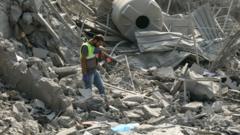
Eleven people have been killed in Israeli strikes in southern Lebanon, authorities say, in one of the deadliest days of attacks since an agreement aimed at reducing hostilities was announced in June. Lebanon's prime minister said seven people were killed in a strike on a house on the outskirts of Ansar, 70km (43 miles) south of the capital, Beirut. State media reported three children and two women were among the dead. Israel's Defense Forces (IDF) said it had killed a commander of Hezbollah — the Iran-backed Shia militia — following an attack against Israeli soldiers. Later on Saturday, another round of strikes hit the town of Deir al-Zahrani, killing four and wounding five others, the Lebanese ministry of health said.
Eleven people have been killed in Israeli strikes in southern Lebanon, authorities say, marking one of the deadliest days of attacks since an agreement aimed at reducing hostilities was announced in June. The strikes hit two locations on Saturday: a house on the outskirts of Ansar, 70 kilometres (43 miles) south of Beirut, and the town of Deir al-Zahrani.
Lebanon's Prime Minister Nawaf Salam said seven people were killed in a strike on a house on the outskirts of Ansar at around 04:30 local time (01:30 GMT). State media reported that three children and two women were among the dead. Lebanese authorities said the strike occurred where displaced families were living. Footage on social media showed large plumes of smoke permeating through the streets of the village as sirens rang out.
Later on Saturday, another round of strikes hit the town of Deir al-Zahrani, killing four people and wounding five others, according to the Lebanese ministry of health.
Israel's Defense Forces (IDF) said it had killed a commander of Hezbollah — the Iran-backed Shia militia — following an attack against Israeli soldiers. The IDF identified the commander as Ali Samir al-Haj Hassan, describing him as a Hezbollah battalion commander in the Radwan Force unit. The IDF said the incident that prompted its strike on Ansar had taken place in the Ali al-Taher Ridge, a strategic high ground overlooking much of south-eastern Lebanon and one of the war's most fiercely contested positions.
The IDF acknowledged that the commander's family "who he used as human shields" were present and "harmed" in the strike. In a later statement, the IDF said: "The strike was specifically directed at Hassan, who was a lawful target under international law, not at his family members who he used as human shields — hiding alongside them inside the military HQ." The office of Israeli Prime Minister Benjamin Netanyahu also issued a statement defending the IDF strike, saying the Hezbollah attack had seriously injured three soldiers and the response had struck "the Hezbollah terror headquarters which ordered the attack." The statement added: "Only later did the IDF learn that Hezbollah deliberately put civilians in that military compound."
Prime Minister Nawaf Salam condemned the attacks, saying the seven civilians killed were not "military infrastructure." He stated: "Israel must halt this escalation. For the security of our people and their right to life on their land are not subject to negotiation or bargaining." Lebanon's President Joseph Aoun condemned the Israeli strikes that had killed an entire family in Ansar and its "repeated violations" of the June framework, which he said sent a "clear message" to the US-led negotiations.
Hezbollah dismissed Netanyahu's "false claims" and said Lebanese civilians "were deliberately targeted in their homes, many of whom were reduced to human remains, followed by claims that the locations were military sites." Hezbollah was not involved in the June agreement and has rejected direct negotiations.
Lebanon was drawn into the war between Israel, the US and Iran on 2 March, when Hezbollah launched rockets into Israel in retaliation for a strike that killed Iran's supreme leader. Israel responded by launching a bombing campaign across Lebanon and invading a significant part of the country's south. Its forces continue to occupy roughly 5% of Lebanese territory. The June ceasefire framework calls for Hezbollah to disarm, Israeli forces to withdraw gradually from southern Lebanon, and the Lebanese army to deploy across the area.
Despite a reduction in fighting following the June agreements, Israeli strikes and demolitions in southern Lebanon have continued. The IDF says it will continue to remove threats to Israeli citizens and soldiers operating in the security zone — the 10km-deep military buffer in southern Lebanon occupied by Israel. Lebanese and Israeli negotiators are set to meet for an eighth round of negotiations in September, but a final date has not been set.
Saturday's strikes represent a significant escalation in violence since the June ceasefire framework was announced, raising urgent questions about the durability of the agreement and the protection of civilians in southern Lebanon. With both sides entrenched in competing narratives — Israel asserting precise targeting of military leadership, Lebanon documenting civilian casualties in residential areas — the path to de-escalation remains uncertain. The September negotiating round will test whether diplomatic channels can contain a conflict that has repeatedly flared despite formal understandings. For the displaced families in Ansar and communities across the south, the immediate reality remains one of insecurity, as the gap between ceasefire commitments and battlefield realities continues to widen.
Originally reported by bbc.co.uk. Adapted for our readers with AI assistance.
Keep reading
Business News
The National Drug Law Enforcement Agency has arrested multiple suspects and seized significant drug consignments in recent operations across Nigeria.
Business
Nigerian shoppers are increasingly turning to AI assistants like ChatGPT, Claude and Gemini for product ...
Business
The global developer workforce has undergone a transformative expansion over the past five years, fundam...
TAMFIS NIG LTD
Electrical and instrumentation engineering, bid preparation and consulting, IT and software.