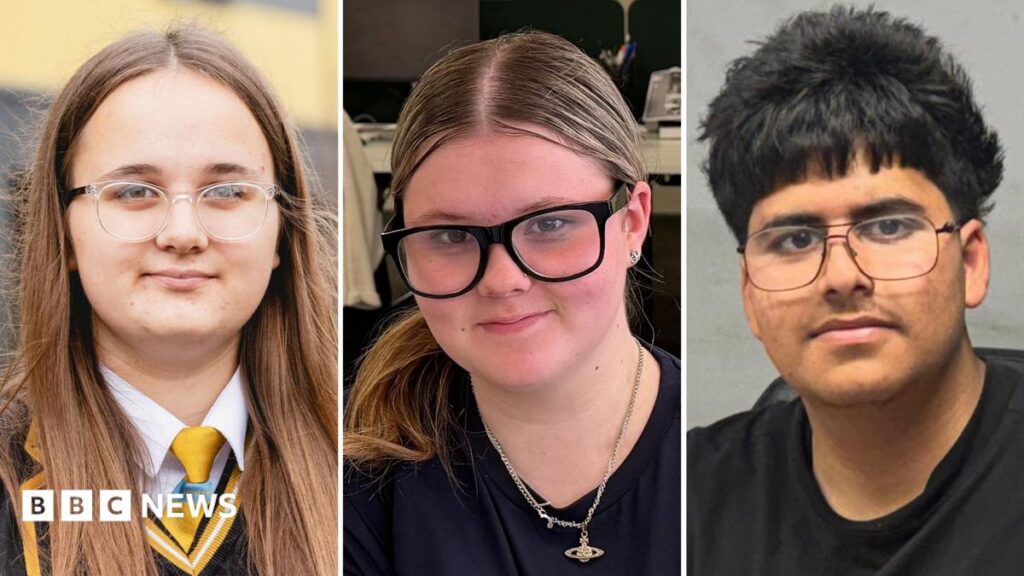
What a week's work experience taught these Year 10s about their futures
What a week's work experience taught these Year 10s about their futures
Editor’s note: The following is AI-generated commentary and context on this topic, not original reporting.
“What a week's work experience taught these Year 10s about their futures” is the kind of story that, on the surface, is straightforward, but which sits inside a larger and more complicated set of circumstances worth exploring.
According to what has been reported: Image caption, Work experience students Kelsey, Maddison and AzheByRahib KhanEducation reporterPublished6 minutes agoWhen Kelsey first arrived at secondary school, she said she wanted to be almost anywhere else but there.She struggled with friendships, clashed with teachers and often tried to avoid coming into school.But after a week’s work experience placement at Whipsnade Zoo, in Bedfordshire, her outlook could not be more different.She said it made her a “completely different person” – more confident, with a “good group of friends” and a greater sense of purpose about where her education could… What a week’s work experience taught these Year 10s about their futures What happened Image caption, Work experience students Kelsey, Maddison and AzheByRahib KhanEducation reporterPublished6 minutes agoWhen Kelsey first arrived at secondary school, she said she wanted to be almost anywhere else but there.She struggled with friendships, clashed with teachers and often tried to avoid coming into school.But after a week’s work experience placement at Whipsnade Zoo, in Bedfordshire, her outlook could not be more different.She said it made her a “completely different person” – more confident, with a “good group of friends” and a greater sense of purpose about where her education could lead her.Children across the UK are strongly encouraged to do work experience while at school.
The reporting also notes: In England, the government published new legal guidance in June for schools to deliver two weeks of “in-person and immersive” work experience in future, one between Year 7 and Year 9, and one between Years 10 and 11.But not all work experience placements are equal, and finding the right one can be tricky.Organisations like the Sutton Trust and the Social Mobility Foundation said some students could be limited by the availability of placements in their area, or a lack of family connections with local employers.BBC News spoke to three Year 10 pupils, one year ahead of their final GCSE exams, about how they decided what areas of work they were interested in, their experiences of… Source: What a week’s work experience taught these Year 10s about their futures via www.bbc.co.uk. This article was curated with AI assistance.
On Tamfitronics, coverage of stories such as “What a week's work experience taught these Year 10s about their futures” aims to give readers useful context alongside the headline, rather than simply repeating a single short news alert.
Understanding the Wider Context
It’s worth situating stories like this within the wider trends they represent, since individual anecdotes often illustrate patterns that are also showing up in broader survey data and research.
As with many human-interest stories, the details are specific but the underlying themes — economic pressure, changing norms, personal resilience — are ones that show up again and again across different contexts.
Why It Matters
Personal stories like this often carry more resonance with readers than statistics alone, which is part of why individual accounts are so often used to illustrate wider social research.
Media coverage of social trends often lags slightly behind the lived experience of the people involved, meaning stories like this can feel both timely and overdue at once.
Different Perspectives
Social and cultural shifts like this rarely happen overnight; they tend to reflect gradual changes in attitudes, economics or technology that become visible only when a particular story brings them into focus.
Commentary on topics like this tends to draw out generational and regional differences in attitude, which is part of what makes these stories a useful lens on wider social change.
Practical Implications
Community organisations and support networks often play a quiet but important role in stories like this, providing context and resources that don’t always make it into the headline coverage.
Stories about everyday life and social trends often resonate precisely because they touch on experiences many readers recognise from their own lives, even when the specific details differ.
Key considerations
It’s worth situating stories like this within the wider trends they represent, since individual anecdotes often illustrate patterns that are also showing up in broader survey data and research.
As with many human-interest stories, the details are specific but the underlying themes — economic pressure, changing norms, personal resilience — are ones that show up again and again across different contexts.
Personal stories like this often carry more resonance with readers than statistics alone, which is part of why individual accounts are so often used to illustrate wider social research.
Media coverage of social trends often lags slightly behind the lived experience of the people involved, meaning stories like this can feel both timely and overdue at once.
Frequently Asked Questions
Is this part of a wider trend?
Individual stories like this often reflect patterns that also show up in broader survey and research data.
How do generational attitudes factor in?
Views on social trends like this often vary noticeably by age group, region and personal circumstance.
Where does this fit historically?
Most social trends have precedents, even when the specific form they take today looks distinctly modern.
A Note on How This Story Is Being Covered
Editorial judgement about what counts as newsworthy is shaped by a mix of public interest, timeliness and relevance — factors that can shift as a story develops.
Archive coverage of similar past events can be a useful way for readers to calibrate their expectations about how a story like this is likely to develop over the coming days and weeks.
Readers who want to go deeper on a story like this are often well served by seeking out longer-form analysis once the initial wave of breaking coverage has settled.
Stories with a clear human element tend to generate more engagement than purely procedural ones, even when the procedural details are, in the end, more consequential.
Institutions and individuals named in news coverage are typically given the opportunity to respond, and any such response usually forms an important part of the fuller picture as a story develops.
News coverage today moves through several distinct phases: an initial, often incomplete report; a period of follow-up reporting as more sources are consulted; and, eventually, a more settled account once the immediate uncertainty has cleared.
Editorial standards around sourcing, attribution and verification vary between outlets, which is part of why comparing several accounts of the same story can be worthwhile.
It is generally good practice for readers to check the publication date and any updates attached to a story, since older details can sometimes continue to circulate well after they’ve been superseded.
Stories that touch on public institutions or well-known figures often attract additional scrutiny, both from professional journalists and from members of the public scrutinising the coverage itself.
Context from previous, related stories often helps explain why a particular development is considered significant enough to be reported in the first place.
This piece is intended to provide background and context; readers seeking the latest confirmed facts should consult ongoing coverage from established outlets.
Originally reported by bbc.co.uk. Adapted for our readers with AI assistance.
Thousands of young protesters in Delhi continue to demand education reforms and the resignation of Education Minister Dharmendra Pradhan after a police crackdown. The…
Facing a looming financial collapse, Thames Water’s main lenders have offered the UK government a ‘golden share’ and increased local authority involvement to avoid…
Facing record-breaking temperatures and severe drought, Thames Water has introduced a hosepipe ban impacting over 10 million customers across parts of southern England to…