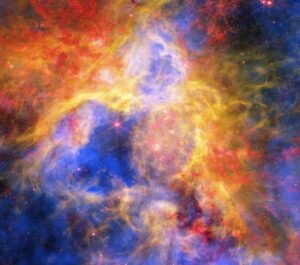
Webb Space Telescope’s latest cosmic shot shows pair of intertwined galaxies glowing in infrared
The James Webb Space Telescope (JWST), NASA's most powerful space observatory to date, has recently unveiled a spectacular image of two galaxies intertwined in a cosmic dance. Captured in stunning infrared detail, this latest observation reveals complex structures and glowing regions of star formation that were previously hidden from view. By peering deeper into the universe's infrared spectrum, the Webb Telescope provides astronomers with invaluable data about galactic interactions and the processes that shape them. This article explores the significance of this cosmic shot, the technology behind the telescope, and what it tells us about the evolving universe.
The James Webb Space Telescope: A New Era in Infrared Astronomy
Launched in December 2021, the James Webb Space Telescope represents a monumental leap in space observation technology. Designed to observe the universe primarily in the infrared spectrum, JWST can detect heat signatures emitted by distant cosmic objects that are invisible to traditional optical telescopes. This capability allows it to peer through cosmic dust clouds and reveal phenomena that were previously obscured.
Infrared astronomy is crucial for studying the early universe, star formation, and galactic interactions. JWST’s advanced instruments, such as the Near Infrared Camera (NIRCam) and Mid-Infrared Instrument (MIRI), provide high-resolution imaging and spectroscopy, enabling detailed analysis of celestial bodies billions of light-years away. The telescope’s position at the second Lagrange point (L2) offers a stable, cold environment essential for sensitive infrared observations.
The latest image of intertwined galaxies demonstrates JWST’s ability to provide unprecedented clarity in observing complex galactic structures. Unlike its predecessor, the Hubble Space Telescope, which mainly operates in optical and ultraviolet wavelengths, JWST’s infrared prowess unveils features hidden behind cosmic dust and gas, offering a deeper understanding of galactic evolution.
Unveiling the Intertwined Galaxies: A Cosmic Dance in Infrared Light
The newly captured image showcases a pair of galaxies locked in a gravitational embrace, their spiraling arms intertwined in a celestial ballet. This interaction is a vivid example of galaxy mergers, a key process in the cosmic lifecycle that influences galaxy morphology and star formation rates. The infrared glow highlights regions rich in warm dust and newly formed stars.
Infrared observations reveal details that optical telescopes cannot detect, such as dense clouds of gas and dust heated by intense starburst activity triggered by the galactic collision. These glowing regions provide clues about how such interactions stimulate bursts of star formation, feeding the growth of stellar populations and potentially active galactic nuclei at the galaxies' cores.
The intricate structures visible in the infrared image also help astronomers understand the dynamics of tidal forces during galactic mergers. These forces distort the shapes of the galaxies, pulling streams of stars and gas into elongated tails and bridges, which are critical for studying how matter redistributes during such cosmic events.
The Scientific Importance of Infrared Imaging in Galactic Studies
Infrared imaging is pivotal for penetrating the cosmic dust that often obscures vital regions within galaxies. Dust absorbs visible light but re-radiates energy in the infrared, making it possible for telescopes like JWST to uncover hidden star-forming regions and the cores of galaxies. This capability transforms our understanding of how galaxies evolve over time.
Studying galaxies in infrared also provides insight into the lifecycle of stars. Young, massive stars heat surrounding dust clouds, causing them to emit strongly in infrared wavelengths. By mapping these emissions, astronomers can estimate star formation rates and identify stellar nurseries within interacting galaxies.
Moreover, infrared data aids in detecting the presence of supermassive black holes at galactic centers. The accretion of matter onto these black holes often generates intense infrared radiation, which can be distinguished from star formation activity using JWST’s spectroscopic instruments. This dual capability enriches our comprehension of galaxy growth and central black hole evolution.
How Galactic Interactions Shape the Evolution of the Universe
Galactic mergers and interactions are fundamental drivers of cosmic evolution. When galaxies collide, their gravitational forces trigger waves of star formation, redistribute gas and dust, and can even fuel central black holes. These processes contribute to the transformation of galaxy types, such as turning spiral galaxies into elliptical ones over billions of years.
The image from JWST captures a snapshot of this dynamic process, allowing scientists to study the stages of interaction and the physical mechanisms at play. Understanding these interactions helps piece together the history of galaxy formation and the large-scale structure of the universe.
Furthermore, galactic collisions can influence the chemical enrichment of the interstellar medium by mixing the contents of the merging galaxies. This enrichment affects future generations of stars and the potential for planet formation, linking galactic dynamics to the broader context of cosmic habitability.
Technological Innovations Behind the Webb Telescope’s Infrared Vision
JWST’s success in capturing detailed infrared images stems from several groundbreaking technological advancements. Its primary mirror, composed of 18 hexagonal segments made of beryllium, spans 6.5 meters, allowing it to collect more light than any previous infrared space telescope. This large aperture is critical for resolving faint, distant objects.
The telescope’s instruments are cooled to cryogenic temperatures to minimize thermal noise, which could otherwise overwhelm the faint infrared signals from distant galaxies. The sunshield, a five-layer structure the size of a tennis court, protects JWST from solar radiation and maintains the instruments at around -223 degrees Celsius.
Additionally, JWST’s orbit around the L2 point offers a stable environment free from Earth's thermal and radio interference. This strategic positioning enhances the telescope’s sensitivity and operational lifespan, enabling long-duration observations essential for deep cosmic surveys.
Implications of JWST’s Infrared Discoveries for Future Astronomy
The detailed infrared images from JWST are reshaping our understanding of galaxy formation and evolution. By revealing previously unseen structures and star-forming regions, the telescope provides a richer dataset for refining theoretical models and simulations of cosmic phenomena.
These discoveries also pave the way for future missions focused on infrared and multi-wavelength astronomy. The success of JWST underscores the importance of investing in advanced space telescopes capable of probing deeper into the universe’s history and complexity.
Moreover, JWST’s findings have interdisciplinary impacts, informing studies in cosmology, astrophysics, and planetary science. The telescope’s ability to detect the faintest light from the early universe helps trace the timeline of cosmic reionization and the formation of the first galaxies, connecting the dots of our cosmic origins.
Public Engagement and the Awe of Cosmic Imagery
Beyond its scientific value, the Webb Telescope’s stunning images captivate the public imagination, inspiring interest in space exploration and science education. The breathtaking views of intertwined galaxies glowing in infrared highlight the beauty and complexity of the universe beyond what the naked eye can see.
NASA and partner agencies have leveraged these images to promote STEM education initiatives, encouraging students and enthusiasts to explore astronomy and related fields. The accessibility of such high-quality cosmic imagery fosters a global sense of wonder and curiosity about our place in the cosmos.
As JWST continues to deliver unprecedented views of the universe, each new image becomes a bridge connecting scientific discovery with cultural appreciation. This synergy enhances support for space research and motivates the next generation of scientists and explorers.
Conclusion
The James Webb Space Telescope’s latest infrared image of intertwined galaxies marks a milestone in our quest to understand the universe. By unveiling structures and processes hidden behind cosmic dust, JWST provides invaluable insights into galactic interactions and star formation. These observations not only deepen scientific knowledge but also inspire a widespread appreciation for the cosmos. As JWST continues to explore the universe’s infrared frontier, it promises to transform astronomy and enrich humanity’s cosmic perspective for decades to come.
Originally reported by chron.com. Adapted for our readers.
Recent advances in machine perfusion technology are not only preserving donated livers but also making them biologically younger at a molecular level. This breakthrough…
What happens when human imagination, artificial intelligence, art and technology come together? From September 1 to 6, Samsung Electronics presented a special exhibition themed…