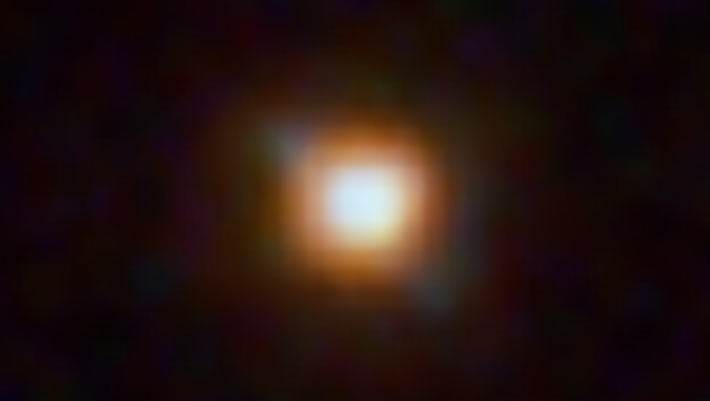
Webb Discovers Early Galaxy with Odd Light Signature
The James Webb Space Telescope (JWST), a collaborative project by NASA, ESA, and CSA, has once again expanded our understanding of the cosmos by detecting a peculiar galaxy approximately one billion years after the Big Bang. This galaxy, catalogued as JADES-GS+53.12175-27.79763 or GS-NDG-9422, presents an unprecedented light signature where the nebular gas shines more brightly than the stars themselves. This phenomenon challenges conventional knowledge of early galaxy formation and offers a unique window into the transitional phases of the Universe’s infancy. In this article, we delve into the discovery, explore its significance, and discuss what it tells us about the early Universe.
The Discovery of GS-NDG-9422: A Unique Early Galaxy
The galaxy GS-NDG-9422 was spotted using JWST’s Near-Infrared Spectrograph (NIRSpec), which allowed astronomers to analyze its light spectrum in unprecedented detail. Unlike typical galaxies where starlight dominates, the spectrum from this galaxy revealed that its glowing gas emitted a significantly stronger signal than its stars. This unusual characteristic immediately caught the attention of researchers, prompting deeper investigation into its physical and chemical properties.
Located about one billion years after the Big Bang, GS-NDG-9422 represents a critical era in cosmic history when the first galaxies were forming and evolving. The galaxy’s discovery adds a missing link in understanding how galaxies transitioned from the earliest stellar populations to more mature, well-established systems we observe today. Its peculiar light signature suggests that the gas surrounding new stars was intensely energized, producing nebular emission brighter than the stellar light itself.
The identification of GS-NDG-9422 underscores JWST’s power to uncover new phenomena in the early Universe. According to Dr. Alex Cameron of the University of Oxford, the initial reaction to the galaxy’s spectrum was one of surprise, as it revealed a previously unseen cosmic environment. This finding exemplifies Webb’s ability to explore uncharted territory in galactic evolution and stellar formation.
Understanding the Odd Light Signature: Gas Outshining Stars
The light signature of GS-NDG-9422 is dominated by emission from hot ionized gas rather than starlight, a phenomenon rarely observed in the local Universe. Detailed spectroscopic data indicated that the galaxy’s gas clouds are energized by photons from extremely hot, massive stars, causing the gas to glow brightly and outshine the stars themselves. This nebular dominance is a key clue to the physical conditions prevailing in early galaxies.
In typical galaxies nearby, massive stars have surface temperatures ranging between 40,000 and 50,000 degrees Celsius. However, observations suggest that the stars in GS-NDG-9422 are significantly hotter, exceeding temperatures of 80,000 degrees Celsius. These intense temperatures result in a powerful flux of ultraviolet photons that ionize the surrounding gas, leading to the bright emission lines detected by JWST.
Such a state implies that GS-NDG-9422 is undergoing a brief but intense star formation phase within a dense gas cloud. The interaction between these massive, hot stars and their gaseous environment creates the extraordinary nebular glow that dominates the galaxy’s light profile. This scenario is supported by computer models simulating cosmic gas clouds irradiated by very hot stars, which closely match the observed spectral features.
Implications for Early Stellar Populations and Galactic Evolution
The discovery of GS-NDG-9422’s nebular-dominated light challenges existing models of early stellar populations. While the galaxy does not contain Population III stars—the Universe’s first generation of stars characterized by pristine chemical composition—the presence of such hot, massive stars suggests a transitional stellar population. These exotic stars may provide vital clues about how galaxies evolved from primordial stars to the more chemically complex populations seen today.
Population III stars are theorized to have been massive and short-lived, but detecting them directly has remained elusive. GS-NDG-9422’s chemical complexity rules out the presence of these first stars, yet its unusual stellar temperatures indicate a stellar initial mass function skewed towards very massive stars. This insight sheds light on the conditions that governed star formation during the Universe’s formative years.
Understanding these transitional stellar populations helps astronomers reconstruct the timeline of chemical enrichment and star formation in the early Universe. GS-NDG-9422 acts as a cosmic laboratory, illustrating how galaxies might have evolved during a critical phase when the Universe was less than a billion years old.
The Role of JWST’s Near-Infrared Spectrograph in Unveiling Cosmic Mysteries
JWST’s Near-Infrared Spectrograph (NIRSpec) played a pivotal role in the discovery and analysis of GS-NDG-9422. By capturing detailed spectra across a broad wavelength range, NIRSpec enables astronomers to dissect the chemical composition and physical conditions within distant galaxies. This capability is essential for distinguishing between light emitted by stars and that from ionized gas clouds.
NIRSpec’s sensitivity to faint and distant objects allows it to probe galaxies formed during the Universe’s first billion years, a period previously difficult to study with older telescopes. Its advanced instrumentation helped reveal the unique nebular emission lines in GS-NDG-9422, which provided the critical evidence that the galaxy’s gas was outshining its stars.
This discovery highlights how JWST’s cutting-edge technology is pushing the boundaries of observational cosmology. By enabling the study of early galaxies in such detail, NIRSpec is helping scientists answer fundamental questions about the origins and evolution of the cosmos.
Challenges and Questions Raised by the New Findings
While the discovery of GS-NDG-9422 offers profound insights, it also raises several unanswered questions. One key issue is determining how common nebular-dominated galaxies were in the early Universe. Was GS-NDG-9422 an outlier, or part of a broader population of galaxies undergoing similar intense star formation phases?
Another challenge is understanding the precise mechanisms that produce such extreme stellar temperatures and their impact on galactic evolution. Are these conditions unique to the early Universe’s environment, or can similar processes occur elsewhere? Further observations and theoretical modeling are necessary to clarify these aspects.
Additionally, astronomers aim to explore what GS-NDG-9422 can reveal about even earlier cosmic epochs. By identifying more galaxies with similar properties, researchers hope to piece together a more comprehensive narrative of how the first stars and galaxies shaped the Universe’s development.
Future Directions: Expanding the Search for Nebular-Dominated Galaxies
Building on the discovery of GS-NDG-9422, astronomers are actively searching for additional examples of nebular-dominated galaxies. Expanding the sample size will enable more robust statistical analyses and improve understanding of how widespread these phenomena were in the early Universe.
Ongoing JWST surveys, combined with complementary observations from other telescopes, are expected to uncover more galaxies exhibiting similar signatures. These efforts will help define the role such galaxies played in cosmic reionization and the buildup of chemical elements essential for later generations of stars and planets.
By studying a diverse population of early galaxies, scientists can refine models of star formation, gas dynamics, and chemical evolution. This research promises to deepen our knowledge of the Universe’s formative years and the processes that led to the rich cosmic tapestry we observe today.
The Broader Significance for Cosmology and Astrophysics
The identification of GS-NDG-9422’s unusual light signature has significant implications beyond galaxy formation. It offers a new perspective on the interplay between stars and their environments in shaping cosmic structures. Understanding these interactions is crucial for constructing accurate models of galaxy evolution across cosmic time.
Moreover, the discovery informs theories about the initial mass function of stars in the early Universe, a fundamental parameter influencing the rate of chemical enrichment and the formation of subsequent stellar generations. Unraveling these details helps astrophysicists trace the lineage of matter from primordial gas clouds to the complex galaxies we see today.
Ultimately, GS-NDG-9422 exemplifies how cutting-edge astronomical instruments like JWST are revolutionizing our understanding of the cosmos. Each new discovery not only answers longstanding questions but also opens fresh avenues of inquiry, enriching the field of cosmology and inspiring future exploration.
Conclusion
The James Webb Space Telescope’s detection of GS-NDG-9422 marks a milestone in exploring the early Universe. This galaxy’s extraordinary light signature, dominated by glowing gas energized by unusually hot stars, offers a rare glimpse into the transitional stages of galactic evolution shortly after the Big Bang. As astronomers continue to investigate similar galaxies, our understanding of the cosmic dawn and the processes that shaped the Universe’s infancy will deepen. Webb’s observations not only unravel new cosmic mysteries but also pave the way for future discoveries that will enrich our knowledge of the cosmos for decades to come.
Originally reported by sci.news. Adapted for our readers.
Author of the article: Published Sep 18, 2026 11 minute read Article content Kyndryl Canada has been engaged to deliver a commercialization strategy and…
The National Agency for Science and Engineering Infrastructure (NASENI) on Friday 4th September 2026, marked three years of institutional transformation under its Executive Vice…
Municipal Administration Minister P. Narayana speaks to residents after laying the foundation stone for the slum redevelopment project at Velampeta, near Lakshmi Nagar in…