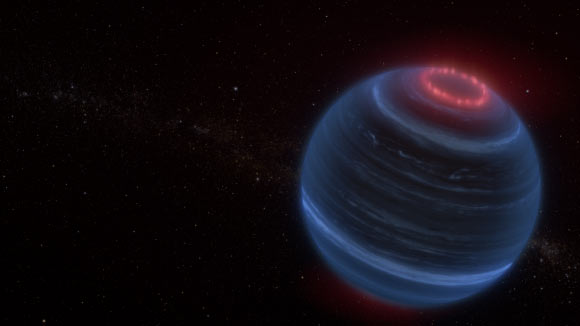
Webb Detects Methane Emission from Cold Brown Dwarf
The James Webb Space Telescope (JWST), a collaborative mission between NASA, ESA, and CSA, continues to revolutionize our understanding of the cosmos. Recently, astronomers utilizing Webb's unparalleled infrared capabilities identified methane emission from an isolated cold brown dwarf known as CWISEP J193518.59-154620.3, or W1935. This discovery is unprecedented and provides new insights into the atmospheric chemistry and physical processes of substellar objects. Unlike previous observations where methane was only detected in absorption, the emission detected here suggests complex and dynamic atmospheric phenomena, including possible auroral activity. This article delves into the discovery, its scientific context, and its broader implications for astronomy.
Understanding Brown Dwarfs: The Bridge Between Stars and Planets
Brown dwarfs are celestial objects that occupy the mass range between the heaviest gas giant planets and the lightest stars. They are often described as 'failed stars' because they lack sufficient mass to sustain hydrogen fusion in their cores, the hallmark of true stars. Despite this, brown dwarfs emit light primarily in the infrared spectrum due to residual heat from their formation and slow gravitational contraction.
These objects are crucial for understanding stellar and planetary formation processes. Their atmospheres share characteristics with both gas giant planets and low-mass stars, making them laboratories for studying atmospheric physics under unique conditions. Brown dwarfs can have complex weather patterns, temperature gradients, and chemical compositions that vary significantly with temperature and age.
W1935, the brown dwarf in question, is particularly interesting due to its relatively low temperature of about 482 Kelvin (approximately 209 degrees Celsius). This temperature places it among the coldest brown dwarfs observed, allowing researchers to probe atmospheric processes that differ markedly from warmer counterparts.
The Discovery of Methane Emission in W1935
Methane (CH4) is a common molecule in the atmospheres of gas giants and brown dwarfs, typically observed in absorption, where it absorbs specific wavelengths of light. However, the detection of methane emission—where methane radiates light rather than absorbs it—is rare and unexpected in brown dwarfs. Using JWST’s advanced infrared instruments, astronomers observed this unusual methane emission from W1935, marking the first time such a phenomenon has been recorded in a brown dwarf.
The discovery was made during a survey of brown dwarfs conducted by Dr. Jackie Faherty and her team at the American Museum of Natural History. They noticed that W1935’s spectral signature deviated from typical brown dwarfs, with methane emission lines clearly visible. This unexpected finding challenged existing atmospheric models and prompted further investigation into the underlying causes.
The detection was facilitated by JWST’s sensitivity and spectral resolution, which enabled the team to isolate methane emission features that would have been undetectable with previous telescopes. This breakthrough demonstrates JWST’s transformative impact on substellar research.
Temperature Inversion: A Surprising Atmospheric Phenomenon
One of the most intriguing aspects of W1935’s atmosphere is the presence of a temperature inversion, a phenomenon where temperature increases with altitude rather than decreasing. Temperature inversions are common in planetary atmospheres with external heat sources, such as Earth’s stratosphere heated by ozone absorption of ultraviolet light, but are unexpected in isolated brown dwarfs that lack a nearby star.
Computer atmospheric models applied to W1935’s data revealed this temperature inversion, suggesting an unknown internal or atmospheric heating process. Dr. Ben Burningham of the University of Hertfordshire noted that such an inversion was both surprising and exciting, as it implies active and complex atmospheric dynamics in isolated substellar objects.
The temperature inversion likely plays a role in the methane emission detected, as it can lead to excitation of methane molecules in the upper atmosphere, causing them to emit light. Understanding the source of this upper atmospheric heating is key to interpreting the emission mechanisms.
Auroral Activity: Linking Brown Dwarfs to Gas Giants
Aurorae are luminous phenomena caused by charged particles interacting with a planet’s magnetic field and atmosphere, producing spectacular light shows near magnetic poles. On Earth, Jupiter, and Saturn, aurorae are driven by solar wind particles or interactions with moons that inject charged particles into the magnetosphere.
The researchers hypothesized that similar auroral mechanisms could be responsible for the methane emission and temperature inversion observed in W1935. Since W1935 is isolated and lacks a nearby star to supply solar wind, the source of charged particles must differ, possibly arising from internal magnetic activity or interactions with a yet-undetected moon.
This potential auroral activity on a brown dwarf bridges the gap between planetary and substellar atmospheric phenomena, suggesting that brown dwarfs can exhibit dynamic magnetospheric processes akin to those seen in giant planets. This finding opens new avenues for studying magnetic fields and atmospheric interactions beyond the solar system.
The Role of Moons and Magnetic Fields in Brown Dwarf Atmospheres
In our solar system, moons like Io and Enceladus play crucial roles in enhancing auroral emissions on Jupiter and Saturn by supplying charged particles through volcanic activity and geysers. The possibility that W1935 hosts an active moon introduces an exciting scenario where substellar companions influence the brown dwarf’s magnetosphere and atmosphere.
Detecting such a moon would be challenging due to the faintness and distance of W1935, located approximately 47 light-years away in the constellation Sagittarius. However, future observations using JWST and other telescopes could search for indirect signs of satellite activity, such as periodic variations in emission or gravitational effects.
Magnetic fields in brown dwarfs are known to be strong and complex, generated by dynamo processes within their interiors. These magnetic fields could accelerate particles and create auroral currents independent of external stellar winds, providing an internal source of atmospheric heating and emission.
Implications for Exoplanet and Substellar Research
The detection of methane emission and temperature inversion in W1935 challenges existing atmospheric models of brown dwarfs and exoplanets. It suggests that isolated substellar objects can have active and dynamic atmospheres influenced by magnetic and possibly satellite interactions, even in the absence of a host star.
This discovery encourages astronomers to revisit theoretical frameworks for substellar atmospheres, incorporating auroral processes and internal heating mechanisms. It also highlights the diversity of atmospheric phenomena that may be found in exoplanets and brown dwarfs, expanding the scope of comparative planetology.
Moreover, JWST’s ability to detect faint molecular emissions opens new possibilities for characterizing the atmospheres of cold brown dwarfs and exoplanets, potentially identifying biosignatures or habitability indicators in future studies.
Future Observations and Research Directions
Further observations of W1935 using JWST and complementary telescopes are essential to confirm the presence of auroral activity and investigate the potential existence of moons or other companions. Time-resolved spectroscopy could reveal variability associated with magnetic phenomena or satellite interactions.
Expanding the survey to include other cold brown dwarfs will help determine whether methane emission and temperature inversions are common or unique to W1935. Such comparative studies will refine our understanding of atmospheric chemistry and physics in substellar objects.
Additionally, advancements in modeling techniques will be necessary to simulate the complex interplay between magnetic fields, atmospheric chemistry, and external or internal particle sources. These efforts will deepen our insight into the nature of brown dwarfs and their place in the cosmic landscape.
Conclusion
The detection of methane emission from the cold brown dwarf W1935 by the James Webb Space Telescope marks a milestone in the study of substellar atmospheres. This discovery reveals unexpected atmospheric complexity, including temperature inversions and potential auroral activity, broadening our understanding of brown dwarfs beyond traditional models. The possibility of moon-driven aurorae introduces exciting new questions about the interactions between substellar objects and their environments. As JWST continues to probe the cosmos, such findings underscore the telescope’s transformative role in unveiling the hidden dynamics of objects bridging the gap between stars and planets. The ongoing and future studies inspired by W1935 promise to deepen our knowledge of atmospheric physics and magnetospheric phenomena in the universe.
Originally reported by sci.news. Adapted for our readers.
Recent advances in machine perfusion technology are not only preserving donated livers but also making them biologically younger at a molecular level. This breakthrough…
What happens when human imagination, artificial intelligence, art and technology come together? From September 1 to 6, Samsung Electronics presented a special exhibition themed…