Trippy NASA Visualization Takes You on a Journey Through the Iconic Pillars of Creation
The Pillars of Creation, towering shimmery columns of cosmic dust and gas nestled within the Eagle Nebula, have captivated astronomers and space enthusiasts alike since their iconic capture by the Hubble Space Telescope in 1995. These finger-like formations, spanning several light-years, are stellar nurseries where new stars are born. Recently, NASA released an unprecedented, trippy visualization that takes viewers on a three-dimensional voyage through these celestial structures. By combining data from both the Hubble and the James Webb Space Telescopes, this visualization reveals the pillars in stunning detail across multiple wavelengths, offering fresh insights into star formation and the complex architecture of this cosmic wonder.
The Pillars of Creation: Cosmic Marvels in the Eagle Nebula
The Pillars of Creation are dense clouds of interstellar gas and dust located within the Eagle Nebula, approximately 7,000 light-years from Earth in the constellation Serpens. These towering structures stretch across roughly 4 to 5 light-years and serve as stellar nurseries where new stars are actively forming. Their dramatic shapes and ethereal glow have made them one of the most iconic images in astronomy.
Discovered and immortalized by the Hubble Space Telescope in 1995, the Pillars’ captivating appearance combines opaque dust with glowing ionized gases, creating a visual spectacle that has fascinated scientists and the public alike. The Eagle Nebula itself is vast, spanning about 70 by 55 light-years, but it is the pillars’ intricate formations that have drawn the most attention.
The name 'Pillars of Creation' reflects the role these structures play in the cosmic lifecycle: they are sites where gravity causes clouds of gas and dust to collapse and ignite new stars. This process sheds light on how the universe continuously renews itself, making the pillars a natural laboratory for studying star birth.
Bringing the Pillars to Life: NASA’s Groundbreaking Visualization
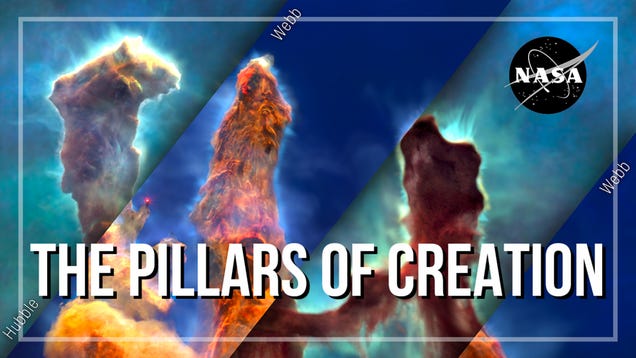
NASA’s latest visualization project offers a trippy, immersive journey through the Pillars of Creation, crafted using observational data from both the Hubble and James Webb Space Telescopes. This 2.5-minute video guides viewers through a three-dimensional model of the pillars, highlighting their complex structure and revealing hidden features invisible to a single telescope alone.
The visualization integrates multiple wavelengths of light, showcasing the pillars as seen in visible light by Hubble and in infrared light by Webb. This multi-wavelength approach provides a richer understanding of the pillars’ composition, temperature variations, and embedded stellar activity, offering a dynamic perspective on this celestial landmark.
By simulating a fly-through experience, the visualization allows viewers to perceive the depth and scale of the pillars, moving beyond static two-dimensional images. It reveals the interplay between dense dust clouds and glowing gases, helping to communicate the pillars’ three-dimensional nature and the processes occurring within.
Visible vs. Infrared Views: Contrasting Perspectives from Hubble and Webb
The Hubble Space Telescope captures the Pillars of Creation in visible light, highlighting objects that emit or reflect higher temperature light. In Hubble’s images, the pillars appear as dark brown, opaque dust structures with bright yellow ionized gas against a greenish-blue nebular background. This view emphasizes the dense, cooler dust that blocks visible light.
On the other hand, the James Webb Space Telescope’s infrared capabilities reveal cooler objects, often hidden behind thick dust clouds. Webb’s infrared vision penetrates the obscuring dust, unveiling stars embedded within the pillars and the warm dust glowing in shades of orange and orange-brown. The background in Webb’s images is a deep blue, with light blue ionized gases creating a striking contrast.
This complementary imaging highlights why multiple space telescopes are essential for a comprehensive understanding of cosmic phenomena. While Hubble shows the surface features and ionized gases, Webb uncovers the hidden stellar nurseries and cooler materials, together painting a fuller picture of the pillars’ structure and activity.
Unveiling Star Formation: Insights from the Visualization
The visualization reveals several stages of star formation occurring within the Pillars of Creation. Near the top of the central pillar, an infant protostar shines bright red in the infrared spectrum, indicating its early developmental phase. This young star is still enveloped in dense dust, making it invisible in visible light but detectable by Webb’s infrared sensors.
In the left pillar, a diagonal jet of material can be seen ejecting from a newborn star. This jet, a hallmark of active star formation, signals energetic processes where material is expelled along the star’s rotational axis. Although the star itself remains obscured, the jet’s presence confirms ongoing stellar birth.
Toward the end of one of the left pillar’s finger-like protrusions, a blazing new star radiates brightly, visible in both visible and infrared light. This progression—from deeply embedded protostar to emerging newborn star—provides a vivid snapshot of the lifecycle of stars within these cosmic towers.
Scientific Importance of Multi-Wavelength Observations
Combining data from different wavelengths is crucial for understanding the complex environments within the Pillars of Creation. Visible light observations reveal ionized gases and surface dust structures, while infrared imaging penetrates obscuring material to detect cooler objects and embedded stars. This synergy allows scientists to study star formation in unprecedented detail.
Multi-wavelength observations help astronomers differentiate between various components of the nebula, such as dense dust clouds, ionized gases, and young stars. They also provide temperature and composition information, enabling a more comprehensive picture of how stars influence and shape their surroundings during formation.
NASA’s visualization exemplifies the power of such combined data, showcasing how the pillars’ appearance changes with wavelength and revealing hidden phenomena. This approach continues to refine our understanding of stellar nurseries and the processes driving cosmic evolution.
Technological Advances Behind the Visualization
The creation of this immersive visualization was led by Frank Summers, principal visualization scientist at NASA’s Universe of Learning. Using observational data published in the Meteoritic & Planetary Science journal, his team reconstructed the three-dimensional structure of the Pillars of Creation with remarkable accuracy.
Advanced computer graphics and data processing techniques enabled the seamless integration of Hubble’s visible light images with Webb’s infrared data, generating a coherent, navigable model. This method allows viewers to experience the pillars as if flying through space, enhancing both educational and research applications.
Such visualizations represent a growing trend in astronomy, where complex datasets are transformed into accessible, engaging formats. They not only aid scientific discovery but also inspire public interest and understanding of the universe’s grandeur.
Public Engagement and Educational Value
NASA’s trippy Pillars of Creation visualization offers a unique way for the public to connect with space science. By immersing viewers in a 3D cosmic environment, it transforms abstract astronomical data into a tangible, awe-inspiring experience accessible to all ages and backgrounds.
This visualization serves as a powerful educational tool, illustrating fundamental concepts of star formation, light wavelengths, and nebular structure. Educators can use it to engage students and foster curiosity about astrophysics, while enthusiasts gain a deeper appreciation for the universe’s complexity.
Moreover, the visualization underscores the importance of continued space exploration and telescope missions. It highlights how advanced technology expands our cosmic horizons and brings distant phenomena closer to home, sparking wonder and inspiring future generations of scientists.
Looking Ahead: The Future of Cosmic Visualizations
The Pillars of Creation visualization marks a significant milestone in astrophysical imaging, but it also points toward a future rich with immersive cosmic experiences. As telescope technology advances and data processing improves, expect even more detailed and interactive visualizations that deepen our understanding of the universe.
Upcoming missions and observatories will provide data across additional wavelengths, including X-rays and radio waves, further enriching multi-spectral views of star-forming regions and other celestial phenomena. Integrating these data into 3D models will offer holistic perspectives on cosmic evolution.
Such tools will not only benefit scientists but also enhance public engagement, making astronomy more accessible and captivating. The journey through the Pillars of Creation is just the beginning of an era where space exploration is experienced in vivid, multidimensional ways.
Conclusion
NASA’s trippy visualization of the Pillars of Creation offers an unprecedented window into one of the universe’s most breathtaking stellar nurseries. By merging the strengths of the Hubble and James Webb Space Telescopes, this immersive 3D journey reveals the pillars’ intricate structure, star-forming processes, and the contrasting views offered by visible and infrared light. Beyond its scientific value, the visualization serves as a powerful educational and public engagement tool, inspiring awe and curiosity about the cosmos. As technology progresses, such visualizations will become even more sophisticated, inviting all of us to explore the universe’s wonders in vivid new dimensions.
Originally reported by gizmodo.com. Adapted for our readers.
Recent advances in machine perfusion technology are not only preserving donated livers but also making them biologically younger at a molecular level. This breakthrough…
What happens when human imagination, artificial intelligence, art and technology come together? From September 1 to 6, Samsung Electronics presented a special exhibition themed…