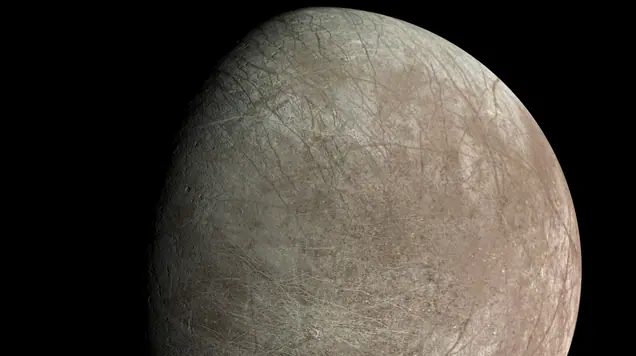
The icy crust of Jupiter’s moon Europa might maybe well in actual fact be transferring within the course of the moon’s hidden ocean
Europa, one of Jupiter’s largest moons, has long fascinated scientists due to its mysterious icy surface and the ocean believed to lie beneath it. Recent close flybys by NASA’s Juno spacecraft have provided unprecedented high-resolution images and data, revealing that Europa’s icy crust is not a rigid shell but a dynamic layer potentially moving above a hidden salty ocean. Understanding these movements is key to unraveling the moon’s geological history, its potential for harboring life, and planning future missions. This article explores the latest findings about Europa’s shifting ice shell, the evidence supporting this activity, and what it means for planetary science.
Europa’s Hidden Ocean: The Foundation of Its Dynamic Surface
Europa is believed to possess a subsurface ocean beneath its frozen exterior, with estimates suggesting it contains twice the volume of all Earth’s oceans combined. This vast salty ocean is kept liquid by tidal heating generated from gravitational interactions with Jupiter and neighboring moons, which prevents it from freezing solid despite the moon’s frigid surface temperatures.
The presence of this ocean is inferred from multiple lines of evidence, including magnetic field measurements, surface geology, and observations of water vapor plumes erupting from the surface. This hidden ocean is of immense scientific interest because it may provide conditions suitable for life beyond Earth.
Crucially, the ocean’s interaction with the overlying ice shell is believed to drive much of Europa’s surface geology. The dynamic relationship between the ocean and ice is responsible for the moon’s fractured terrain, chaotic regions, and possibly cryovolcanic activity, indicating a complex and active system beneath the icy crust.
NASA’s Juno Flyby: Capturing Europa’s Icy Surface in Detail
On September 29, 2022, NASA’s Juno spacecraft executed its closest flyby of Europa, passing within 220 miles (355 kilometers) of the moon’s surface. This close approach allowed Juno’s suite of instruments, including the JunoCam and Stellar Reference Unit (SRU), to capture high-resolution images of Europa’s chaotic terrain and subtle surface features.
The images revealed a landscape marked by intricate networks of ridges, grooves, and bands crisscrossing the surface. These features indicate tectonic activity and ice shell deformation, suggesting that the icy crust is not a static layer but one that shifts over time.
One particularly notable discovery was a newly named surface feature, nicknamed 'Platypus,' a 42-mile-wide region characterized by ridges and reddish-brown material with large ice blocks. This feature exemplifies the complex interactions between the ice shell and the underlying ocean or briny pockets beneath the surface.
Evidence for Ice Shell Movement: The ‘Polar Wobble’ Phenomenon
One of the most compelling findings from Juno’s observations is the evidence supporting the 'polar wobble' hypothesis. This theory proposes that Europa’s icy shell is decoupled from its rocky interior, allowing the ice to shift relative to the moon’s poles over time.
The polar wobble causes stress and strain within the ice shell, leading to predictable break patterns, fractures, and the formation of ridges and bands. Mapping these break patterns, especially in the southern hemisphere for the first time, has strengthened the case that Europa’s ice shell is free-floating and mobile.
This dynamic movement may create regions where the ice shell is thinner or fractured, allowing subsurface ocean water or briny liquid pockets to interact with the surface, potentially influencing surface chemistry and geology.
Chaotic Terrain and Cryovolcanism: Signs of Subsurface Activity
Europa’s surface is punctuated by chaotic terrains—areas with disrupted ice blocks, ridges, and dark stains—that hint at subsurface activity. These regions appear to be caused by the upwelling of warmer liquid water or briny fluids from beneath the ice, which break apart the crust and refreeze in new configurations.
The dark reddish-brown material observed around features like Platypus is thought to be related to minerals or salts deposited from below, possibly transported by cryovolcanic plumes or brine pockets. This suggests active exchange between Europa’s ocean and surface.
Such cryovolcanic activity is significant because it can transport nutrients and energy from the ocean to the surface, creating environments where microbial life might survive. It also provides accessible sampling sites for future missions aiming to analyze Europa’s habitability.
Implications for Habitability and Astrobiology
The movement of Europa’s ice shell and the presence of liquid water near the surface have profound implications for the moon’s potential to support life. A dynamic ice shell increases the likelihood that chemical nutrients and energy sources from the ocean reach the surface and vice versa.
Regions where the ice shell is thinner or fractured could allow exchange of materials, including organic compounds, between the ocean and the surface environment. This exchange is vital for creating habitable niches and sustaining potential microbial ecosystems.
Understanding the nature of the ice shell’s movements and subsurface ocean dynamics informs astrobiological models and helps prioritize landing sites for future missions. Targeting areas with recent or ongoing activity maximizes the chances of detecting biosignatures.
Technological Advances: How Juno’s Instruments Unveiled Europa’s Secrets
Juno’s successful flyby was made possible by its advanced imaging technology, including the JunoCam and Stellar Reference Unit (SRU). The SRU, primarily used for spacecraft navigation, provided high-resolution black-and-white images that revealed fine surface details.
These instruments allowed scientists to identify subtle features such as double ridges, grooves, and particulate deposits that were previously unresolved. The ability to capture images under intense radiation conditions near Jupiter was crucial for this mission.
Moreover, the data from Juno complement previous observations from missions like Galileo and Hubble, providing a more comprehensive understanding of Europa’s geology and ice shell dynamics. This synergy of technology and data drives forward planetary science research.
Future Missions and the Quest to Explore Europa’s Ocean
The revelations from Juno’s flyby underscore the importance of upcoming missions such as NASA’s Europa Clipper and ESA’s Jupiter Icy Moons Explorer (JUICE), which aim to study Europa’s ice shell and subsurface ocean in unprecedented detail.
Europa Clipper, scheduled for launch in the mid-2020s, will conduct multiple close flybys, equipped with instruments designed to probe the ice thickness, detect plumes, map surface composition, and analyze the moon’s magnetic environment to better understand its ocean.
By building on Juno’s findings, these missions will help ascertain the extent of ice shell mobility, the nature of subsurface water pockets, and the potential habitability of Europa, paving the way for future landers or even subsurface probes.
Challenges and Opportunities in Studying Europa’s Ice Shell
Studying Europa’s ice shell presents significant challenges due to the moon’s harsh radiation environment, thick ice cover, and the complexities of remote sensing. The intense radiation belts around Jupiter can damage spacecraft instruments, limiting observation time and data quality.
Moreover, interpreting surface features requires careful analysis to distinguish between geological processes such as tectonics, cryovolcanism, and impact cratering. The dynamic ice shell complicates understanding the moon’s geological timeline and activity cycles.
However, these challenges also create opportunities for technological innovation in spacecraft design, imaging techniques, and data analysis methods. Each new discovery about Europa’s shifting crust brings scientists closer to answering fundamental questions about ocean worlds and life beyond Earth.
Conclusion
The discovery that Europa’s icy crust is not a static shell but a mobile, shifting layer over a vast subsurface ocean marks a significant milestone in planetary science. This dynamic activity reveals a moon with a complex and evolving geology, where interactions between ice and ocean create environments potentially suitable for life. NASA’s Juno spacecraft has opened a new window into Europa’s secrets, setting the stage for future missions that will probe deeper into its hidden ocean and ice shell. As we continue to explore Europa, we move closer to understanding the conditions that might allow life to thrive beyond Earth, making this icy moon one of the most compelling targets in our solar system for astrobiology and exploration.
Originally reported by qz.com. Adapted for our readers.
Author of the article: Published Sep 18, 2026 11 minute read Article content Kyndryl Canada has been engaged to deliver a commercialization strategy and…
The National Agency for Science and Engineering Infrastructure (NASENI) on Friday 4th September 2026, marked three years of institutional transformation under its Executive Vice…
Municipal Administration Minister P. Narayana speaks to residents after laying the foundation stone for the slum redevelopment project at Velampeta, near Lakshmi Nagar in…