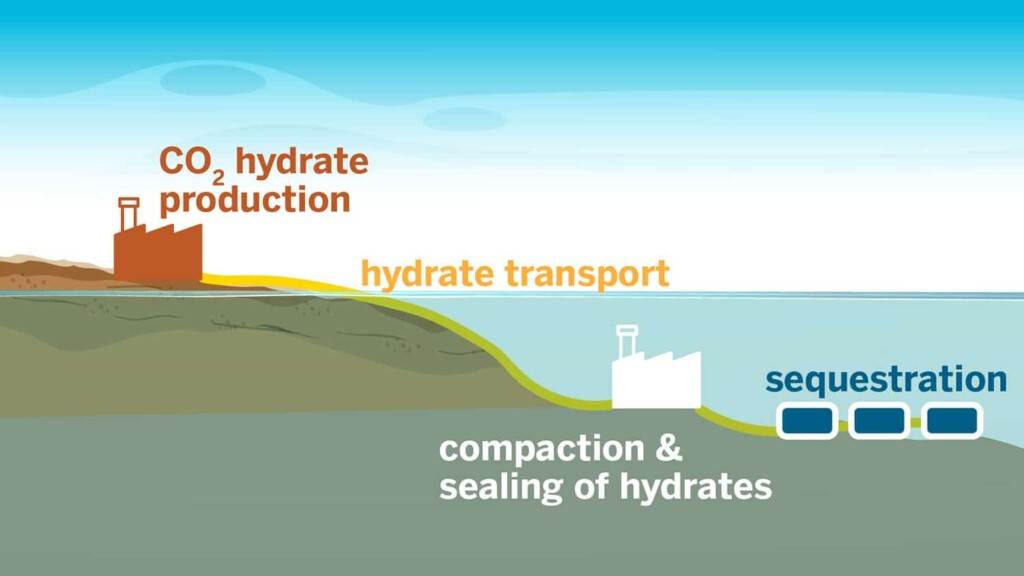
As the world grapples with the escalating climate crisis, innovative solutions for carbon capture and storage are critical to achieving sustainable carbon emission reductions. Researchers at the University of Texas at Austin have pioneered a novel technology that accelerates the formation of carbon dioxide (CO2) hydrates—ice-like structures capable of securely trapping CO2—without relying on environmentally harmful chemical accelerants. This advancement not only enhances the speed and efficiency of carbon sequestration but also opens new avenues for scalable, global deployment, particularly in oceanic environments. This article delves into the technology's development, mechanisms, benefits, and potential impact on global carbon management strategies.
Understanding Carbon Dioxide Hydrates and Their Role in Climate Mitigation
Carbon dioxide hydrates are crystalline, ice-like compounds formed when CO2 molecules become trapped within water molecules under specific pressure and temperature conditions. These hydrates have garnered attention for their potential to securely sequester carbon dioxide, preventing its release into the atmosphere and thereby mitigating greenhouse gas-driven climate change.
Unlike traditional carbon storage methods that inject CO2 into underground geological formations, hydrate-based storage leverages the ocean’s stable thermodynamic conditions, particularly in seabed sediments, to maintain the integrity of stored carbon. This approach offers a promising alternative, especially for regions lacking suitable geological reservoirs for underground injection.
Despite their advantages, the practical application of CO2 hydrates has been limited by slow formation rates and the need for chemical additives to accelerate the process—both factors that reduce overall efficiency and environmental benefits. The new technology developed by the University of Texas team addresses these challenges, making hydrate-based carbon storage more viable.
Innovative Ultrafast Formation Technique Developed by University of Texas Researchers
Led by Professor Vaibhav Bahadur of the Walker Department of Mechanical Engineering, the research team developed a method that accelerates the formation of CO2 hydrates up to six times faster than previous techniques. This breakthrough eliminates the reliance on chemical promoters traditionally used to speed up hydrate growth, thereby preserving the environmental integrity of the carbon capture process.
The team’s approach utilizes a reactor setup that facilitates a high flow rate of carbon dioxide bubbling through seawater infused with magnesium ions. Magnesium acts as a natural catalyst, promoting rapid hydrate nucleation and growth without chemical additives. This innovation streamlines the process, reducing energy consumption and complexity.
Importantly, the system’s compatibility with seawater eliminates the need for costly and energy-intensive desalination processes. This aspect significantly enhances the technology’s scalability and feasibility for widespread adoption, particularly in coastal regions worldwide.
Challenges of Existing Carbon Storage Methods and How Hydrate Technology Addresses Them
Current carbon storage predominantly relies on injecting CO2 into underground reservoirs, a method that, while effective, presents several challenges including potential leakage, groundwater contamination, and induced seismicity. Additionally, many countries lack suitable geological sites, limiting the global applicability of this approach.
Hydrate-based storage offers solutions to many of these issues by utilizing stable oceanic conditions to securely trap CO2 in solid form. This reduces the risk of leakage and contamination associated with subsurface injection. Moreover, ocean-based storage leverages abundant natural resources, making it accessible to countries with coastlines regardless of their geological makeup.
By accelerating hydrate formation without harmful chemicals, the new technology overcomes previous barriers related to slow kinetics and environmental concerns, potentially positioning hydrates as a primary method for large-scale carbon sequestration.
Environmental and Economic Advantages of the New Carbon Storage Technology
The chemical-free nature of this ultrafast hydrate formation method ensures that the carbon capture process does not introduce secondary pollutants or offset its environmental benefits. This aligns with global sustainability goals by enabling cleaner carbon management solutions.
Economically, the use of seawater and magnesium, both widely available and inexpensive, coupled with the elimination of desalination needs, lowers operational costs and simplifies infrastructure requirements. This can accelerate deployment timelines and reduce barriers to entry for emerging economies.
Furthermore, by facilitating rapid CO2 sequestration at scale, this technology can play a crucial role in meeting international climate commitments, such as those outlined in the Paris Agreement, by enabling gigaton-scale carbon removal from the atmosphere.
Global Accessibility and Deployment Potential of Hydrate-Based Carbon Storage
One of the most compelling aspects of this breakthrough is its potential to democratize carbon storage. Since the technology is compatible with seawater and relies on natural catalysts, it can be deployed in virtually any coastal country, expanding carbon sequestration capabilities beyond regions with suitable underground reservoirs.
This widespread applicability supports equitable climate action by enabling developing nations with extensive coastlines to participate actively in carbon removal efforts without expensive or complex infrastructure investments.
Moreover, the technology's adaptability to marine environments presents opportunities for integration with offshore renewable energy installations, promoting synergistic approaches to sustainability and carbon management.
While primarily designed for carbon capture, the ultrafast hydrate formation technology holds promise for various industrial applications. Its ability to rapidly create hydrate foams could revolutionize gas separation processes, enhancing efficiency in industries such as natural gas purification and chemical manufacturing.
Additionally, the technology’s desalination potential could contribute to addressing global freshwater scarcity by enabling energy-efficient salt removal from seawater through hydrate-based methods.
Gas storage and transportation also stand to benefit, as hydrates can serve as compact storage media for gases, potentially improving safety and reducing costs in logistics.
Future Prospects and Commercialization Efforts
The University of Texas research team has filed two patents related to this innovative technology, signaling strong commercial interest and potential market readiness. Plans are underway to establish a startup aimed at bringing the technology to industry and scaling its application.
Continued research will focus on optimizing reactor designs, scaling operations, and conducting real-world pilot projects to validate performance and environmental safety under diverse marine conditions.
Successful commercialization could position this technology as a cornerstone of global carbon management strategies, supporting international efforts to achieve net-zero emissions and combat climate change effectively.
Conclusion
The development of the fastest-of-its-kind carbon storage technology utilizing ultrafast formation of carbon dioxide hydrates marks a significant leap forward in climate change mitigation efforts. By eliminating harmful chemical accelerants and leveraging seawater-compatible processes, this innovation offers a scalable, efficient, and environmentally friendly solution for carbon sequestration. Its global accessibility, particularly for coastal nations, and potential applications beyond carbon storage present transformative possibilities for sustainable industry practices. As commercialization advances, this technology could become a pivotal tool in the global quest to reduce atmospheric CO2 levels and foster a sustainable future.
Author of the article: Published Sep 18, 2026 11 minute read Article content Kyndryl Canada has been engaged to deliver a commercialization strategy and…
The National Agency for Science and Engineering Infrastructure (NASENI) on Friday 4th September 2026, marked three years of institutional transformation under its Executive Vice…
Municipal Administration Minister P. Narayana speaks to residents after laying the foundation stone for the slum redevelopment project at Velampeta, near Lakshmi Nagar in…