Rare quadruple photo voltaic flare occasion captured by NASA
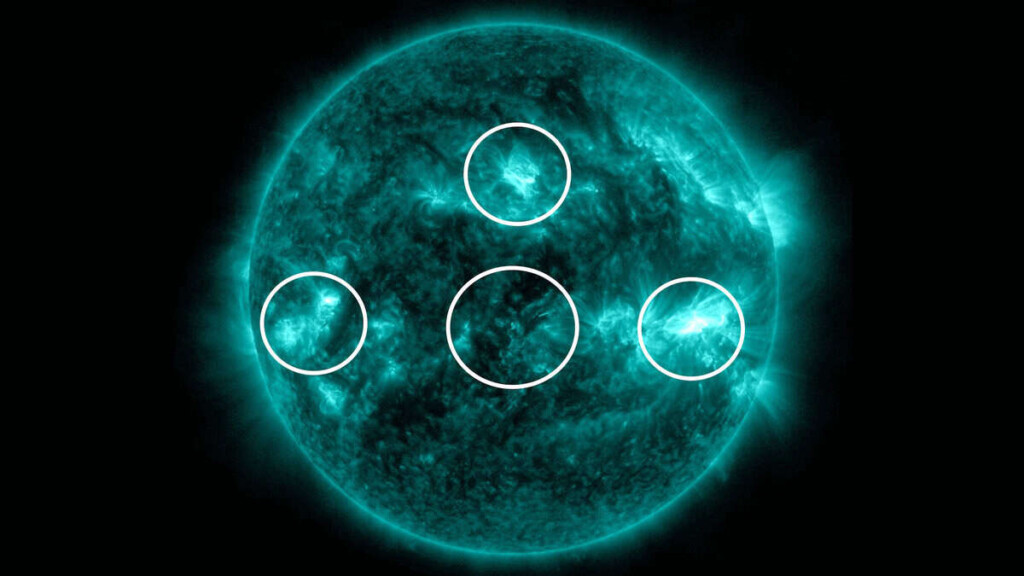
Earlier this year, NASA’s Solar Dynamics Observatory (SDO) recorded a remarkable and exceptionally rare event: four nearly simultaneous solar flares erupting from three separate sunspots and an associated magnetic filament. This phenomenon, known as a gigantic-sympathetic flare, showcases the sun’s complex magnetic activity and underscores the challenges posed to satellites, spacecraft, and ground-based technology. As the sun approaches its solar maximum, understanding such events becomes increasingly critical for predicting space weather impacts and safeguarding modern technological systems.
Understanding Solar Flares and Their Origins
Solar flares are intense bursts of radiation caused by the release of magnetic energy stored in the sun’s atmosphere. They occur when magnetic field lines near sunspots become twisted and suddenly realign, releasing vast amounts of energy in the form of light, X-rays, and energetic particles. These eruptions can last from minutes to hours and vary widely in intensity.
Sunspots are cooler, darker areas on the sun’s surface with strong magnetic fields. They serve as the primary sources of solar flares because their magnetic complexity fosters the buildup and explosive release of energy. The interaction between multiple sunspots can also lead to complex flare events, such as the quadruple flare observed by NASA.
The sun’s magnetic field extends into the corona, where magnetic loops and filaments form. These structures can link distant sunspots, enabling chain reactions that trigger multiple flares almost simultaneously. Such interconnected magnetic activity is the key to understanding gigantic-sympathetic flares.
The Rare Quadruple Solar Flare Event Captured by NASA
On a recent Tuesday morning, NASA’s SDO observed an extraordinary quadruple flare event involving three distinct sunspots and a magnetic filament connecting them. Despite being separated by millions of miles on the sun’s surface, these flares erupted within minutes of each other, creating a spectacular display of solar activity.
This rare event is classified as a gigantic-sympathetic flare, where multiple flares occur nearly simultaneously due to magnetic interactions within the sun’s corona. The combined area affected by the flares covered roughly one-third of the sun’s surface facing Earth, highlighting the scale and intensity of the eruption.
Such multi-flare occurrences are uncommon; the last notable event of this kind was the Massive Eruption in 2010. This recent observation provides valuable data for scientists studying solar magnetic dynamics and the mechanisms behind flare initiation and propagation.
The Solar Cycle and Its Role in Flare Activity
The sun operates on an approximately 11-year solar cycle characterized by fluctuating magnetic activity, sunspot numbers, and flare frequency. The cycle progresses from solar minimum, with minimal sunspots and flares, to solar maximum, marked by heightened activity.
Astronomers have noted that the sun is currently approaching its solar maximum, expected later this year. This phase typically brings more frequent and intense solar flares, increasing the likelihood of events like the recent quadruple flare.
Although the exact causes of the solar cycle remain partially understood, it is clear that the sun’s magnetic field undergoes periodic reversals and reorganizations. These processes drive the cyclical nature of solar activity and influence flare occurrence rates.
Potential Impacts on Earth and Space Technology
Solar flares can emit electromagnetic radiation and energetic particles that interact with Earth’s magnetosphere, potentially disrupting satellite operations, communication networks, and navigation systems. The recent quadruple flare event raises concerns about such impacts.
One of the most significant risks arises from coronal mass ejections (CMEs), massive bursts of solar plasma often accompanying flares. CMEs directed toward Earth can cause geomagnetic storms, leading to auroras but also to technological disturbances like GPS signal degradation and power grid fluctuations.
The electromagnetic debris from the recent event is expected to reach Earth within days, possibly resulting in temporary disruptions. While these effects are typically short-lived, they underscore the vulnerability of our increasingly satellite-dependent infrastructure to space weather phenomena.
Challenges in Predicting Solar Flares and Space Weather
Despite advances in solar observation, predicting solar flares with high precision remains challenging. The complexity of magnetic interactions on the sun and the rapid onset of flares limit forecasting accuracy, leaving scientists reliant on real-time monitoring for early warnings.
Magnetohydrodynamic models simulate the sun’s magnetic field dynamics but struggle to capture the fine-scale processes that trigger flare eruptions. Additionally, the unpredictable nature of gigantic-sympathetic flares adds a layer of difficulty to forecasting efforts.
Improving prediction capabilities requires enhanced observational technology, sustained funding, and interdisciplinary research. NASA and other agencies continue to develop instruments and models to better understand flare precursors and improve space weather forecasts.
Historical Context: Previous Multi-Flare Events
Multi-flare events, while rare, have been documented throughout solar observation history. The 2010 Massive Eruption was among the most notable, involving multiple flares from spatially separated sunspots that generated significant geomagnetic activity on Earth.
These events provide important case studies for understanding solar magnetic connectivity and the potential for chain-reaction flare sequences. They also highlight the importance of continuous solar monitoring to capture transient, high-impact phenomena.
Comparing historical and recent events helps scientists identify patterns and refine models of solar flare dynamics, contributing to improved risk assessment and mitigation strategies for space weather hazards.
Preparing for Future Solar Maximum and Its Effects
As the sun approaches its solar maximum, the frequency and intensity of solar flares are expected to increase, raising the stakes for technological resilience. Satellite operators, power grid managers, and communication providers are enhancing their preparedness for potential disruptions.
Developing redundancy systems, hardening electronic components, and improving space weather forecasting capabilities are critical measures to mitigate flare-related risks. International collaboration is also essential to share data and coordinate responses to solar storm events.
Public awareness and education about space weather impacts support community readiness and encourage investment in research. Continued monitoring by NASA’s SDO and other observatories will be vital in providing timely alerts and advancing scientific understanding.
Conclusion
The recent rare quadruple solar flare event recorded by NASA’s Solar Dynamics Observatory offers a vivid reminder of the sun’s dynamic and sometimes volatile behavior. As our society becomes ever more reliant on space-based technology and electronic infrastructure, understanding and preparing for solar activity is paramount. While predicting these powerful eruptions remains a scientific challenge, ongoing research and advanced monitoring systems are improving our readiness. With the solar maximum on the horizon, vigilance and investment in space weather forecasting will play crucial roles in protecting both Earth and the satellites orbiting it from potentially disruptive solar storms.
Originally reported by popsci.com. Adapted for our readers.
Recent advances in machine perfusion technology are not only preserving donated livers but also making them biologically younger at a molecular level. This breakthrough…
What happens when human imagination, artificial intelligence, art and technology come together? From September 1 to 6, Samsung Electronics presented a special exhibition themed…