Online sport unleashes tens of millions of citizen scientists on microbiome learn
The human microbiome, a complex ecosystem of microorganisms living inside and on our bodies, holds vast untapped potential for understanding health and disease. Traditional scientific methods to analyze microbiome data face challenges due to the sheer volume and complexity of genetic sequences involved. Recently, an innovative approach has emerged that leverages the power of online gaming to crowdsource scientific research. By embedding a casual mini-game within a mass-market video game, millions of players worldwide have become active contributors to microbiome research. This article explores how this groundbreaking intersection of gaming and science is accelerating microbial phylogeny studies and engaging tens of millions of citizen scientists in the process.
The Emergence of Citizen Science in Microbiome Research
Citizen science involves public participation in scientific research, harnessing the collective intelligence and enthusiasm of non-experts. In microbiome research, where data sets often comprise millions of RNA sequences, the traditional computational approaches can be limited by algorithmic complexity and resource constraints. Crowdsourcing offers a complementary strategy by distributing data analysis tasks to a large number of participants who solve puzzles or challenges related to sequence alignment and interpretation.
This approach has a rich history, with early projects like Foldit engaging gamers to solve protein folding problems. Building on these successes, researchers have developed specialized mini-games that translate complex bioinformatics tasks into accessible puzzles. This democratization of science not only speeds up data processing but also fosters public awareness and education about microbiome science.
The latest innovation involves integrating these mini-games into mainstream video games, vastly expanding the reach and engagement levels. By embedding scientific challenges into popular gaming environments, researchers tap into existing gaming communities, motivating millions to contribute without needing prior scientific knowledge.
Borderlands Science: A Revolutionary Mini-Game for Microbiome Analysis
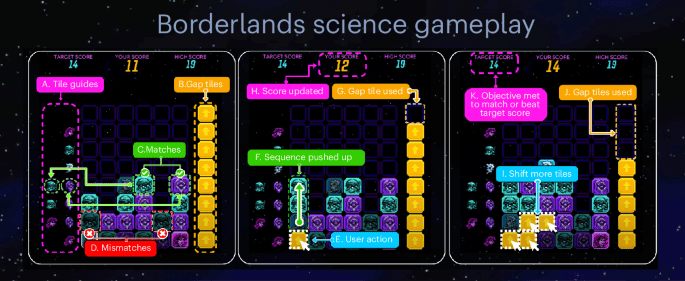
Borderlands Science is a pioneering mini-game incorporated within a widely played video game, designed to crowdsource the alignment of RNA sequences from the human microbiome. Since its launch, the game has attracted over four million participants who collectively generated more than 135 million puzzle solutions. These contributions have been instrumental in constructing a reference alignment crucial for microbial phylogeny studies.
The game translates complex sequence alignment tasks into engaging puzzles that players solve by rearranging sequence fragments to optimize matches. This intuitive gameplay allows participants without specialized training to contribute meaningfully to scientific research. Each puzzle solution helps refine the understanding of microbial relationships and evolutionary pathways.
By integrating scientific objectives with entertainment, Borderlands Science exemplifies how gamification can unlock the potential of citizen scientists. The vast dataset produced by this community accelerates research timelines that would otherwise take years using traditional computational methods alone.
How Online Gaming Accelerates Microbial Phylogeny
Microbial phylogeny involves mapping the evolutionary relationships between microorganisms based on genetic data. Accurate sequence alignment is a foundational step in this process, enabling researchers to identify conserved and variable regions across species. However, aligning millions of RNA sequences is computationally intensive and prone to errors when relying solely on automated algorithms.
The participation of millions of gamers in sequence alignment puzzles introduces a diverse range of problem-solving strategies, often uncovering novel alignments that algorithms may miss. Human intuition and pattern recognition complement computational methods, leading to more accurate and comprehensive phylogenetic trees.
Furthermore, the massive scale of participation means that data validation can occur through consensus, where multiple independent players solve the same puzzles, enhancing the reliability of the results. This crowdsourced model substantially improves the quality and speed of microbial phylogeny research.
Engaging the Public: The Social and Educational Impact
Beyond advancing science, online citizen science games like Borderlands Science have significant educational value. They introduce players to complex biological concepts in an accessible and interactive manner, fostering scientific literacy among diverse demographics. Players often develop a deeper appreciation for microbiology and genomics as they engage with the puzzles.
The social aspect of gaming communities further amplifies this impact. Players share strategies, discuss scientific insights, and motivate each other to contribute more, creating a vibrant ecosystem of learning and collaboration. This collective enthusiasm can inspire future generations of scientists and promote broader public engagement with scientific research.
Additionally, by participating in real-world scientific projects, players experience a sense of purpose and contribution, which enhances motivation and satisfaction. This model of citizen science provides a blueprint for integrating research with entertainment to achieve educational and societal benefits.
Technological Innovations Driving the Integration of Science and Gaming
The success of citizen science gaming relies heavily on advances in technology that enable seamless integration of scientific challenges into engaging gameplay. Sophisticated algorithms translate complex bioinformatics problems into puzzle formats that are both scientifically meaningful and entertaining.
Cloud computing and data analytics facilitate real-time collection and analysis of player-generated solutions, ensuring that scientific data is rapidly incorporated into research pipelines. Machine learning techniques also help prioritize puzzles and validate solutions, optimizing the workflow between gamers and scientists.
Furthermore, the use of mobile platforms and cross-device compatibility expands accessibility, allowing millions to participate regardless of their hardware. These technological innovations collectively create an ecosystem where gaming and scientific discovery co-evolve.
Challenges and Ethical Considerations in Citizen Science Gaming
While citizen science gaming offers tremendous potential, it also presents challenges. Ensuring data quality and accuracy requires robust validation mechanisms to filter out erroneous or malicious inputs. Developers must balance game complexity to maintain engagement without oversimplifying scientific tasks.
Ethical considerations include informed consent, data privacy, and fair recognition of contributors. Players should be aware of how their data and efforts are used, and mechanisms should exist to credit their participation appropriately. Transparency in project goals and outcomes fosters trust and sustained involvement.
Moreover, inclusivity and accessibility must be prioritized to avoid excluding populations with limited access to technology or gaming culture. Addressing these challenges is essential to maximize the scientific and societal benefits of citizen science gaming.
Future Directions: Expanding Citizen Science Through Gaming
The success of Borderlands Science paves the way for broader applications of citizen science gaming across diverse fields such as environmental monitoring, drug discovery, and climate modeling. Integrating scientific challenges into popular gaming platforms can mobilize vast global communities to tackle pressing research questions.
Emerging technologies like virtual reality and augmented reality hold promise for creating even more immersive and intuitive citizen science experiences. These platforms can simulate complex scientific environments, enhancing engagement and learning outcomes.
Collaborations between game developers, scientists, and educators will be key to designing games that balance entertainment with scientific rigor. By continuing to innovate at this intersection, citizen science gaming can become a powerful tool for democratizing research and accelerating discovery.
Conclusion
The fusion of online gaming and citizen science represents a transformative approach to tackling complex scientific challenges such as microbiome analysis. By engaging tens of millions of players worldwide, projects like Borderlands Science demonstrate how entertainment can drive real-world research breakthroughs. This model not only accelerates microbial phylogeny studies but also democratizes science, educates the public, and builds collaborative communities. As technology continues to evolve, citizen science gaming is poised to become an indispensable tool for scientific discovery and societal engagement across numerous disciplines.
Originally reported by nature.com. Adapted for our readers.
Author of the article: Published Sep 18, 2026 11 minute read Article content Kyndryl Canada has been engaged to deliver a commercialization strategy and…
The National Agency for Science and Engineering Infrastructure (NASENI) on Friday 4th September 2026, marked three years of institutional transformation under its Executive Vice…
Municipal Administration Minister P. Narayana speaks to residents after laying the foundation stone for the slum redevelopment project at Velampeta, near Lakshmi Nagar in…