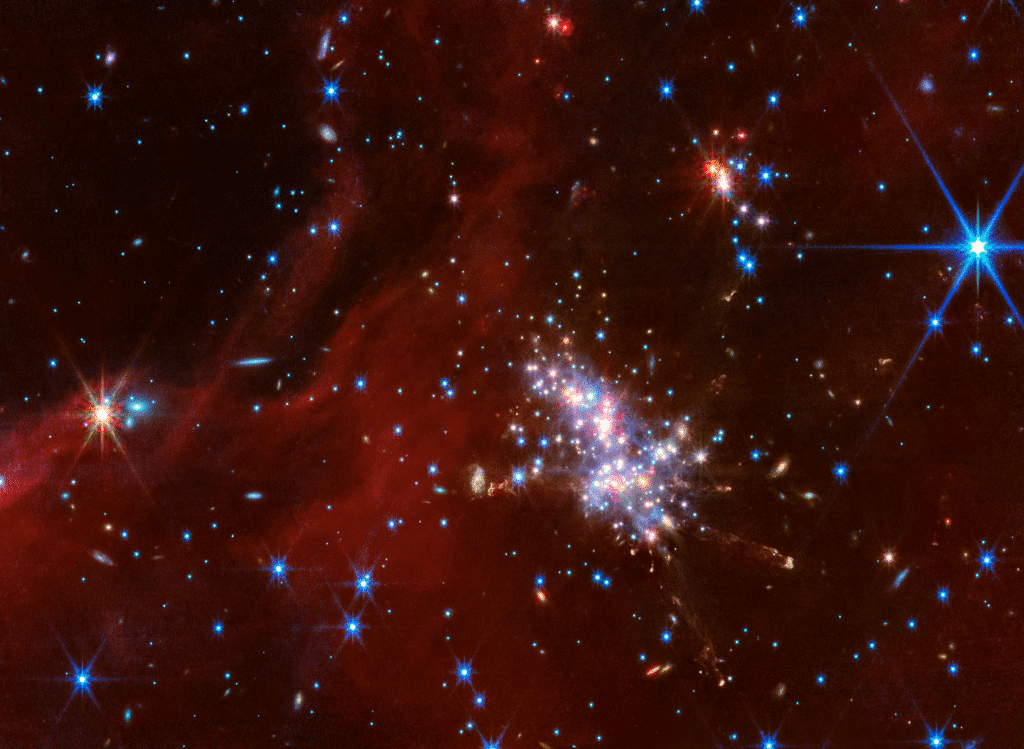
The James Webb Space Telescope (JWST), NASA’s most advanced space observatory, has recently turned its powerful gaze toward the farthest reaches of our Milky Way galaxy. Targeting a region known as the Extreme Outer Galaxy—located more than 58,000 light-years from the Galactic Center—JWST’s observations are uncovering new details about star formation in a remote and chemically unique environment. These findings not only expand our knowledge of how stars emerge in distant parts of our galaxy but also provide analogs to conditions in the early universe.
Peering into the Extreme Outer Galaxy
The Extreme Outer Galaxy is a sparsely populated region of the Milky Way situated over twice as far from the Galactic Center as Earth. This remoteness makes it a fascinating subject for astronomers seeking to understand star formation under conditions different from those in our local neighborhood. Using JWST’s Near-Infrared Camera (NIRCam) and Mid-Infrared Instrument (MIRI), scientists have focused on two molecular clouds within this region—known as Digel Clouds 1 and 2—to capture high-resolution images of ongoing stellar birth.
These molecular clouds are rich in gas and dust, the raw materials for star formation. However, unlike regions closer to Earth, the Extreme Outer Galaxy’s clouds have a lower abundance of elements heavier than hydrogen and helium—known as metals in astronomical terms. This composition resembles that of dwarf galaxies and the early Milky Way, offering a unique window into star formation in chemically primitive environments.
Unveiling Star Clusters and Protostars
Within Digel Clouds 1 and 2, JWST has identified four distinct clusters of young stars, labeled 1A, 1B, 2N, and 2S. The observations of Digel Cloud 2S are particularly striking, revealing a dense cluster of newly formed stars exhibiting dynamic activity. Several stars in this cluster emit extended jets of material from their poles—a hallmark of early stellar development.
These jets, often compared to cosmic firecrackers, shoot out in various directions, indicating vigorous processes at work. Prior to JWST’s observations, the existence of a sub-cluster within Cloud 2S was only suspected. The telescope’s unprecedented sensitivity and resolution have now confirmed its presence, providing a clearer picture of the region’s complexity.
The detection of very young, or Class 0, protostars alongside these jets and nebular structures highlights the detailed insight JWST offers into the earliest stages of star formation. Such features were previously difficult to observe at such distances due to limitations in telescope sensitivity and resolution.
Why Study Star Formation in the Extreme Outer Galaxy?
Studying star formation in the Extreme Outer Galaxy is crucial for several reasons. First, the lower metallicity environment mimics conditions thought to be common in the early universe and in small, primitive galaxies. Understanding how stars form under these conditions can illuminate the processes that shaped the Milky Way’s evolution and the broader cosmos.
Second, by comparing star formation in the Extreme Outer Galaxy with that in the solar neighborhood, astronomers can investigate how environmental factors influence the mass distribution of newly formed stars. This distribution, known as the initial mass function, affects the evolution of galaxies and the formation of planets.
Finally, the region offers an opportunity to study circumstellar disks—the disks of gas and dust surrounding young stars where planets may form. Observations suggest these disks have shorter lifetimes in the Extreme Outer Galaxy compared to closer star-forming regions, a puzzle that scientists aim to solve through ongoing research.
Future Directions and Continuing Mysteries
The current JWST observations represent only the beginning of a deeper investigation into the Extreme Outer Galaxy. The research team plans to revisit these molecular clouds to explore several outstanding questions. One focus is the kinematics of the jets observed in Cloud 2S—understanding their speeds, directions, and interactions with surrounding material.
Additionally, the team intends to combine JWST data with observations from other telescopes and observatories to track the full evolutionary sequence of star formation in this remote environment. This multi-faceted approach will help clarify how stars and planetary systems develop under varying galactic conditions.
As the James Webb Space Telescope continues its mission, its ability to probe distant and faint regions of space promises to revolutionize our understanding of star formation, galactic evolution, and the cosmic history of our universe.
What this means
The James Webb Space Telescope’s exploration of the Extreme Outer Galaxy marks a significant advance in the study of star formation beyond our immediate cosmic neighborhood. By revealing the intricate details of young stars and their environments in a chemically primitive region, JWST provides valuable analogs to the early stages of our galaxy and the broader universe. Continued observations and analyses will deepen our understanding of how stars and planetary systems emerge under diverse conditions, enriching our knowledge of the cosmos and our place within it.
Originally reported by science.nasa.gov. Adapted for our readers with AI assistance.
Recent advances in machine perfusion technology are not only preserving donated livers but also making them biologically younger at a molecular level. This breakthrough…
What happens when human imagination, artificial intelligence, art and technology come together? From September 1 to 6, Samsung Electronics presented a special exhibition themed…