NASA’s OSIRIS-REx Asteroid Sample Is Already Rewriting Solar System History
NASA Space Technology
Meteorites are messengers from the depths of primordial time—cast-off fragments of asteroids and comets that formed alongside our sun from raw material predating our star itself. Nonetheless their messages are in most cases muddled by their final, fateful encounter with Earth—charred in their fiery fall through our planet’s atmosphere and altered by our world’s ever-shifting environmental tumult. And unlike a usual piece of misplaced mail, they don’t come with a return address to show their provenance. Nonetheless what if the scientists wishing to be historians of our solar system’s earliest days could well sidestep these problems? Rather than relying solely on the random, scattered chapters of cosmic history from meteorites, wouldn’t it be better to directly consult space’s most ancient archives—the asteroids and comets—to bring back complete geologic records to read?
NASA’s Origins, Spectral Interpretation, Resource Identification, and Security-Regolith Explorer (OSIRIS-REx) spacecraft did just that in 2020, when it dove down to the surface of the near-Earth asteroid Bennu and retrieved some rocks dating back 4.5 billion years before bringing them back to Earth last September in dramatic fashion. It’s not the first (or second) spacecraft to collect samples from an asteroid. Nonetheless it retrieved the largest sample to date: a whopping 121.6 grams of pristine material from the solar system’s dawn.
Nearly instantly after the sample return capsule landed on Earth, scientists started their forensic examinations. And earlier this month at the Lunar and Planetary Science Convention in The Woodlands, Tex., they offered their first in-depthfindings for the overall world to survey. Their analyses are preliminary, on the opposite hand it seems that Bennu’s fashioned compose modified into shockingly familiar across the gigantic gulf of eons. Billions of years ago Bennu modified into it seems that section of a water-soaked world now long misplaced and otherwise forgotten, one with a beating geologic heart and an abundance of prebiotic organic discipline fabric. In many respects, this anonymous world could well be pleased borne a passing resemblance to the early, useless Earth.
NASA Space Technology Supporting science journalism
If you’re enjoying this article, please consider supporting our award-winning journalism by subscribing. By purchasing a subscription, you are helping to ensure the continued delivery of impactful reporting on the discoveries and ideas shaping our world today.
“Bennu actually carries the building blocks of life within its minerals,” says Louisa Preston, an astrobiologist at University College London.
Less certain conclusions are still to come, but already it’s clear that these precious pieces of Bennu hold enormous potential. “What we’re trying to do with these samples is understand how Earth formed—not just its water, not just its prebiotic compounds but how Earth itself formed,” says Harold Connolly, a geologist at Rowan University and mission sample scientist on OSIRIS-REx.
And it’s not all about our blue-green marble. One of the sample’s tiny grains reveals that Bennu’s journey began before the sun’s first fires ignited, which means planetary scientists can use it as a foothold in their effort to answer one of their field’s most enduring and fundamental questions. “What was the initial mineralogy of the solar system? Where did that dust come from? Did it all come from a single star or multiple generations of stars or different types of stars?” says Ashley King, a meteoriticist at London’s Natural History Museum and an OSIRIS-REx science team member.
Thanks to the mission’s daring exploration of Bennu’s ancient archives, “we’re putting it all together,” Connolly says.
Presolar Prelude
The “Origins” in OSIRIS-REx’s full name refers to the genesis and history of Bennu as a proxy for all other carbon and water-rich asteroids that have orbited the sun over the past few billion years. It’s a superb endeavor. “We’ve looked at 1 percent of the sample” so far, Connolly says. Nonetheless, that is enough to begin to test a wish list of hypotheses the team has about Bennu’s history.
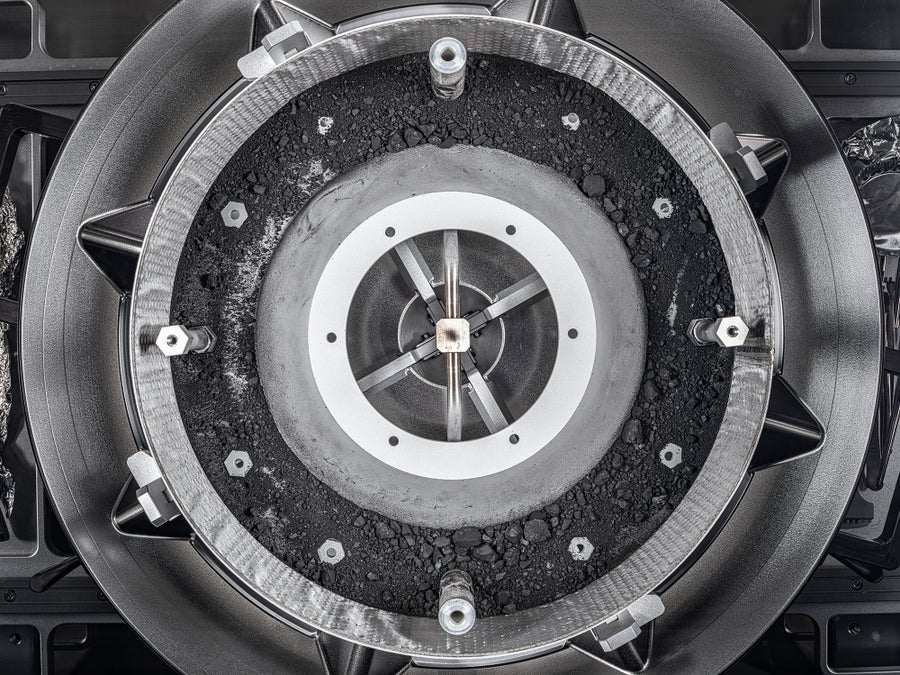
A top-down view of the contents of the OSIRIS-REx sample return capsule, revealing a treasure trove of material from the earliest epochs of our solar system’s history.
Credit: NASA/Erika Blumenfeld & Joseph Aebersold
A key question: What went into forming Bennu’s original (or “parent”) body? Clues remain in its presolar grains—crystals that condensed before the sun existed—“in most cases, the building blocks of our solar system,” says Pierre Haenecour, a cosmochemist at the University of Arizona and OSIRIS-REx team member.
To this point they’ve identified no less than two major classes of presolar grains. Many have the chemical signatures of intermediate-to-low-mass stars that were in the latter phases of their existence; such stars produce potent stellar winds as they age, expelling much of their atmosphere into deep space to form clouds of gas and dust that can be recycled into a newborn star. Other grains hint at a more violent origin. “We do have some presolar grains that appear to have compositions … more consistent with what we find in supernovae,” Haenecour says. Altogether, this supports the long-standing suspicion that our solar system was seeded and enriched by the explosive deaths of a variety of thermonuclear furnaces.
Not long after the sun emerged, worlds began to coalesce around it under gravity’s influence, including Bennu’s unknown parent body. Bennu could exist as a midsize asteroid in a near-Earth orbit today, but the team suspects that, eons ago, its water-rich parent first formed beyond the snow line—a diffuse thermal circumstellar boundary that determines where more volatile substances, including water, can exist as ice around a star.
There is still no consensus on exactly how far out Bennu’s protoplanet formed. One hypothesis holds it was not in the asteroid belt between Mars and Jupiter but somewhere farther out. Key to testing that idea would be the absence or presence of various ices and their residues in the sample; water ice can exist close to the sun, including within the asteroid belt, whereas frozen carbon monoxide must be much farther out—somewhere in the realm of Neptune—to avoid vaporization.
The array of testy chemical substances already found in the sample is “consistent with an outer solar system origin,” says Kelly Miller, a cosmochemist at the Southwest Research Institute in San Antonio, Tex. Intriguingly, the detection of a solution of ammonia, an extremely volatile substance, was also announced at the conference. This could be linked to the asteroid’s organic matter. Nonetheless, if it came from ammonia ice, then “that could well push [Bennu’s parent body] out even farther into the outer solar system,” Connolly says—perhaps in or beyond the realm of the ice giant planets Uranus and Neptune.
The Misplaced Water World
Wherever Bennu’s parent body formed, it was certainly not in stasis. The sample appears to be packed with clays and other mineral assemblages that are clear signs of dynamic transformations, such as being saturated in liquid water or even having some of that water evaporate to leave behind salts. “Bennu is dominated by materials that have been altered by water,” says Sara Russell, a planetary scientist at London’s Natural History Museum and an OSIRIS-REx science team member.
Although the water wasn’t scorching hot, it was completely warm and could have evolved in composition over time, which implies that multiple hydrothermal systems were driven by melting ice. That ice melted, at least for a few million years, because the parent body had a warm geologic core heated by the decay of radioactive isotopes. According to this, Bennu’s precursor was at least 10 kilometers wide, perhaps larger, Connolly says.
Back in February the mission team announced the significant presence of phosphates in the sample. Beneath the icy crust of Saturn’s moon Enceladus, a geologically active world, is a warm liquid-water ocean that contains a variety of compounds essential to life, including phosphorus compounds. After discovering phosphates in the Bennu sample, OSIRIS-REx principal investigator Dante Lauretta speculated that the asteroid “may be a fragment of an ancient ocean world.”
“I’m not ready to go there yet because we haven’t teased out enough of the petrology and petrography to piece the story together,” Connolly says. Nevertheless Bennu is enriched with materials that are linked to significant geologic activity.
One of the kinds of rock the spacecraft observed on Bennu, which appears “cauliflower-like,” is “very much like a mélange,” Connolly explains—a broken-up, compressed-together mess of a sediment-rich rock “that is mostly formed in subduction zone areas” similar to those found at Earth’s continental margins and deep-sea basins. The idea of a precursor world on Bennu with Earth-like movement and shifting of tectonic plates is intriguing, to say the least. However, these rocks are chaotic and difficult to interpret. “It does not mean that the parent body was tectonically active,” Connolly says.
Currently, most scientists are envisioning not so much a geologically hyperactive world but a water-rich rock with a dynamic early history. “I like to think of it as a giant mudball,” King says.
The Gigantic Deliverer
That mudball eventually ended up in the asteroid belt, perhaps after being pulled out of a more distant orbit by Jupiter’s gravitational pull. One working hypothesis is that after about three billion years, this parent body was destroyed by a catastrophic collision, releasing the fragment we know today as Bennu, which eventually made its way into near-Earth space.
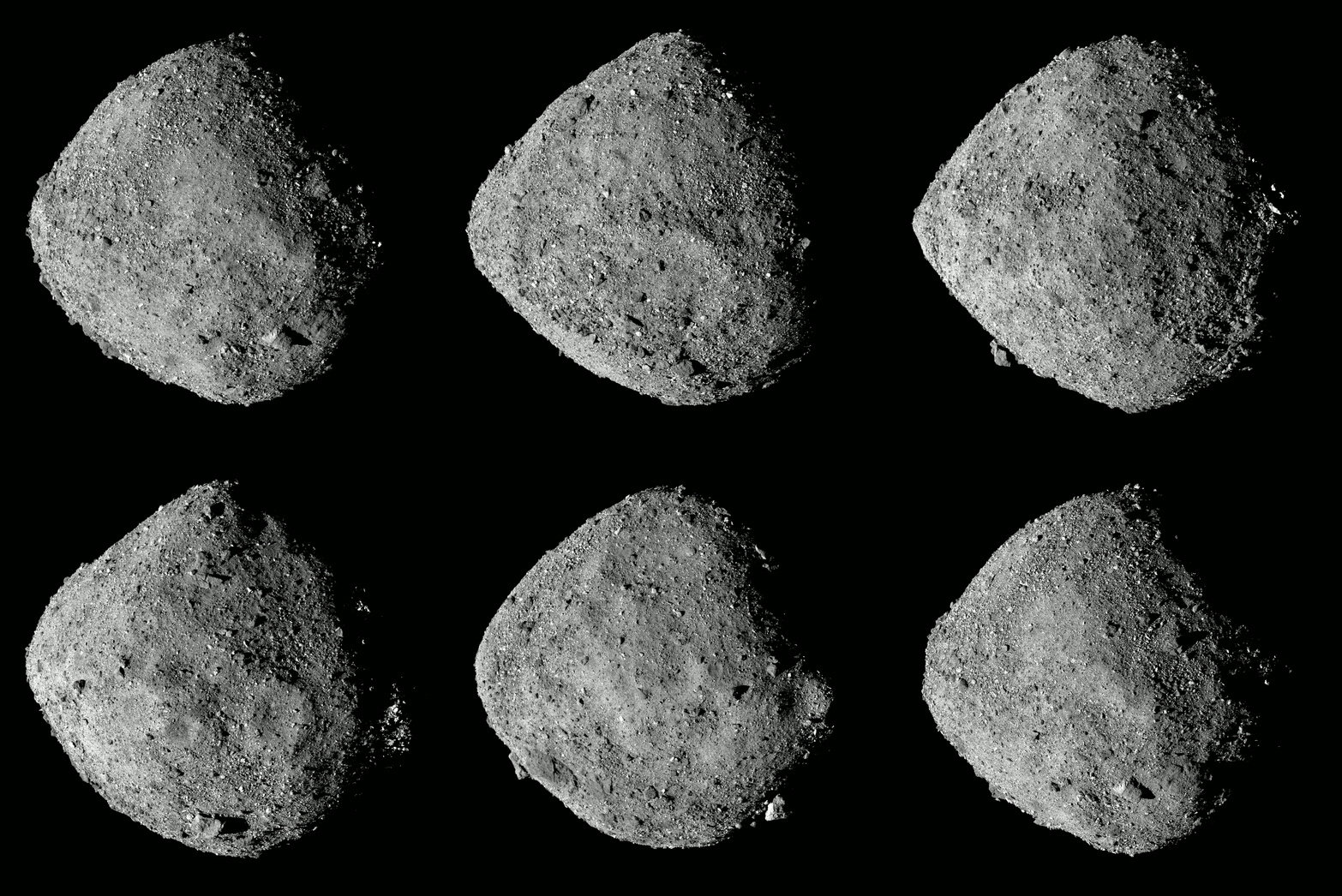
An animation showing the rotation of the near-Earth asteroid Bennu, captured over a four-hour period on December 2, 2018 by NASA’s OSIRIS-REx spacecraft.
Credit: NASA/Goddard/University of Arizona
That inward migration speaks to a key chapter in the history of the solar system: the delivery of water and prebiotic organic material—carbon-based compounds used by biology—to rocky worlds.
“It’s a long-standing question: Where did Earth’s water come from?” says Richard Binzel, an asteroid expert at the Massachusetts Institute of Technology and OSIRIS-REx co-investigator. “For a very long time, we thought it [came from] comets, because they’re the most water-rich things we observe.” However, in recent years, investigations of water ice on various comets have revealed its chemical fingerprints to be somewhat different from those of the water that fills Earth’s oceans.
Conversely, the water found in numerous hydrated meteorites is a much closer match to that of our planet’s reservoirs. And what of Bennu? That important question remains unresolved for now, but regardless of whether Bennu has Earth-like water, this enduring question will not be definitively answered—Earth’s seas and oceans were likely acquired from a variety of cosmic sources. It is also possible that their origin did not rely on asteroids at all; rather, Earth’s oceans may have been trapped within the planet as it formed before escaping to the surface through ancient volcanism.
Then there are the organic compounds. “Biology started out as chemistry,” Preston says. Even in the extremely unlikely event that the OSIRIS-REx sample harbors fossilized alien microorganisms, Bennu won’t provide any concrete answers as to how life originated on Earth. Nonetheless, life could not exist at all without a set of carbon-bearing compounds such as amino acids. One idea is that these formed in the regions between the stars before asteroids like Bennu delivered them to Earth.
“We know [that asteroids] can carry these materials to Earth. But the first step is: How did they become life? We need to understand that inventory in order to answer that,” King says. And already the team has identified a long list of organic molecules, including a suite of amino acids, present in the sample. “They even found uracil and thymine—uracil being one of the four nucleotide bases used in RNA bases and … substituted by thymine in DNA,” Preston says.
Most of these life-essential substances also have primordial origins. “Bennu contains organic matter that formed in the interstellar medium,” stated Ann Nguyen, a planetary scientist at NASA and an OSIRIS-REx co-investigator, during a presentation at the conference.
Not all astrobiologists are fixated on amino acids. “I could well also very well be moderately of a heretic,” says Cole Mathis an astrobiologist at Arizona State University. Nonetheless he isn’t especially drawn to abundances of organic matter in Bennu. “It’s no longer tense to get dangle of amino acids.” Must you mix nitrogen, carbon and oxygen, he says, “these items are roughly unavoidable.” Asteroids could well be pleased delivered them to Earth, but very like the planet’s water, these compounds could well be pleased also easily fashioned on Earth without requiring a Bennu-like supply.
Mathis wants to make employ of Bennu to explore the boundary between chemistry and biology. “There are some molecules which will doubtless be so complex that easiest existence could well be pleased made them,” he says, providing weight reduction program B12 as an instance. He isn’t expecting anybody to in discovering the relaxation like that in the sample. Nonetheless he wants to uncover which molecules will even be made by both existence and abiotic chemistry and which is in a spot to easiest be made by existence. “Where need to that transition be?”
Bennu, he hopes, will supply hints as to where this boundary lies—since the extra baroque an organic compound is, the trickier it is for chemistry alone to get dangle of it. Mathis’s quiz, then, is no longer about abundance but chemical convolution: “What’s the most complex person molecules we can in discovering in these offers?”
Solutions to this quiz and many others are coming soon. They are hidden within a little pouch of pristine asteroid material waiting to be analyzed. Those grains could well be pleased to designate $1.2 billion to bring back home. Nonetheless they’re effectively helpful because they will add context to that famous saying: “we are all stardust.” Scientists are actually starting to uncover the true nature, and origin, of this stardust—the material that went into forming everything we see, including Earth and ourselves.
Hopes had been high when OSIRIS-REx collected that sample from Bennu. Already they’ve been exceeded. “The universe was smiling on us,” Connolly says.
Recent advances in machine perfusion technology are not only preserving donated livers but also making them biologically younger at a molecular level. This breakthrough…
What happens when human imagination, artificial intelligence, art and technology come together? From September 1 to 6, Samsung Electronics presented a special exhibition themed…