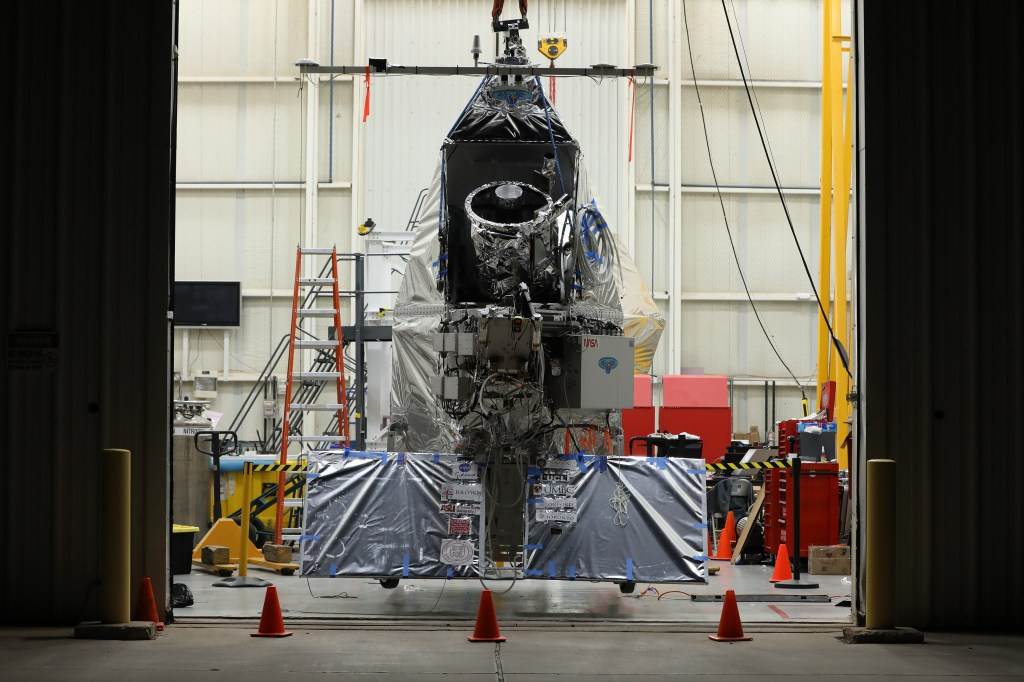
NASA’s EXCITE Mission Prepared for Scientific Balloon Flight
Understanding the atmospheres of exoplanets—planets orbiting stars beyond our solar system—is a frontier in astronomy that promises to reveal the nature of these distant worlds and their potential habitability. NASA’s latest initiative, the EXoplanet Climate Infrared TElescope (EXCITE), is preparing for a pioneering scientific balloon flight to gather detailed infrared data on hot Jupiter exoplanets. This mission leverages the unique advantages of high-altitude balloon platforms to conduct long-duration observations that are challenging for space telescopes due to limited time and resources. EXCITE’s innovative approach aims to enhance the study of exoplanet atmospheres by capturing continuous, three-dimensional data over entire planetary orbits.
The Science Behind EXCITE: Exploring Hot Jupiter Atmospheres
EXCITE focuses on hot Jupiters, a class of gas giant exoplanets characterized by their close proximity to their host stars, completing orbits in just one to two days. These planets are tidally locked, meaning one side perpetually faces their star, resulting in extreme temperature differences between their day and night hemispheres. Understanding how heat and atmospheric molecules distribute across these planets is critical for developing models of planetary climate and atmospheric dynamics.
The mission employs phase-resolved spectroscopy, a technique that observes how molecules in a planet’s atmosphere absorb and emit infrared light throughout its orbit. This continuous monitoring allows scientists to detect key compounds such as water vapor, methane, and carbon dioxide, and to analyze their global circulation patterns. Such comprehensive data provide a three-dimensional picture of atmospheric temperature and composition, offering insights that are difficult to obtain through snapshot observations.
Challenges of Space-Based Observations and the Balloon Advantage
Historically, space telescopes like Hubble, James Webb, and the now-retired Spitzer have conducted phase-resolved spectroscopy of exoplanets, but these observations are resource-intensive. For example, studying the exoplanet WASP-43 b required over 100 hours of combined telescope time, which is a precious and limited resource shared among numerous scientific projects.
EXCITE addresses these challenges by utilizing a helium-filled scientific balloon to ascend to approximately 132,000 feet (40 kilometers), above 99.5% of Earth’s atmosphere. This altitude significantly reduces atmospheric interference, especially in the infrared spectrum, enabling clearer and more sensitive observations. Moreover, launching from Antarctica allows for continuous observation of target stars without interruption, as the stars remain above the horizon during the polar summer. This capability enables EXCITE to collect uninterrupted data over multiple days, effectively doubling the number of phase-resolved spectra available to researchers.
Innovative Instrumentation and Precision Engineering
The EXCITE telescope is designed with meticulous precision to ensure stable and accurate data collection. Infrared light from the target exoplanets is directed through a spectrometer, where it passes through a complex arrangement of mirrors and prisms before reaching a highly sensitive detector. Even minor misalignments of a few millimeters could prevent the light from reaching the detector, underscoring the importance of precise engineering.
A critical component of the instrument is the cryostat, a cooling vessel that maintains the spectrometer’s detector at approximately minus 210 degrees Celsius (350 degrees below zero Fahrenheit). This extreme cooling reduces thermal noise, allowing the detector to measure subtle changes in infrared light intensity essential for detailed spectral analysis.
The entire assembly is mounted on a platform capable of rotating along three axes with remarkable stability, maintaining pointing accuracy to within 50 milliarcseconds. This precision is comparable to focusing on a U.S. quarter coin from 65 miles away, ensuring that the telescope can track exoplanets accurately throughout their orbits.
Collaborative Efforts and Mission Operations
EXCITE represents a collaborative effort among multiple institutions, including NASA’s Goddard Space Flight Center, Brown University, Arizona State University, and StarSpec Technologies in Ontario, with additional contributions from partners in Canada, Italy, and the United Kingdom. This international cooperation has been crucial in assembling the sophisticated subsystems and integrating them into a cohesive instrument.
The mission will launch from the Columbia Scientific Balloon Facility (CSBF) in Antarctica, managed by NASA’s Wallops Flight Facility in Virginia. CSBF has a long history of supporting scientific balloon flights, having launched over 1,700 balloons in the past four decades. The facility provides mission planning, engineering support, and field operations, with Peraton operating the CSBF on NASA’s behalf.
Scientific balloons offer a cost-effective and frequent platform for near-space research, enabling technology maturation and scientific investigations in astrophysics, heliophysics, and atmospheric sciences. They also serve as valuable training grounds for emerging scientists and engineers.
What this means
NASA’s EXCITE mission exemplifies innovative approaches to exoplanet research by combining advanced infrared instrumentation with the unique advantages of high-altitude balloon platforms. By enabling continuous, detailed observations of hot Jupiter atmospheres, EXCITE is poised to significantly expand the available data on exoplanet climates and atmospheric dynamics. This mission not only complements the capabilities of space-based telescopes but also demonstrates the value of scientific balloons for cutting-edge astrophysical investigations. As EXCITE prepares for its inaugural flight, the scientific community anticipates new insights that will deepen our understanding of distant worlds and the complex processes shaping their atmospheres.
Originally reported by science.nasa.gov. Adapted for our readers with AI assistance.
Recent advances in machine perfusion technology are not only preserving donated livers but also making them biologically younger at a molecular level. This breakthrough…
What happens when human imagination, artificial intelligence, art and technology come together? From September 1 to 6, Samsung Electronics presented a special exhibition themed…