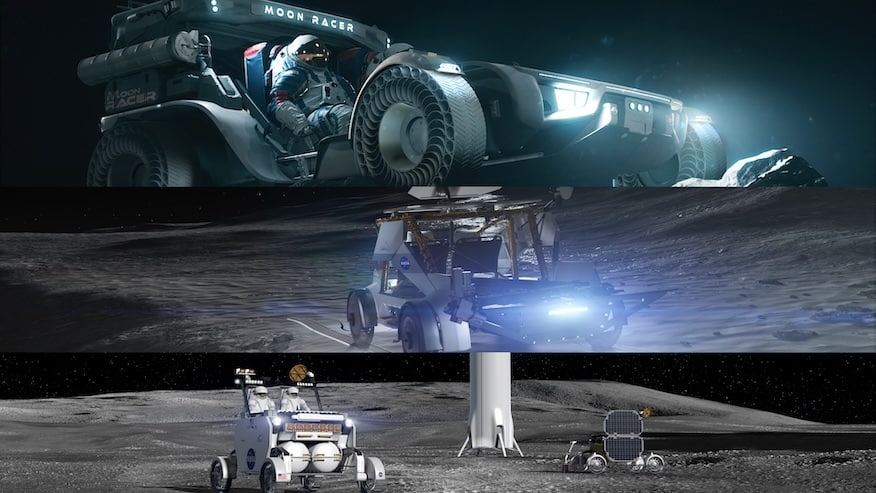
NASA unveils three teams to compete for crewed lunar rover demonstration mission
NASA Space Technology
NASA awarded contracts to three corporations and their teams to participate in the feasibility phase of developing alternatives for a Lunar Terrain Vehicle (LTV). Renderings: Intuitive Machines, Lunar Outpost, Astrolab
NASA selected three corporations to proceed with developing crewed, unpressurized rovers capable of operating on the Moon’s South Pole on Wednesday.
Intuitive Machines’ Moon RACER (Reusable Independent Crewed Exploration Rover), Lunar Outpost’s Lunar Scout, and Venturi Astrolab’s FLEX (Flexible Logistics and Exploration) rovers were selected by NASA as part of its Lunar Terrain Vehicle Services (LTVS) contract. The maximum potential value of the indefinite-delivery/indefinite-quantity, milestone-based contract is $4.6 billion, according to NASA.
These three teams are each leading multi-company teams in this competition.
Lunar Smash of day – Lunar Outpost, Lockheed Martin, Frequent Motors, Goodyear and MDA Save
FLEX – Venturi Astrolab, Axiom Save and Odyssey Save Research
“Science is our toolbox for studying and enhanced mobility is one among a truly remarkable tools in that science toolbox,” mentioned Jacob Bleacher, NASA’s Chief Exploration Scientist, all the plot in which by the announcement at the Johnson Save Center on Wednesday.
“The value of Apollo samples increased when the Lunar Roving Vehicle enabled exploration of more surface locations per mission. That breadth of lunar data is what we seek now,” he added.
Lara Kearney, the manager of the Extravehicular Activity and Human Surface Mobility Program at JSC, said the contractors are being tasked with designing rover capabilities that would last 10 years. She said while there are specific high-level requirements placed on the selected suppliers, they also have considerable flexibility.
“Now we like asked the corporations to fulfill a 10-365 days working life. We did no longer clarify how they wished to build that,” Kearney mentioned. “They are able to also, as an instance, attain in and allege, ‘I’m going to raise one rover. It’s going to closing 10 years’ or ‘I’m going to raise 10 rovers that closing handiest one 365 days.’”
The three corporations will each have a role uncover for the so-called “feasibility section” of the LTVS program. This could last about 365 days culminating in a preliminary bag review. That 365-day-long interval will allow NASA to work with them to “perceive what their designs take a look at out esteem, iterating with them on the place we are able to affect improvements and dealing out how they incorporate into our total idea or structure.”
“Once we pass that stage, we will have a follow-on competitive request for proposals issued. They will then compete for what we call a ‘demonstration task order,’ Kearney said. “That demonstration will allow them to finalize the design, deliver the LTV to the Moon and demonstrate it on the surface before the arrival of the Artemis 5 crew.”
Kearney mentioned they’ll possible handiest be in a neighborhood to award the demonstration job uncover to 1 company. This could well also be followed by service job orders on an annual cadence to offered each crewed and uncrewed services and products all the plot in which by the final interval of the contract.
She mentioned while NASA could be the primary customer through the Artemis program, about 25 percent of the rover’s usage will come from commercial customers.
“I think what’s truly important is to applaud NASA for this innovative, forward-thinking procurement,” said Steve Altemus, the CEO of Intuitive Machines. “It is clear that not only are we going to support the Artemis campaign, with crewed and uncrewed missions, but also it’s commercially available for us as a business to sell expertise on that rover and develop it for international partners and for other commercial companies and space agencies around the world.”
A rendering of Intuitive Machines’ Moon RACER rover, which is being developed in partnership with AVL, Boeing, Michelin and Northrop Grumman. Graphic: Intuitive Machines
Challenges to cruising the Moon
As is the case with any mission on the Moon, the proposition of bringing a rover that can operate with or without people is a major undertaking. Beyond the three companies selected, rovers such as those developed by the Teledyne Brown-led team (which included Nissan North America, Sierra Space, Textron and Bridgestone Corporation) and a partnership between Lidos and NASA did not make the cut.
One of the challenges faced by the teams selected for this next phase is that their vehicles must still be operable not only when an astronaut is at the controls in person, but also remotely from Earth, between crewed Artemis missions.
“One requirement from NASA is that we cannot have more than 10-meter error on the lunar surface at any given time. This is without any infrastructure in place,” said Justin Cyrus, the CEO of Lunar Outpost. “We don’t have GPS satellites around the Moon, we don’t have communication infrastructure, and we need to understand our environment and perceive our vehicle dynamics to a degree that we know exactly where we are.”
Lunar Smash of day’s belief illustration of a NASA Lunar Terrain Car (LTV) rover for the Artemis program. Graphic: Lunar Outpost
Another venture will be establishing a power generation and storage system that can not only provide ample service for the vehicle to operate for 10 years, but also withstand the harshness of the lunar night.
“There’s a list of the subsystems that we’ve put in as the initial package that will be traded over that 12-month period. That will give us a better understanding of things like surviving the night, operating throughout the night, how efficient solar arrays are versus fuel cells, what the drivetrain needs to look like, what the battery life extensions are, what the suspension needs to be,” Altemus said. “And tires in particular, we brought Michelin on board, who’s done extensive work on lunar tires with the Glenn Research Center. And so, that research has been going on for years.”
The three representatives of the winning companies didn’t go into astronomical detail about their designs or specific numbers when it came to functionality, citing the ongoing competition for the demonstration portion of the contract. Some of the NASA requirements, highlighted by Astrolab founder and CEO Jaret Matthews, include being able to travel at least 15 km/h, traverse 20 km on a charge, and support an eight-hour spacewalk mission.
Astrolab mentioned in an announcement that its contract is worth as much as $1.9 billion and Intuitive Machines (Nasdaq: LUNR, LUNRW) mentioned it obtained $30 million as a prime contractor. Lunar Outpost didn’t disclose the value of its contract in its press release.
A rendering of Astrolab’s FLEX rover on the floor of the Moon beside a SpaceX Starship rocket. Graphic: Astrolab
Matthews mentioned his company constructed “a full-scale, fully functional terrestrial prototype over two years ago and had been doing hundreds of hours of testing in the field with it.”
“We normally take it out to the Death Valley location of California and that has allowed us to stress the hardware and truly test out our tire prototypes in the real-world environment as well as in our environmental chambers that we have at our company,” Matthews mentioned. “Our tire technology has already been in thermal vacuum chambers. It’s currently on an endurance test rig at NASA Glenn.”
Extra rovers to provide assistance
While these three corporations and their industry partners are working on these rovers, these aren’t the only ones being developed for use throughout the Artemis program.
Kearney mentioned the LTV will be unpressurized vehicles, but they’re also working to add pressurized rovers as an additional capability, similar to the Lunar Cruiser developed by Toyota.
“The idea is that they work together as part of a lunar system to support the crew,” Kearney said. “Where the LTV is unpressurized, this is mostly more limited in its range. A pressurized rover, when it comes along with life support, we’ll be able to extend the cruise range even farther away from a lander.”
She teased that an announcement about the pressurized vehicles is coming “a week from now.”
A rendering of Toyota’s Lunar Cruiser, a pressurized rover that is being considered for future operation on the Moon’s surface. Graphic: Toyota
Recent advances in machine perfusion technology are not only preserving donated livers but also making them biologically younger at a molecular level. This breakthrough…
What happens when human imagination, artificial intelligence, art and technology come together? From September 1 to 6, Samsung Electronics presented a special exhibition themed…