NASA spacecraft tracks comet SWAN in incredible 40-day timelapse — and even glimpses interstellar invader 3I/ATLAS (video)
Comets have long fascinated humanity with their sudden appearances and spectacular tails streaking across the night sky. Among these icy wanderers, Comet SWAN (C/2025 R2) recently captured the attention of astronomers worldwide, not only for its brightness but also for its unique behavior as it journeyed close to the sun. NASA’s PUNCH (Polarimeter to Unify the Corona and Heliosphere) spacecraft provided an unprecedented 40-day timelapse of Comet SWAN, showcasing its movement and interaction with solar wind in remarkable detail. Adding to the excitement, the timelapse also briefly features 3I/ATLAS, one of the rare interstellar objects passing through our solar system. This article delves deep into the mission, comet characteristics, and the significance of these observations for space science and astronomy.
PUNCH Spacecraft: A New Window into the Heliosphere
NASA’s PUNCH mission is designed to study the sun’s outer atmosphere, the corona, and the solar wind that shapes the entire heliosphere. Launched to provide continuous imaging of the sun’s influence on the surrounding space environment, PUNCH consists of four microsatellites working in coordination. This mission offers a fresh perspective on solar phenomena by capturing wide-field images of the solar wind and its interactions with various celestial bodies, including comets.
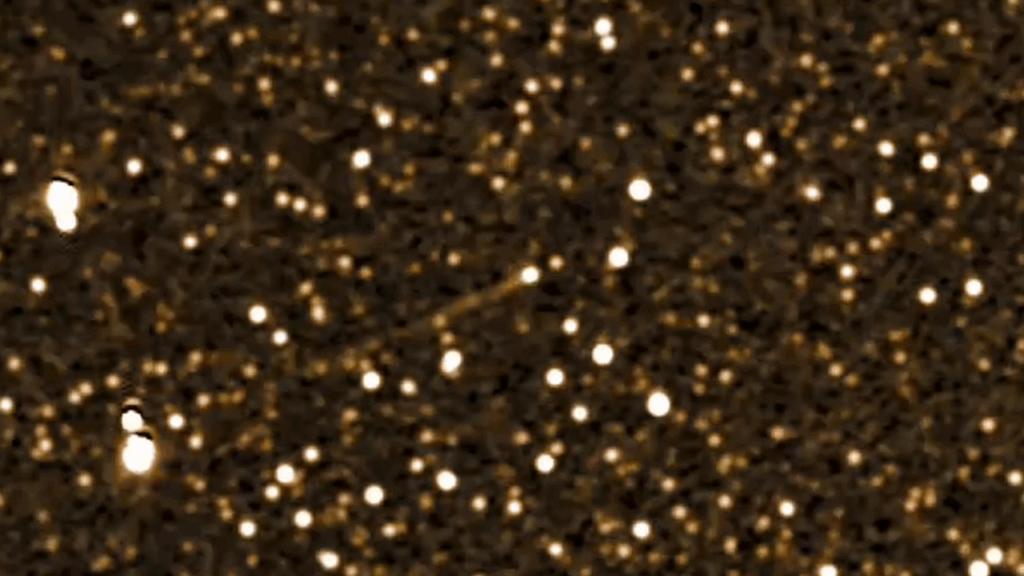
The unique capability of PUNCH to track faint objects over extended periods has allowed astronomers to observe Comet SWAN’s journey in unprecedented detail. By stitching together hundreds of images taken between August 25 and October 2, 2025, PUNCH created a seamless timelapse revealing the comet’s dynamic behavior as it moved against the backdrop of stars and planets. Such continuous monitoring is crucial to understanding transient space events that unfold over days or weeks.
Beyond comet tracking, PUNCH’s observations contribute to a holistic understanding of space weather. Solar wind streams, coronal mass ejections, and their interactions with objects in the solar system can impact satellites, astronauts, and Earth’s technological infrastructure. By providing multi-vantage observations, PUNCH enhances predictive models and helps safeguard space assets.
Discovery and Characteristics of Comet SWAN (C/2025 R2)
Comet SWAN was first identified in early September 2025 by Ukrainian amateur astronomer Vladimir Bezugly. He detected the comet as a bright, fuzzy blob near the sun while examining publicly available images from the Solar and Heliospheric Observatory (SOHO). This initial discovery quickly drew attention due to the comet’s brightness and proximity to the sun during its perihelion passage.
Comet SWAN’s perihelion occurred just one day after its discovery, at a distance of approximately 46.74 million miles (75.20 million kilometers) from the sun. As the comet approached the sun, solar radiation caused its ices to vaporize in a process called sublimation, creating a glowing coma of gas and dust that enveloped the nucleus. This activity also produced a distinct bluish-green coma, a signature caused by gaseous molecules fluorescing under solar ultraviolet radiation.
An intriguing feature of Comet SWAN was its unusual triangular 'hammerhead' shaped coma observed by mid-September. Astronomers believe this shape indicates a fragmenting nucleus, where multiple pieces release gas unevenly, stretching the normally round coma into an asymmetrical form. This fragmentation provides valuable clues about the comet’s internal structure and its response to solar heating.
The 40-Day Timelapse: Visualizing Comet SWAN’s Journey
The PUNCH spacecraft’s timelapse spans from late August to early October 2025, capturing Comet SWAN as it moves across the sky. The video sequences reveal the comet passing between Mars, visible as a bright object at the top of the frame, and the star Spica in the constellation Virgo at the bottom. This celestial backdrop helps contextualize the comet’s trajectory relative to well-known celestial landmarks.
Throughout the timelapse, the comet’s tail is seen pushed backward by the solar wind, giving the impression that Comet SWAN drifts 'backward' as it moves leftward. This tail, composed of gas and dust particles swept away by the charged particles streaming from the sun, acts as a natural tracer of solar wind dynamics. Watching these interactions offers scientists direct visual evidence of how solar wind shapes cometary environments.
The video is composed of hundreds of individual PUNCH images stitched together. Due to the preliminary processing of these images, faint black seams marking boundaries between frames remain visible, but they do not detract from the overall stunning visual narrative of the comet’s motion and evolution over more than a month.
A Rare Glimpse of Interstellar Visitor 3I/ATLAS
Adding to the timelapse’s significance is the fleeting appearance of 3I/ATLAS, a rare interstellar object that passed through our solar system around the same time. Unlike typical comets originating from the Kuiper Belt or Oort Cloud, 3I/ATLAS came from outside our solar system, offering a unique opportunity to study material formed around other stars.
In the PUNCH timelapse, 3I/ATLAS briefly crosses from left to right near the bottom of the frame beneath Comet SWAN towards the end of the sequence. Its movement is much faster, reflecting its hyperbolic trajectory and high velocity relative to the sun. Observing this visitor alongside a native comet provides a valuable comparative perspective on cometary physics and solar wind interactions.
3I/ATLAS’s detection and imaging by PUNCH add to the growing catalog of interstellar objects, which remain extremely rare and scientifically precious. Each observation helps scientists piece together the composition, structure, and origins of bodies formed in distant star systems and their interaction with our sun’s environment.
Scientific Insights from Comet SWAN and Solar Wind Interaction
Comet tails are natural indicators of solar wind conditions, as the charged particles streaming from the sun interact with the gas and dust emitted by comets. By tracking Comet SWAN’s tail morphology and movement, scientists gain real-time data on solar wind speed, density, and magnetic field orientation. This helps refine models of heliospheric conditions and space weather forecasting.
The unusual 'hammerhead' coma shape observed in Comet SWAN also provides evidence of nucleus fragmentation and complex outgassing behavior. Such fragmentation can influence comet brightness, tail formation, and the release of dust and gas particles, all of which impact the comet’s interaction with solar wind and radiation pressure.
Researchers use these observations to better understand how cometary materials respond to solar heating and space environment stresses. This knowledge enhances our understanding of comet evolution, solar wind dynamics, and the broader processes shaping the solar system.
Comet SWAN’s Close Approach and Visibility from Earth
Comet SWAN made its closest approach to Earth in late October 2025, coming within approximately 25.10 million miles (40.38 million kilometers). This proximity placed it near the threshold of naked-eye visibility, making it an exciting target for amateur astronomers and skywatchers equipped with binoculars or small telescopes.
The comet’s brightness and position near prominent celestial objects like Mars and Spica facilitated easy identification in the night sky. Observers reported seeing the comet’s glowing coma and streaming tail, especially during clear, dark conditions away from urban light pollution.
This close approach offered a rare opportunity to witness a dynamically evolving comet, providing not only a visual spectacle but also valuable observational data to complement spacecraft imagery. Such events help foster public interest in astronomy and highlight the ongoing discoveries enabled by space missions.
Implications for Future Space Weather Monitoring and Exploration
The PUNCH mission’s success in tracking Comet SWAN and capturing the interstellar visitor 3I/ATLAS demonstrates the power of continuous, multi-point observations in space weather monitoring. By understanding how solar wind interacts with various objects, scientists can better predict space weather events that might impact satellites, communication systems, and astronaut safety.
This detailed monitoring also aids in planning future missions that may encounter similar environments, ensuring spacecraft can withstand or avoid harmful solar wind conditions. Additionally, studying comet fragmentation and tail dynamics informs mission designs for potential comet rendezvous or sample-return missions.
As space exploration advances, missions like PUNCH will continue to provide critical data that bridges solar physics, planetary science, and interstellar studies, enriching our comprehension of the complex space environment surrounding Earth and the solar system.
Public Engagement and the Role of Amateur Astronomers
The discovery of Comet SWAN by amateur astronomer Vladimir Bezugly underscores the vital role that citizen scientists play in modern astronomy. With access to public space mission data and powerful image processing tools, amateurs can contribute significantly to identifying transient celestial phenomena.
Public engagement is further enhanced by the release of captivating imagery and timelapse videos from missions like PUNCH. These visuals inspire curiosity and support educational initiatives that promote STEM learning and awareness of space science.
Collaborations between professional scientists, space agencies, and the amateur community create a dynamic ecosystem for discovery. They ensure that no significant event goes unnoticed and that the broader public remains connected to the ongoing exploration of our cosmic neighborhood.
Conclusion
The remarkable 40-day timelapse of Comet SWAN captured by NASA’s PUNCH spacecraft marks a milestone in cometary science and space weather observation. By revealing the comet’s dynamic behavior, including its unusual coma shape and tail interactions with solar wind, the mission has deepened our understanding of how these icy bodies respond to solar forces. The serendipitous glimpse of interstellar visitor 3I/ATLAS adds a rare and valuable dimension to the data, bridging the study of our solar system with objects from beyond. These insights not only enrich scientific knowledge but also highlight the importance of continuous space monitoring and public involvement in astronomical discovery. As we continue to explore the cosmos, missions like PUNCH pave the way for safer, more informed space exploration and a greater appreciation of our place in the universe.
Originally reported by space.com. Adapted for our readers.
Recent advances in machine perfusion technology are not only preserving donated livers but also making them biologically younger at a molecular level. This breakthrough…
What happens when human imagination, artificial intelligence, art and technology come together? From September 1 to 6, Samsung Electronics presented a special exhibition themed…