
AI Trends & News
Surface Laptop Ultra Pre-orders Open: Price, Release Date and AI Features
Microsoft opens Surface Laptop Ultra pre-orders from US$2,599.99. Explore its launch date, NVIDIA RTX Spark features and implications for Nigerian businesses.
TAMFIS NIG LTDRC 8067447CAC ACTIVEFinima, Bonny Island, Rivers State

For over two decades, the International Space Station (ISS) has served as a unique laboratory enabling scientific experiments that are impossible to conduct on Earth. Among the many crucial roles supporting this frontier of research is the NASA Marshall Space Flight Center’s expert crew, who manage the intricate logistics of preparing, launching, and safely receiving scientific samples. This article delves into how the Marshall team ensures the integrity and success of experiments involving microgravity and space exposure, focusing on recent missions involving zinc selenide-based crystal growth studies. Their efforts exemplify the meticulous planning and technical expertise required to advance our understanding of material science and spaceflight phenomena.
NASA’s Marshall Space Flight Center in Huntsville, Alabama, plays a pivotal role in the lifecycle of scientific experiments conducted aboard the ISS. The center’s specialized teams oversee the preparation and integration of sample hardware, ensuring that experiments can withstand the stresses of launch, microgravity conditions, and re-entry to Earth. Their expertise guarantees that scientific samples remain uncontaminated and intact throughout these phases.
The process begins with close collaboration among engineers, scientists, and mission planners to design containers and hardware tailored to specific experiment needs. These teams handle everything from assembling sealed ampoules that house samples to conducting rigorous ground testing that simulates the harsh environment of space. This integration work is vital to the success of each mission and the reliability of experimental data.
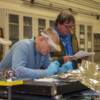
Marshall’s role extends beyond preparation. After samples complete their time aboard the ISS, the center is responsible for receiving and de-integrating the returned hardware. This phase involves careful documentation, photographic records, and handling by experienced technicians to preserve the samples’ condition for subsequent scientific analysis.
A recent focus at Marshall involved the de-integration of zinc selenide (ZnSe) crystal samples grown aboard the ISS. This experiment investigates how the absence of gravity influences the physical properties and structural integrity of these crystals, which are critical in applications such as optics and electronics. Understanding crystal growth in microgravity can lead to advancements in material science and manufacturing.
The experiment utilized six sample cartridge assemblies, each containing sealed ampoules heated to temperatures as high as 1,200 degrees Celsius inside the Materials Science Laboratory furnace on the ISS. This precise thermal environment allowed scientists to observe crystal formation without the interference of Earth’s gravity-driven convection currents, potentially leading to purer and more uniformly structured crystals.
By studying these crystals after their return, researchers hope to uncover new insights into material behaviors that could revolutionize technologies ranging from laser systems to semiconductor devices. The zinc selenide crystal experiment exemplifies how microgravity research can impact practical applications on Earth.
The Instrument Construction, Integration, and Test Branch at Marshall is instrumental in readying experimental hardware for spaceflight. Lead systems test engineer John Luke Bili and his team coordinate closely with scientists and mission personnel to assemble and validate sample cartridge assemblies before launch. Their responsibilities include meticulous sealing of ampoules and verification of thermal and mechanical tolerances.
To simulate the extreme conditions of the space environment, the team employs ground-based furnace replicas that replicate the temperatures and stresses the samples will experience aboard the ISS. This testing ensures that hardware can endure the rigors of launch, microgravity operation, and re-entry without compromising sample integrity.
Such rigorous procedures minimize the risk of hardware failure and maximize the scientific return of each mission. The collaboration between engineers and researchers at this stage is essential to tailoring solutions that meet the unique demands of space experimentation.
Following preparation, the sample cartridge assemblies undergo a carefully orchestrated journey to their launch sites. After final packaging at NASA’s Johnson Space Center in Houston, the samples are transported to Kennedy Space Center in Florida, where they are integrated into commercial resupply vehicles such as SpaceX’s Dragon and Northrop Grumman’s Cygnus spacecraft.
The zinc selenide crystal assemblies launched aboard SpaceX’s 24th Commercial Resupply Services mission in December 2021 and Northrop Grumman’s 19th mission in August 2023. Each assembly spent approximately a week inside the ISS Materials Science Laboratory furnace, undergoing the controlled heating process necessary for crystal growth.
Coordinating these logistics requires precise timing and adherence to handling protocols to maintain sample conditions. The Marshall team’s experience ensures smooth transitions between facilities and missions, supporting continuity and reliability in space-based research.
The success of sample handling operations at Marshall is underpinned by a workforce with decades of specialized experience. Technicians and engineers involved in de-integration and testing bring 20 to 30 years of expertise, offering invaluable knowledge in machining, hardware integration, and technical tolerances.
This depth of skill allows the team to rapidly address challenges and implement mitigation strategies during all phases of hardware processing. Their proficiency ensures that delicate spaceflight hardware is treated with the utmost care, preserving the scientific value of returned experiments.
The collaborative environment at Marshall fosters continuous knowledge sharing and innovation, enabling the center to maintain leadership in spaceflight hardware management and support groundbreaking research aboard the ISS.
The ISS has served as a critical platform for microgravity research for over 25 years, hosting more than 3,000 experiments that have expanded scientific understanding across numerous disciplines. Its unique environment allows researchers to study phenomena without Earth’s gravitational influence, revealing insights impossible to obtain otherwise.
Experiments like the zinc selenide crystal growth contribute to knowledge that enhances material science, biology, physics, and engineering. These findings have practical implications for industries including pharmaceuticals, manufacturing, and telecommunications.
Moreover, the ISS acts as a proving ground for technologies and procedures essential for the future of long-duration space exploration. The work conducted aboard informs NASA’s strategies for missions to the Moon, Mars, and beyond, underscoring the station’s vital role in advancing human spaceflight.
As commercial partnerships expand and NASA continues to develop the Gateway lunar outpost, the opportunities for conducting sophisticated experiments in space are growing. Facilities like Marshall will remain central to preparing and managing the complex logistics of these endeavors.
Advancements in automated sample handling, remote monitoring, and materials processing are expected to increase the efficiency and scope of space science. These innovations will enable more frequent and diverse experiments, accelerating discovery.
The continued collaboration between NASA centers, commercial providers, and the scientific community promises to unlock new frontiers in space research, driving technological progress and deepening our understanding of the universe.
The NASA Marshall Space Flight Center’s dedicated crew exemplifies the meticulous care and technical expertise necessary to support pioneering scientific research aboard the International Space Station. By expertly managing every phase—from hardware assembly and testing to launch integration and sample recovery—they ensure that experiments like the zinc selenide crystal growth study can thrive in the microgravity environment. These efforts not only advance our understanding of fundamental science but also lay the groundwork for future exploration and commercial opportunities in space. As NASA and its partners look ahead to new missions and technologies, Marshall’s role will remain indispensable in turning ambitious scientific goals into reality.
Originally reported by nasa.gov. Adapted for our readers.
Keep reading
AI Trends & News
Microsoft opens Surface Laptop Ultra pre-orders from US$2,599.99. Explore its launch date, NVIDIA RTX Spark features and implications for Nigerian businesses.
Science & Technology
DJI’s IBC recognition puts pocket gimbal and panoramic capture in the spotlight. Here is how creators can assess framing, editing effort and recording workflows.
Business News
App store steering is about more than permission to add a link. Explore fees, renewal terms, customer experience and the UK consultation.
TAMFIS NIG LTD
Electrical and instrumentation engineering, bid preparation and consulting, IT and software.

