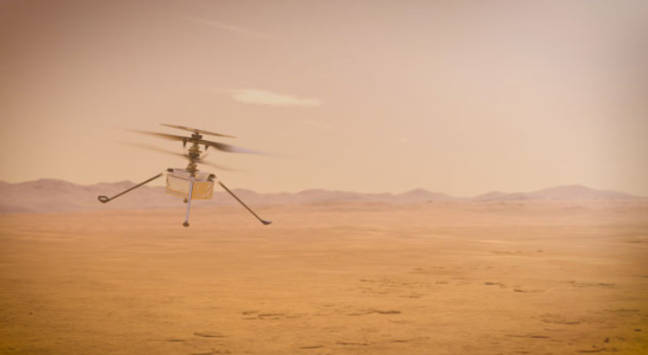
Ingenuity helicopter’s flying days cut short by featureless Martian terrain
NASA's Ingenuity helicopter has captivated the world since its historic first flight on Mars in April 2021. Originally designed for just five test flights, this small rotorcraft surpassed expectations by completing 72 flights, demonstrating the potential for powered flight on another planet. However, Ingenuity’s flying career came to a sudden halt earlier this year, triggered by the unique challenges posed by Mars’ stark and featureless landscape. This article delves into the factors that led to Ingenuity’s premature grounding, the technical aspects behind its navigation difficulties, and what this means for the future of Martian aerial exploration.
The Historic Mission and Ingenuity’s Design
Ingenuity was developed as a technology demonstration to prove that powered, controlled flight is possible in Mars’ thin atmosphere, which is less than 1% the density of Earth's. Weighing just 1.8 kilograms (4 pounds), the helicopter was equipped with lightweight materials, solar panels for power, and state-of-the-art avionics. Its compact design incorporated off-the-shelf cellphone processors, a bold choice that paved the way for affordable and adaptable spaceflight technology.
The helicopter was carried to Mars attached to the Perseverance rover, which safely delivered it to the Jezero Crater. From there, Ingenuity embarked on a series of flights that exceeded all expectations, showcasing agility, stability, and autonomous navigation capabilities. Its success opened new avenues for aerial reconnaissance and scientific exploration on Mars, inspiring plans for larger, more capable rotorcraft in the future.
Despite its small size, Ingenuity faced formidable challenges. Mars’ low air density demanded rotor blades spinning at approximately 2,400 rotations per minute, much faster than helicopters on Earth. The helicopter’s navigation system relied heavily on its downward-facing camera to identify surface features and track movement, a system well-suited for textured terrain but vulnerable in featureless environments.
The Abrupt End: Flight 72 and Its Challenges
Ingenuity’s final flight, Flight 72, was intended to be another routine operation, but it quickly turned problematic. About 20 seconds after takeoff, the helicopter’s navigation system lost the ability to detect enough surface features to maintain stable flight. This was due to the featureless, steep sand ripples in the landing area, which lacked the textured patterns necessary for the camera-based navigation system to function properly.
Telemetry data revealed that Ingenuity’s navigation errors led to high horizontal velocities upon touchdown. The helicopter likely made a hard landing on a slope, causing excessive stress on the rotor blades. All four blades snapped at their weakest points due to the sudden pitch and roll, and one blade was completely detached. This catastrophic damage induced vibrations that further compromised the rotor system and caused the helicopter to lose communications with the Perseverance rover.
The loss of communication and physical damage confirmed that Ingenuity would not be able to fly again. NASA engineers had to accept that the helicopter’s remarkable mission had come to an unexpected conclusion, underscoring the challenges of operating autonomous flying vehicles in an alien and unpredictable environment.
Understanding the Role of Martian Terrain in Ingenuity’s Demise
Mars’ surface is vastly different from Earth’s, with wide expanses of barren, featureless sand and rock. Ingenuity’s navigation system was optimized for flat, textured terrain, where the downward-facing camera could easily identify landmarks and track movement. The steep, smooth sand ripples where Flight 72 took place provided insufficient visual cues, causing the navigation algorithms to lose track of the helicopter’s position.
The absence of distinguishable features meant that the helicopter’s inertial measurement unit had to compensate for the lost visual data. However, this compensation was insufficient to maintain stable flight, especially on a slope where gravitational forces and wind conditions added complexity. The combination of these factors culminated in the hard landing and rotor blade damage that ended Ingenuity’s flying days.
This scenario highlights the importance of terrain analysis and adaptive navigation systems for future Martian aircraft. Engineers must consider the diversity of Martian landscapes and develop technologies capable of handling feature-poor environments to ensure mission safety and success.
Telemetry and the Challenges of Remote Flight Investigation
Investigating what happened during Ingenuity’s final moments posed unique challenges. Unlike terrestrial crashes, NASA engineers had no physical access to the helicopter or the ability to deploy investigative tools on-site. There were no ‘black boxes’ or witnesses, so the team relied entirely on telemetry data transmitted from millions of kilometers away to reconstruct the incident.
Telemetry included detailed sensor readings, navigation data, rotor speeds, and communication logs. Analyzing this data allowed engineers to piece together the sequence of events leading to the hard landing and rotor blade failure. Despite the distance and limitations, this remote investigation provided critical insights into the helicopter’s operational environment and failure modes.
This experience underscores the complexity of conducting failure analysis on extraterrestrial vehicles and the importance of robust data collection systems. It also emphasizes the need for designing spacecraft with comprehensive telemetry capabilities to enable detailed diagnostics in future missions.
Ingenuity’s Legacy: Pushing the Boundaries of Spaceflight
Although Ingenuity’s flying days have ended, its legacy is profound. The helicopter proved that powered flight on Mars is feasible, setting a precedent for future aerial explorers. Its extended mission, completing 72 flights instead of the planned five, demonstrated remarkable durability and adaptability in a harsh environment, inspiring confidence in the use of commercial off-the-shelf components in deep space missions.
Project manager Teddy Tzanetos highlighted how Ingenuity’s success challenges traditional assumptions about spacecraft design, showing that smaller, lighter, and less radiation-hardened hardware can perform effectively on Mars. This breakthrough paves the way for more cost-effective and innovative approaches to planetary exploration.
Ingenuity also provided valuable data on Martian weather and atmospheric conditions, contributing to scientific knowledge beyond its primary flight demonstration mission. Its continued operation as a stationary sensor platform after Flight 72 further exemplifies its versatility and the ingenuity of the NASA team.
Future Prospects: The Next Generation of Martian Rotorcraft
Inspired by Ingenuity’s achievements, NASA and its partners are already planning the next generation of Martian rotorcraft. These future vehicles are expected to be significantly larger and more capable, designed to carry scientific payloads and operate autonomously over longer distances and durations.
One such concept is the Mars Chopper, which would be approximately 20 times heavier than Ingenuity and capable of traveling up to two miles in a single day. This rotorcraft would enable detailed aerial surveys, sample collection, and support for rover missions, greatly expanding the scope of Martian exploration.
Advances in navigation technology, including improved terrain recognition and adaptive flight control systems, are being developed to prevent navigation failures like those that grounded Ingenuity. These innovations will help ensure safer, more reliable flight operations even in challenging and featureless Martian landscapes.
Lessons Learned and the Importance of Terrain-Adaptive Navigation
Ingenuity’s final flight highlighted critical lessons about the importance of terrain-adaptive navigation systems for extraterrestrial aerial vehicles. The reliance on visual features for navigation proved vulnerable in featureless environments, underscoring the need for multi-modal sensor fusion that can integrate inertial, visual, and possibly radar or lidar data.
Future rotorcraft designs will benefit from these insights by incorporating more robust navigation algorithms capable of dynamically adjusting to varying terrain types and environmental conditions. This adaptability will be essential for ensuring flight stability and mission success on Mars and other planetary bodies.
Additionally, Ingenuity’s experience emphasizes the necessity of thorough terrain mapping and selection of safe flight zones during mission planning. Understanding the surface characteristics in detail can prevent operational risks and maximize the effectiveness of aerial exploration.
Ingenuity’s Impact on Mars Exploration and Beyond
Ingenuity’s pioneering flights have transformed the way scientists and engineers approach planetary exploration. By proving that powered, controlled flight is achievable on Mars, the helicopter has opened new possibilities for accessing regions that rovers cannot reach, such as cliffs, caves, and other difficult terrains.
The data and experience gained from Ingenuity’s mission will inform the design of future missions not only to Mars but also to other celestial bodies with atmospheres, such as Titan, Saturn’s largest moon. Aerial vehicles could become invaluable tools for planetary science, enabling rapid surveys and detailed investigations.
Ultimately, Ingenuity serves as a symbol of human ingenuity and perseverance, showcasing how innovative technologies can overcome extraterrestrial challenges and expand the horizons of space exploration for generations to come.
Conclusion
NASA’s Ingenuity helicopter has left an indelible mark on the history of space exploration. Though its flying days were cut short by the featureless Martian terrain that challenged its navigation systems, the mission’s success and longevity far exceeded initial expectations. Ingenuity has provided invaluable lessons in engineering, remote flight operations, and terrain adaptation that will guide future aerial explorers on Mars and other worlds. As NASA and its partners develop the next generation of rotorcraft, Ingenuity’s pioneering spirit will continue to inspire innovation, pushing the boundaries of what is possible in extraterrestrial aviation.
Recent advances in machine perfusion technology are not only preserving donated livers but also making them biologically younger at a molecular level. This breakthrough…
What happens when human imagination, artificial intelligence, art and technology come together? From September 1 to 6, Samsung Electronics presented a special exhibition themed…