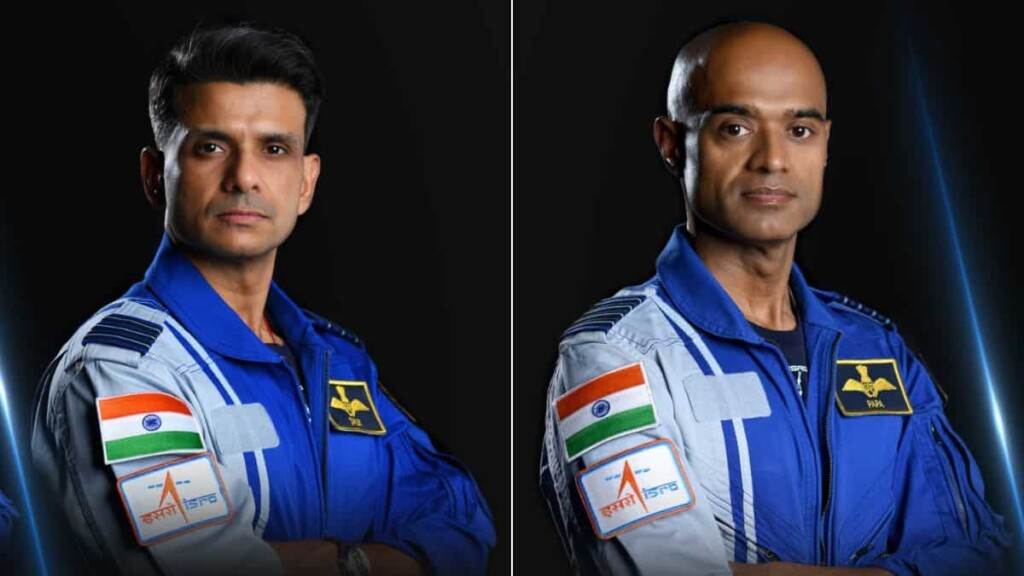
Indian astronauts Group Captain Shubhanshu Shukla, Prashant Nair chosen to train at NASA
India's human spaceflight program has reached a pivotal milestone with the selection of Group Captain Shubhanshu Shukla as the primary astronaut and Group Captain Prashant Balakrishnan Nair as the backup candidate for an upcoming mission to the International Space Station (ISS). Both officers, seasoned test pilots from the Indian Air Force, will undergo intensive training at NASA's Johnson Space Center in Houston, Texas. This collaboration marks a significant step in India's expanding space ambitions, blending indigenous expertise with international cooperation. The mission, supported by ISRO's agreement with Axiom Space Inc., aims to send an Indian astronaut to the ISS aboard a SpaceX Falcon 9 rocket, symbolizing a new era in India's space exploration endeavors.
Background of Indian Astronauts Shubhanshu Shukla and Prashant Nair
Group Captain Shubhanshu Shukla and Group Captain Prashant Balakrishnan Nair are accomplished test pilots in the Indian Air Force with extensive experience in aviation and aerospace technologies. Their rigorous selection process involved assessing their physical fitness, technical knowledge, and adaptability to extreme environments, making them ideal candidates for space missions.
Both officers have undergone preliminary astronaut training through India's Gaganyaan program, which prepares astronauts for human spaceflight. Their roles as primary and backup astronauts demonstrate ISRO's confidence in their abilities to represent India in an international space mission.
Their selection also reflects a growing trend of military test pilots transitioning into astronaut roles worldwide, given their disciplined training and ability to operate complex machinery under pressure. This background equips them well for the challenges of space travel and scientific experimentation aboard the ISS.
Details of the NASA Training Program at Johnson Space Center
The NASA training program at the Johnson Space Center is a comprehensive curriculum designed to prepare astronauts for missions aboard the International Space Station. It covers spacecraft systems, extravehicular activities (spacewalks), robotics, scientific research protocols, and emergency procedures.
Shukla and Nair will undergo simulations replicating the microgravity environment of space, including underwater training to mimic the conditions of spacewalks. They will also learn to operate the SpaceX Crew Dragon spacecraft, which has been selected for this mission.
The training includes collaboration with international astronauts and experts, fostering teamwork and cross-cultural communication essential for the multinational environment aboard the ISS. This exposure will enhance their operational readiness and scientific competence for their mission.
India's Partnership with NASA and Axiom Space
India's Human Spaceflight Centre (HSFC) under ISRO recently formalized a Spaceflight Agreement with Axiom Space Inc., a private American company facilitating commercial space missions. Axiom Space has been designated by NASA to manage astronaut flights aboard the SpaceX Falcon 9 rocket.
This partnership enables India to leverage NASA's expertise and infrastructure for astronaut training and spaceflight logistics while utilizing Axiom's commercial spaceflight services. It represents a strategic collaboration blending public and private sector strengths.
The agreement also marks a shift towards commercial spaceflight accessibility for countries like India, accelerating their human spaceflight ambitions without the need for entirely indigenous launch vehicles or infrastructure.
Understanding the Gaganyaan Program and India's Human Spaceflight Goals
Launched in 2018 by Prime Minister Narendra Modi, the Gaganyaan program represents India's first indigenous human spaceflight initiative. It aims to send Indian astronauts to low Earth orbit aboard an Indian crewed spacecraft and return them safely to Earth.
The program involves developing crew modules, life support systems, and ground infrastructure, with collaborative inputs from international partners. It is a stepping stone towards establishing India's sustained presence in space.
Beyond Gaganyaan, India envisions establishing an uncrewed space station by the end of this decade and a crewed orbital outpost by 2035. Ambitious plans also include lunar missions with astronauts by 2040, positioning India as a major player in global space exploration.
Historical Context: India's Journey in Human Spaceflight
India's human spaceflight journey began in 1984 when Wing Commander Rakesh Sharma became the first Indian to travel to space aboard the Soviet Soyuz T-11 spacecraft. This historic mission was part of the Soviet Interkosmos program, symbolizing early international cooperation in space.
Since then, India has made significant strides in space science and technology, culminating in the development of the Gaganyaan program. The current mission represents a continuation of this legacy, combining indigenous capabilities with international partnerships.
The upcoming NASA training and SpaceX flight signify the second time an Indian astronaut will venture into space, but this time under a US-led mission, reflecting India's evolving geopolitical and technological collaborations.
The Role of the Multilateral Crew Operations Panel (MCOP)
The Multilateral Crew Operations Panel (MCOP) is an international body responsible for selecting astronaut crew members for missions aboard the ISS. It evaluates candidates based on physical health, training progress, and mission requirements.
In this mission, MCOP will finalize which of the two Indian astronauts, Group Captain Shubhanshu Shukla or Group Captain Prashant Nair, will fly to the ISS as the primary crew member. This decision will follow rigorous assessments and training outcomes.
MCOP's involvement ensures that astronaut selection aligns with international standards for safety and mission success, highlighting the collaborative nature of modern space exploration.
Scientific Research and Experiments Planned on the ISS
During the mission, the selected Indian astronaut will conduct a series of scientific experiments and technology demonstrations aboard the ISS. These experiments will focus on areas such as microgravity effects on biological systems, material sciences, and space technology applications.
The research aims to contribute to global scientific knowledge and support India's space technology development. It also provides an opportunity for Indian scientists and engineers to engage in cutting-edge space research.
This hands-on experience in space science will bolster India's capabilities in designing future experiments and missions, laying the groundwork for more advanced human spaceflight endeavors.
Future Prospects for Indian Astronauts and Space Exploration
The training and upcoming mission of Group Captains Shukla and Nair symbolize a new chapter in India's human spaceflight aspirations. Success here could lead to more frequent Indian astronaut missions, both aboard international platforms and indigenous spacecraft.
India's long-term vision includes establishing a permanent presence in orbit, lunar exploration, and potentially interplanetary missions. Developing a cadre of trained astronauts is critical to achieving these goals.
Continued collaboration with global space agencies and private companies will enable India to accelerate its space exploration timeline, inspiring a new generation of scientists, engineers, and explorers.
Conclusion
The selection of Group Captain Shubhanshu Shukla and Group Captain Prashant Balakrishnan Nair for training at NASA signifies a historic moment for India's space ambitions. Their journey from Indian Air Force test pilots to astronauts trained at one of the world's premier space centers embodies India's growing stature in global space exploration. Supported by strategic partnerships with NASA and Axiom Space, this mission not only paves the way for India's second human spaceflight but also strengthens its roadmap towards sustained human presence in space. As these astronauts prepare to contribute to scientific research aboard the ISS, they carry the aspirations of millions, heralding a new era of Indian excellence beyond Earth.
Originally reported by wionews.com. Adapted for our readers.
Recent advances in machine perfusion technology are not only preserving donated livers but also making them biologically younger at a molecular level. This breakthrough…
What happens when human imagination, artificial intelligence, art and technology come together? From September 1 to 6, Samsung Electronics presented a special exhibition themed…