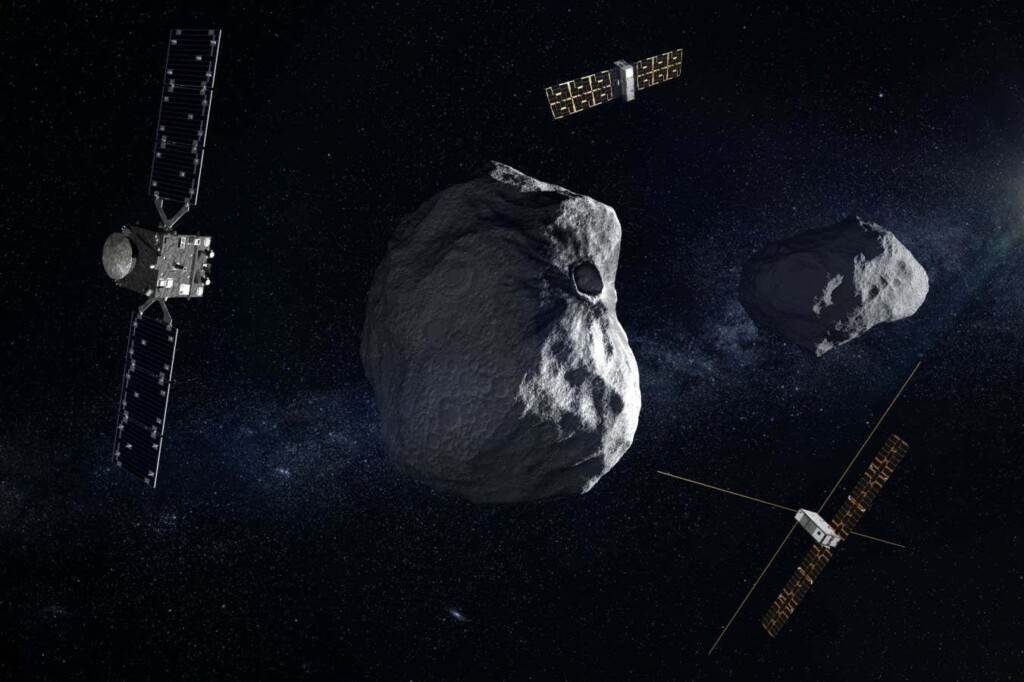
Hera mission set to revisit asteroid after NASA’s redirection test
The threat of potentially hazardous asteroids has long been a concern for planetary defense experts. In 2022, NASA's Double Asteroid Redirection Test (DART) successfully altered the orbit of Dimorphos, a small asteroid moon orbiting Didymos, by intentionally crashing into it at high velocity. Building on this success, the European Space Agency (ESA) is preparing to launch the Hera mission to closely examine the aftermath of DART’s impact. Hera’s comprehensive survey of Dimorphos will provide unprecedented data on asteroid composition, structure, and the effectiveness of kinetic impactor techniques, refining strategies to protect Earth from future asteroid threats.
Background: NASA's DART Mission and Its Historic Impact
In September 2022, NASA's Double Asteroid Redirection Test (DART) spacecraft collided with the asteroid Dimorphos at a speed of 6.6 kilometers per second. This kinetic impactor mission was designed to demonstrate the feasibility of altering the trajectory of an asteroid on a collision course with Earth. By impacting Dimorphos, a small moon orbiting the larger asteroid Didymos, DART aimed to change the moonlet’s orbit around its parent asteroid.
Following the impact, ground-based telescopes and radar observations confirmed that Dimorphos’ orbital period around Didymos had shortened significantly. This success marked the first-ever demonstration of asteroid deflection, proving that kinetic impactors could be a viable planetary defense tool. However, many questions remained about the detailed effects of the collision on the asteroid’s surface and internal structure.
The DART mission was a pivotal milestone, but it was only the first step in developing a comprehensive planetary defense system. To fully understand how to protect Earth from potentially hazardous asteroids, scientists require detailed data on how asteroid materials respond to high-velocity impacts, which led to the conception of ESA’s Hera mission.
ESA's Hera Mission: Objectives and Launch Plans
The European Space Agency’s Hera mission is designed to follow up on NASA’s DART impact by conducting a detailed survey of the Dimorphos asteroid system. Hera will launch from Cape Canaveral aboard a SpaceX Falcon 9 rocket, with a planned launch date in October 2024. The spacecraft, roughly the size of a small car and weighing 1081 kilograms fully fueled, will undertake a multi-year journey to reach Dimorphos by October 2026.
During its transit, Hera will execute a flyby of Mars in March 2025 to gain gravitational assistance, optimizing its trajectory toward the Didymos-Dimorphos system. Once it arrives, Hera will perform an extensive characterization of the asteroid pair, mapping their surfaces and assessing the impact crater created by DART, as well as measuring the mass and density of Dimorphos.
Hera’s mission is crucial in filling knowledge gaps left by Earth-based observations. Unlike telescopes, Hera can provide close-range, high-resolution data on the asteroid’s topography, composition, and internal structure, enabling scientists to refine asteroid deflection models and improve future planetary defense missions.
Advanced Instrumentation: Hera’s Suite of Scientific Tools
Equipped with state-of-the-art instruments, Hera will deploy a comprehensive toolkit to analyze Dimorphos in unprecedented detail. Its payload includes thermal and hyperspectral cameras, which will capture surface temperature variations and mineral compositions, revealing the asteroid’s material diversity and geologic history.
In addition, Hera carries LIDAR (Light Detection and Ranging) and radar systems to generate precise three-dimensional maps of the asteroid’s shape and surface features. These instruments will help scientists determine the asteroid’s mass distribution and internal structure, critical for understanding how the kinetic impact altered the asteroid’s orbit and physical properties.
Beyond Hera itself, the mission includes two CubeSats—Juventas and Milani—that will conduct close-proximity flybys and eventual landings on Dimorphos. These miniature satellites will gather complementary data, such as gravitational field measurements and surface composition, providing a multi-faceted perspective on the asteroid system.
The Role of CubeSats Juventas and Milani in the Hera Mission
Juventas and Milani are two small, innovative CubeSats hitching a ride with Hera to the Didymos-Dimorphos system. These compact satellites will undertake unique roles to enhance the mission’s scientific return. Unlike Hera, which will orbit the asteroid, the CubeSats will perform close flybys and eventually attempt to land on Dimorphos, navigating increasingly risky trajectories.
Juventas is equipped with a radar system designed to probe the asteroid’s interior. By measuring how radar waves travel through Dimorphos, Juventas aims to reveal the asteroid’s internal layering and porosity, providing insights into its structural integrity and response to the DART impact.
Milani carries hyperspectral imaging instruments to study the asteroid’s surface composition and mineralogy. By analyzing reflected light across different wavelengths, Milani will help identify the materials present on Dimorphos and assess how the impact may have altered the surface chemistry and texture.
Scientific and Planetary Defense Implications of Hera’s Findings
Hera’s detailed exploration of Dimorphos will significantly advance scientific understanding of binary asteroids and their physical properties. Dimorphos is the smallest asteroid ever studied in such detail, and its binary nature presents a unique opportunity to investigate gravitational interactions and orbital dynamics within asteroid pairs.
The mission’s data will be invaluable for refining kinetic impactor techniques used in planetary defense. By analyzing the crater size, ejecta distribution, and changes in asteroid momentum, researchers can develop more accurate models to predict outcomes of future deflection attempts on different asteroid types.
Additionally, Hera will help assess the diversity of asteroid compositions and structures, which is essential since asteroid materials vary widely. Understanding these variations will improve risk assessments and inform the design of tailored mitigation strategies for different threat scenarios.
Challenges and Future Directions in Planetary Defense
Despite the success of DART and the promise of Hera, planetary defense remains a complex and evolving field. One major challenge is the limited warning time often available before a potential asteroid impact, underscoring the need for improved detection and tracking systems to identify threats decades or even centuries in advance.
Another difficulty lies in the heterogeneity of asteroids. Their varied sizes, shapes, compositions, and spin states mean that a single deflection method may not be universally effective. Missions like Hera are critical for expanding our knowledge base and developing adaptable strategies for different asteroid types.
Looking ahead, international collaboration will be essential in building a robust planetary defense infrastructure. Combining data from multiple space agencies, ground-based observatories, and future missions will enhance global preparedness and response capabilities against asteroid threats.
Expert Perspectives on Hera and Planetary Defense
Scientists involved with the Hera mission emphasize its foundational role in establishing an effective planetary defense framework. Diego Escorial Olmos of ESA highlights that the combination of DART and Hera provides a practical demonstration of asteroid deflection physics and the potential to scale up such efforts for larger threats.
Alan Fitzsimmons from Queen’s University Belfast notes that Hera will not only improve defense strategies but also contribute significantly to asteroid science by providing detailed data on a binary system and the smallest asteroid ever studied in depth. This dual benefit exemplifies how planetary defense missions can also drive fundamental research.
Chrysa Avdellidou of the University of Leicester stresses the need for continued exploration and data collection to build reliable defense systems. She points out that asteroid materials and surface properties vary widely, and understanding this diversity is key to designing effective impactor missions and predicting their outcomes.
Conclusion: Hera’s Crucial Role in Safeguarding Earth
The Hera mission represents a critical step forward in humanity’s efforts to defend Earth from asteroid impacts. By closely studying the consequences of NASA’s DART impact on Dimorphos, Hera will provide essential data to refine deflection techniques and deepen scientific understanding of asteroid characteristics.
Its advanced instrumentation, combined with the innovative CubeSats Juventas and Milani, will yield a comprehensive picture of the asteroid’s physical state, internal structure, and response to kinetic impacts. This knowledge is vital for preparing effective, targeted planetary defense strategies for future threats.
As Hera embarks on its journey to Dimorphos, its findings will help shape the future of asteroid threat mitigation, ensuring that the lessons learned from DART translate into practical, scalable solutions to protect our planet from potential cosmic hazards.
Conclusion
The Hera mission is set to revolutionize our approach to planetary defense by providing unparalleled insights into the aftermath of NASA’s DART impact on Dimorphos. Its comprehensive scientific investigation will not only enhance asteroid science but also strengthen the foundation for future asteroid deflection efforts. As threats from near-Earth objects persist, Hera’s data and technological advancements will be instrumental in safeguarding our planet, marking a new era of proactive and informed asteroid hazard mitigation.
Originally reported by newscientist.com. Adapted for our readers.
Recent advances in machine perfusion technology are not only preserving donated livers but also making them biologically younger at a molecular level. This breakthrough…
What happens when human imagination, artificial intelligence, art and technology come together? From September 1 to 6, Samsung Electronics presented a special exhibition themed…