The skill storage market will grow sixfold over the next twenty years but will change radically in both needs and technologies. What role will zinc technology play in all this? What are the opportunities for those developing high-value materials and manufacturing and using the devices themselves? Rechargeable versions will be paramount, and the successful materials and capabilities have been established from a deep review of the research pipeline, expert opinions, and fundamentals. Uniquely, the solutions are in the new report, “
Zinc-Based Storage: Zn-ion Batteries, Zn Redox Flow Batteries, Zn-ion Supercapacitors, Zn-air Rechargeable Batteries: Technology, Markets 2024-2044“. Critically, it analyses the flood of recent research, particularly in 2024. It aligns this carefully with what is needed, finding that research must be redirected to include several parameters critical to commercialisation, several of which may not even be measured. These gaps are your opportunities.
The 34 page Executive Abstract and Conclusions is self-ample for those with restricted time as it offers unique infograms, conclusions and roadmaps and there are extra pages with 64 lines of forecasts 2024-2044 every with graphs, tables and explanations. Survey how the four zinc applied sciences will veil lengthy duration energy storage LDES for grids correct across to pulses for electromagnetic weapons and thermonuclear energy. Be taught the a success materials for the $20 billion tool change emerging.
Chapter 2 “Overview of energy storage” provides the big picture in 32 pages. This includes LDES and the diagram showing zinc batteries pivoting from success as small disposables to becoming the leading replacement for large rechargeable versions in the future. Learn realistic evaluation targets for the many forms of zinc-based rechargeable energy storage 2024-2044.
Chapter 3. “Causes for the utilization of zinc in batteries and their variants” takes 44 pages to account for the relevant requirements. Survey the needs including multifunctional “super” zinc storage and the realities in contrast with theoretical efficiency. Here is a statistical evaluation of 2024, 2023 research on rechargeable zinc-ion batteries and the pioneering activity of Eos Energy Enterprises USA, Enzinc USA, Gelion Australia and City Electrical Energy USA despite much of the research being conducted in China.
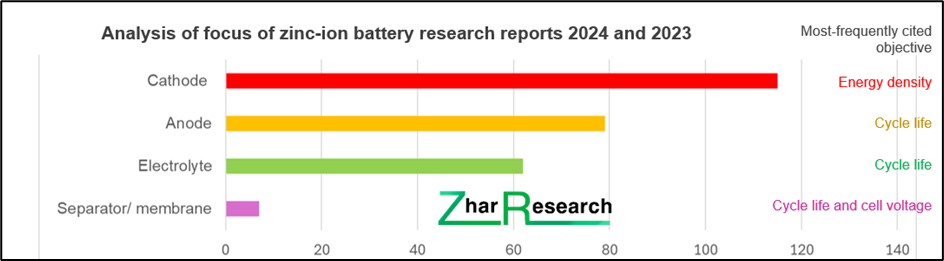
Because zinc-ion batteries ZIB have the ideal potential, the next four chapters examine development with the four key facets—anodes, cathodes, electrolytes and separators—while recognizing that they need to be improved in a coordinated manner. Currently, this entails most research being on cathodes, mainly aimed at increasing energy density, then anodes, the availability of inadequate life, then electrolytes and—less of a concern—separators/membranes. We fully show how this is an over-simplification and, throughout, there are detailed summaries of the most recent research and references for further reading enabling you to go as deep as you want. Although these chapters are oriented toward the major zinc-ion replacement, these same chemistries and materials advances are improving the other forms of zinc-based storage covered later.
Chapter 4 therefore takes forty eight pages for “Zinc-ion anode evaluate development 2024, 2023” introducing the disorders and approaches with anode, electrolyte and separator improvement coordinated. There is a top level belief of development 2019-2024, statistical evaluation of ZIB anode evaluate papers in 2024, 2023 revealing a success materials after which detailed appraisal of Zn-ion anode evaluate 2024, 2023. That spans suppressing Zn pulverisation, stopping dendrites and other degradation and anodes for zinc rechargeable microbatteries.
Chapter 5 on the cathodes is 94 pages because so much is covered here. Which compounds are successful and in what form? Detailed evaluation against what is wanted in the market? It is all here. Survey statistical analysis of ZIB cathode research papers in 2024, 2023 revealing successful materials, detailed appraisal of Zn-ion cathode research 2024, 2023. Specific sections show the role of specifically known vanadium, manganese and molybdenum compounds and other organic and inorganic materials.
Chapter 6. “Zinc-ion electrolyte evaluation development 2024, 2023” (46 pages) explains why hydrogels are trending here and solid electrolytes will open up unique markets. Meanwhile, electrolyte components are mostly an efficient system for overcoming anode and cathode shortcomings and enabling essentially the most traditional aqueous electrolytes to function at low temperatures. Which ones, how, what outcomes?
Chapter 7. Zinc-ion separator membrane evaluation development 2024, 2023 requires 10 pages of compact unique infographics and graphs and detailed evaluation analysis to show how zinc-ion battery separators will range from none to traditional glass fiber, refined ion-exchange polymer specifically for the redox flow variant and zinc-ion versions with advanced coatings addressing shortcomings of anodes and cathodes. The following three chapters specifically tackle the remaining three zinc technologies that expand the addressable markets for rechargeable storage in entirely new directions – zinc-ion capacitors, zinc redox flow batteries and zinc-air batteries.
Chapter 8. “Zinc-ion battery-supercapacitor hybrids: zinc-ion capacitors ZIC” (40 pages) introduces supercapacitors and their variants with a SWOT analysis. The zinc replacement lies in the battery-supercapacitor variant where lithium-ion capacitors LIC promise to outsell supercapacitors as they are adopted in mining, faster trains, nuclear energy and electromagnetic weapons. As with ion-batteries, losing the lithium saves cost however sodium versions are better than zinc in both cases, with zinc presumably offering the safest versions of all and additional benefits noted here. Survey the statistical analysis of research on zinc-based hybrid supercapacitors ZIC 2024, 2023 pointing to winners, and the detailed analysis of research papers 2024, 2023. Why is there more research on ZIC than the sodium equivalent? That does not match the situation with ion-batteries.
The 49 pages of Chapter 9. “Zinc redox shuffle batteries” is particularly intensive because many kinds are already being commercialised, in particular hybrids of RFB and worn solid electrode batteries. They are eagerly sought for the rapidly-rising lengthy duration storage for grid and in particular beyond-grid stationary storage batteries. How are zinc-bromine, zinc-iodine, zinc-iron, zinc- manganese and zinc-vanadium shaping up in opposition to incumbents vanadium after which iron RFB? What change opportunities come from the detailed evaluation of the 2024, 2023 evaluate pipeline? The ZnRFB success of Redflow, Primus Vitality, WeView China/ ViZn Energy Programs in opposition to forty five RFB rivals?
RFB would possibly per chance even additionally be switched off to support payment as lengthy as you want. They’d per chance even additionally be repaired to final 100 years. They’d per chance even seem in a 100MW off-grid solar files center or desalination plant down to your solar condominium. They compensate solar ineffective at night and even weeks of dull climate. Ion-batteries are too leaky, fading and costly for that. Nonetheless, on levelised value of storage, they isn’t any longer going to compete well with the extensive earthworks of pumped hydro and other gravity and underground storage for grids.
Be taught the negatives no longer correct the positives all through this balanced document, “Zinc-Based totally Storage: Zn-ion Batteries, Zn Redox Float Batteries, Zn-ion Supercapacitors, Zn-air Rechargeable Batteries: Know-how, Markets 2024-2044”. Experiences would possibly per chance even additionally be stumbled on Zharresearch.com and giiresearch.com.
Press start dispensed by Pressat on behalf of Zhar Learn , on Monday 20 Might presumably, 2024. For additional files subscribe and apply https://pressat.co.uk/