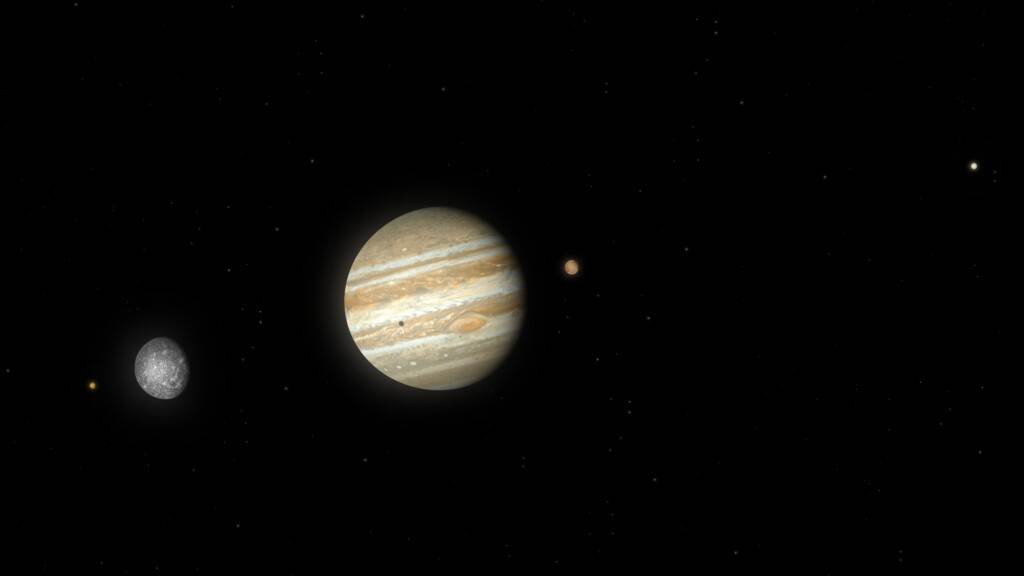
‘Fireflies’ help NASA map radiation around Jupiter and its moons
Understanding the intense radiation environment surrounding Jupiter and its moons is critical for both scientific discovery and the planning of future space missions. NASA’s Juno spacecraft has pioneered a novel approach by adapting its star-tracking cameras to detect high-energy particles, creating the first detailed three-dimensional radiation map of the Jovian system. This innovative method reveals how Jupiter’s powerful magnetosphere shapes radiation patterns around its moons, especially Europa, and sheds light on the interactions between radiation and Jupiter’s ring system. This article explores the technology behind this breakthrough, the key findings about Jupiter’s radiation environment, and the implications for future exploration.
Repurposing Star-Tracking Cameras as Radiation Detectors
Juno’s Advanced Stellar Compass (ASC) and Stellar Reference Unit (SRU) cameras were originally designed to capture star images to determine the spacecraft’s orientation in space. However, engineers and scientists optimized these instruments to detect radiation by identifying the characteristic streaks of light left by high-energy particles striking the cameras’ sensors.
These streaks, resembling the trails of fireflies, occur when energetic electrons from Jupiter’s magnetosphere penetrate the shielding around the cameras. By counting these ‘firefly’ signatures every quarter-second, the ASC provides a precise measure of the radiation levels encountered by the spacecraft. The SRU complements this data by offering additional measurements at different energy levels, enhancing the overall characterization of Jupiter’s radiation environment.
This innovative use of existing hardware demonstrates how spacecraft instruments can be adapted beyond their initial purpose to yield new scientific insights without the need for additional payloads.
Mapping Jupiter’s Magnetosphere and Its Effects on Europa
The resulting 3D radiation map has unveiled how Jupiter’s magnetosphere influences the distribution of high-energy particles around Europa, one of its icy moons. As Europa orbits Jupiter, electrons trapped in the planet’s magnetic field are swept around at high speeds, overtaking the moon from behind and accumulating on its trailing side.
Interestingly, the highest-energy electrons behave differently from the rest of the particle swarm. Instead of following the general flow, they drift backward relative to Jupiter’s rotation, colliding with Europa’s leading side—the hemisphere facing the direction of the moon’s motion. This unexpected behavior provides new insights into the complex dynamics of Jupiter’s radiation belts.
Understanding these radiation patterns is crucial because they affect Europa’s surface chemistry and have implications for the moon’s potential habitability. Radiation can alter the icy surface, producing chemical compounds that might support or hinder life, and pose challenges for future missions aiming to explore Europa’s subsurface ocean.
Interactions Between Jupiter’s Rings, Shepherd Moons, and Radiation
Beyond Europa, the Juno mission’s radiation mapping has revealed intriguing interactions between Jupiter’s radiation environment and its smaller ‘shepherd moons’ orbiting near the planet’s rings. When Juno traverses magnetic field lines connected to these moons or the dense dust surrounding the rings, the radiation levels detected by the ASC and SRU drop significantly.
This suggests that the moons and dust act as natural shields or modifiers of the local radiation environment, influencing particle distribution near the rings. Additionally, the SRU camera captures rare low-light images of Jupiter’s rings from Juno’s unique vantage point, providing valuable visual data that has been scarce from previous missions.
These images help scientists better understand the formation and structure of Jupiter’s rings, as well as the precise locations of the shepherd moons that help maintain the rings’ shape and stability.
Implications for Future Missions and Scientific Understanding
Scott Bolton, Juno’s principal investigator, emphasized that this detailed radiation map represents a major advancement in understanding Jupiter’s radiation environment at higher energies. Such knowledge is essential for designing future spacecraft and instruments that can withstand or avoid harmful radiation during missions to Jupiter and its moons.
The insights gained about Europa’s radiation exposure are particularly valuable for upcoming missions like NASA’s Europa Clipper, which aims to investigate the moon’s habitability and subsurface ocean. Knowing where radiation levels are highest or lowest can inform mission planning, surface operations, and instrument placement.
Moreover, the discovery of how small moons and ring dust influence radiation patterns opens new research avenues into the complex interactions within Jupiter’s magnetosphere. This contributes to a broader understanding of planetary magnetospheres and radiation environments across the solar system.
Juno’s Broader Contributions to Jovian Science
Since its launch in 2011, Juno has transformed our knowledge of the Jovian system. Beyond radiation mapping, it has detected salts and organic compounds on Ganymede’s surface, Jupiter’s largest moon, and observed active volcanism on Io, another of Jupiter’s major satellites.
These discoveries highlight the dynamic and diverse nature of Jupiter’s moons and their environments. Juno’s innovative use of instruments like the ASC and SRU to gather unexpected data exemplifies the mission’s adaptability and scientific value.
Continued analysis of Juno’s data promises to deepen our understanding of Jupiter’s atmosphere, magnetic field, moons, and rings, paving the way for future exploration and discovery.
What this means
NASA’s innovative adaptation of Juno’s star-tracking cameras into radiation detectors marks a significant leap forward in our understanding of Jupiter’s harsh radiation environment. By producing the first detailed 3D radiation map of the planet and its moons, scientists have uncovered new dynamics of particle behavior and interactions within the magnetosphere. These insights not only deepen our scientific knowledge but also play a crucial role in preparing for future exploratory missions to Europa and other Jovian moons. As Juno continues its mission, the data it collects will remain invaluable for unraveling the mysteries of the largest planet in our solar system and its intriguing satellite system.
Originally reported by space.com. Adapted for our readers with AI assistance.
Recent advances in machine perfusion technology are not only preserving donated livers but also making them biologically younger at a molecular level. This breakthrough…
What happens when human imagination, artificial intelligence, art and technology come together? From September 1 to 6, Samsung Electronics presented a special exhibition themed…