ESA Launches Probe to Revisit Asteroid Crime Scene
In October 2022, NASA’s Double Asteroid Redirection Test (DART) mission made headlines by deliberately crashing into the small asteroid moon Dimorphos at over 6 kilometers per second. This kinetic impact slightly altered Dimorphos’s orbit, marking the first practical demonstration of asteroid deflection technology. Now, the European Space Agency (ESA) has launched its Hera spacecraft to conduct a comprehensive post-impact survey of this binary asteroid system. Hera’s mission aims to assess the efficiency of the kinetic impact and gather detailed scientific data that will shape future planetary defense strategies. Scheduled to arrive at Didymos and Dimorphos in late 2026, Hera represents a significant step forward in humanity’s ability to understand and potentially mitigate asteroid threats.
Background: The DART Mission’s Pioneering Impact
NASA’s DART mission targeted Dimorphos, a 151-meter-wide moon orbiting the larger asteroid Didymos, with the goal of testing kinetic impactor technology as a means to alter an asteroid’s trajectory. In September 2022, DART collided with Dimorphos at a velocity exceeding 6 kilometers per second, creating a debris cloud and reducing the asteroid’s velocity by approximately 2.7 millimeters per second. This subtle change in speed is enough to gradually shift Dimorphos’s orbit around Didymos and, by extension, the binary system’s path around the Sun.
While the initial impact demonstrated the feasibility of kinetic deflection, many questions remain. In particular, scientists need precise measurements of Dimorphos’s mass and internal structure to evaluate how efficiently the impact transferred energy. Such data are crucial for refining models that predict how future asteroid deflection efforts might perform against potential Earth-bound threats.
Hera’s Mission Objectives and Scientific Payload
ESA’s Hera spacecraft, launched on October 7, 2024, aboard a SpaceX Falcon 9 rocket from Cape Canaveral, is tasked with conducting an in-depth post-impact investigation of the Didymos system. Hera’s journey includes a Mars flyby in 2025 before arriving at the binary asteroid system in December 2026.
The mission, costing approximately €363 million (US $398 million), involves collaboration among 18 European countries and was developed within a challenging four-year timeframe despite the constraints imposed by the COVID-19 pandemic. Hera carries a suite of 12 scientific instruments designed to analyze the crater formed by DART’s impact, the asteroid’s surface deformation, and the distribution of energy resulting from the collision.
Additionally, Hera will study the internal composition and structure of Dimorphos and its surrounding environment, including the debris field created by the impact. Understanding this debris is important not only for assessing immediate effects but also because it could potentially lead to meteor showers on Mars and even Earth in the future.
Innovative Navigation and Operations Around a Tiny Asteroid
Operating near Dimorphos presents unique challenges due to its extremely low gravity—about 200,000 times weaker than Earth’s. Hera cannot orbit the asteroid in the traditional sense. Instead, it will maneuver around the combined center of gravity (barycenter) of the Didymos binary system. This approach draws on techniques developed during ESA’s Rosetta mission to Comet 67P/Churyumov-Gerasimenko.
Hera will follow a series of hyperbolic arcs at distances of 20 to 30 kilometers to build a global understanding of the asteroid system’s mass, thermal properties, and dynamics. These maneuvers will provide a foundation for more detailed investigations closer to the surface.
Deploying CubeSats for Close-Range Exploration
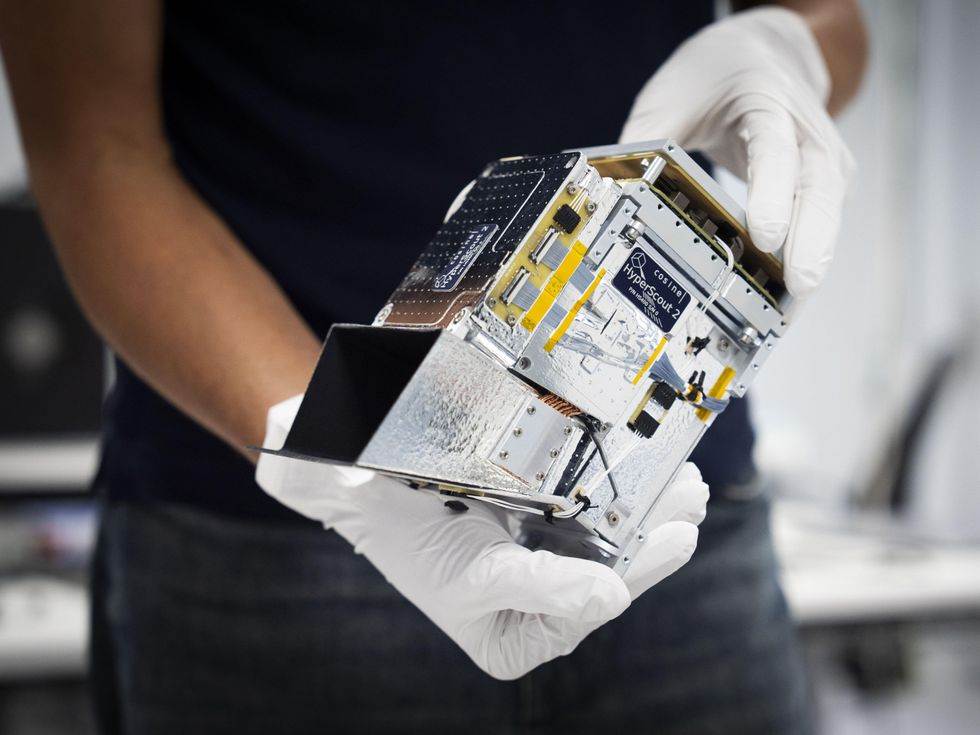
Approximately four weeks after arriving at Didymos, Hera will deploy two CubeSats—Milani and Juventas—to conduct complementary studies. This marks the first time CubeSats will autonomously operate around another celestial body.
Milani is equipped with a hyperspectral imager and instruments to detect dust and volatile compounds, while Juventas carries a radar system to map the asteroid’s internal structure. Both CubeSats use cold gas propulsion for maneuvering and will perform increasingly close flybys of Dimorphos, capturing images with resolutions down to 10 centimeters.
After completing their primary scientific tasks, Milani and Juventas will attempt to land on the asteroid’s surface. Although not specifically designed for landing, they will approach at very low velocities, hoping to continue transmitting data from the surface. Hera itself may also attempt a landing on the larger Didymos asteroid after its six-month primary mission, though details are still being finalized.
Autonomy and Advanced Navigation Technologies
Given the complexity of operating in such a low-gravity environment, Hera incorporates a high degree of onboard autonomy. While ground teams will oversee operations, the spacecraft can independently analyze its surroundings and adjust its trajectory and attitude in real time, similar to how self-driving cars navigate.
One key autonomous navigation feature involves tracking surface features such as boulders and craters to determine Hera’s position relative to the asteroid. This autonomous feature tracking will be fully tested after Hera completes its primary science objectives, demonstrating new capabilities for future deep space missions.
Broader Implications for Planetary Defense and Future Missions
Hera’s mission is a critical step in validating kinetic impactor technology as a viable planetary defense tool. By providing detailed measurements of the impact’s effects and the physical properties of Dimorphos, Hera will help refine models used to predict outcomes of asteroid deflection attempts.
The mission’s success also paves the way for additional asteroid exploration projects. Notably, cost savings from Hera’s efficient development have been redirected to initiate the Ramses mission, a streamlined spacecraft planned to rendezvous with asteroid Apophis during its close approach to Earth in 2029. Together with DART and future missions, Hera contributes to a growing international effort to protect Earth from potential asteroid hazards.
What this means
The Hera mission represents a landmark in asteroid science and planetary defense, providing the first comprehensive follow-up to a deliberate asteroid impact. By combining advanced instrumentation, autonomous navigation, and innovative CubeSat deployments, Hera will deepen our understanding of how kinetic impacts alter asteroid trajectories and structures. This knowledge is essential for preparing effective responses to potential asteroid threats in the future. Moreover, Hera’s success underscores the value of international collaboration and efficient mission design, setting the stage for continued exploration and protection efforts within our solar system.
Recent advances in machine perfusion technology are not only preserving donated livers but also making them biologically younger at a molecular level. This breakthrough…
What happens when human imagination, artificial intelligence, art and technology come together? From September 1 to 6, Samsung Electronics presented a special exhibition themed…