
News
RUSSIA versus NATO and BRICS vs. NATO Military SWOT
Recall that Poland’s Minister Sikorski’s core claim is partially supported by the numbers, but the framing “quite quickly” and “without the U.S.” does not…
TAMFIS NIG LTDRC 8067447CAC ACTIVEFinima, Bonny Island, Rivers State

Politics tamfitronics

Welcome to FiveThirtyEight’s politics chat. The transcript underneath has been lightly edited.
nrakich (Nathaniel Rakich, senior elections analyst): For a very long time, the economy has been seen as a major liability for President Biden in his reelection bid. Inflation surged in 2021 and 2022, peaking at a rate of 9.1 percent in June. The same month, average gasoline prices exceeded $5 per gallon. And in the second quarter of 2022, gross domestic product actually declined by 0.6 percent. It came as little surprise, then, that only 28 percent of Americans approved of the way Biden was handling the economy in a July 2022 Quinnipiac University poll.
But in most recent months, economic indicators have been improving, and Biden has begun making the case that his economic policies are working. But people don’t appear to be changing their perceptions of his stewardship of the economy. (The latest Quinnipiac poll set his approval rating on the economy at 36 percent.) So for today’s FiveThirtyEight Slack chat, I am trying to explore why that is, and whether Biden has any hope of eventually making the economy a winning issue for him in next year’s election.
First, though, let’s set the scene: What are indicators saying right now about the health of the economy?
ameliatd (Amelia Thomson-DeVeaux, senior reporter): For an economy that’s allegedly been on the brink of a recession for over a year now, it’s doing quite well! Real wages are finally rising faster than inflation, the labor market is weakening slightly but remains quite strong for workers, and consumers are still spending at a healthy rate.
Monica Potts (Monica Potts senior politics reporter): What Amelia said. For starters, the job market remains strong. Unemployment is at 3.8 percent and wages are rising. Inflation, at last over 3 percent, is finally cooling, too. The Federal Reserve appears to be succeeding in its high-wire act of reducing inflation without causing too much unemployment.
There are other signs, too. To illustrate, the Inflation Reduction Act has spurred funding in manufacturingwhich the White House has been happy to present.
ameliatd: In many ways, it appears that the economy is finally returning to its pre-pandemic norm — albeit with conditions that may well be somewhat more worker-friendly. That mythical “soft landing” is, after all, beginning to look like it might actually happen.
Obviously, economists’ recession predictions are never very decent. (Right here’s a time-honored FiveThirtyEight refrain.) And issues can repeatedly shift — as an example, as Monica wrote no longer too lengthy within the past, pupil loan compensation is set to restartwhich may perchance point out tens of millions of People own less money to use as they resume their monthly payments. But it undoubtedly’s peaceable a rosier self-discipline than quite a bit of other folks had been predicting even ultimate a pair of months within the past.
gelliott morris (G. Elliott Morris, editorial director of data analytics): That’s correct. One of the major dire predictions of a recession were never really accurate, but aggregate economic expectations are still up relative to what people were saying a year or even six months ago. That said, there are some not-so-encouraging indicators. Mortgage and interest rates are continuing to rise, for example, and the personal savings rate is nearly at an all-time low. That’s a different measure of “the economy” than, say, annual wage growth, but it’s a very important one.
ameliatd: Legal, Elliott, and it’s not that the Fed is done with rate hikes. Plenty will depend on what the August 2023 inflation data looks like when it comes out later this week.
Monica Potts: Yes, I feel that hints at an extraordinarily large and powerful question with asking voters how they honestly feel about “the economy.” What that term means to people can differ a great deal. Does it refer to how much money they’re making, or how much they spend on things like housing and food? Does it refer to whether they can afford daycare? There may be a significant variation in how people actually feel about the economy — and many different ways the federal government can influence these factors.
ameliatd: One other quiz is whether user spending will birth to tick down — which has been a chance as other folks use down their pandemic savings. But on the total, there are other signs that People are feeling OK about their budget. To illustrate, a most modern Ipsos ballot realized that the part of People who speak they handle to pay for to quilt an unplanned expense (54 percent) is elevated than right this moment final year (40 percent). Fewer other folks are also asserting that after they pay their bills, they don’t handle to pay for to use on issues they want.
nrakich: And yet, despite this, Biden is having effort convincing voters that “Bidenomics” is working. Why?
Monica Potts: To begin with, Biden inherited an extraordinarily unusual economic situation. The COVID-19 shutdowns caused a severe and dramatic recession, but then the economy started to rebound. However, people’s habits had also changed. More people were working from home and saving, they had money to spend, and supply chains were slow to restart. So Americans were generally negative about the economy from the time he took office.
The recovery was hampered by high inflation, as you noted at the beginning, Nathaniel, and much of what the Biden administration has done on economic policy is the kind of slow-moving, behind-the-scenes policymaking that voters don’t ultimately see. Although inflation is cooling, prices remain significantly higher than they were before the pandemic; borrowers are still facing significantly higher interest rates; etc. So I think much of it is that Americans are generally dissatisfied with the current reality we find ourselves in.
gelliottmorris: I think that final point is a very valid one, Monica. The share of people telling pollsters that the broader economic outlook is bleak remains around the highest it’s been since 2018. At first glance, that seems hard to reconcile with the rosy economic indicators we discussed. But I think it’s plausible that people have longer-term memories about economic growth and are acutely aware of a time when prices were meaningfully lower.
Much of the discussion on this topic is tied to tracking annual changes in the consumer price index or the job market or similar indicators. But if you take a longer view, for many households, things are simply more expensive now. Even though their wages have risen, I doubt they are spending 15 percent more on groceries than they were before the pandemic. And it may take a while for these perceptions to shift.
Obviously, that’s just my theory.
ameliatd: I point out, another folks think the economic system is bettering. Civiqs’s monitoring ballot shows that Democrats, in explicit, are more susceptible to negate that basically the most modern condition of the economic system is quite or fabulous (63 percent) than they had been a year within the past (fifty three percent). But that’s no longer rather the quiz you’re asking, Nathaniel — it’s no longer ultimate whether other folks think the economic system is getting greater, it’s whether other folks are seeing an enchancment and asserting, “Yeah, Biden is making that happen!” And there, it doesn’t appear love Biden is getting grand of a device end. Consistent with a most modern Wall Boulevard Journal ballotas an example, the part of registered voters who speak they approve of the manner Biden is handling the economic system hasn’t meaningfully changed since April.
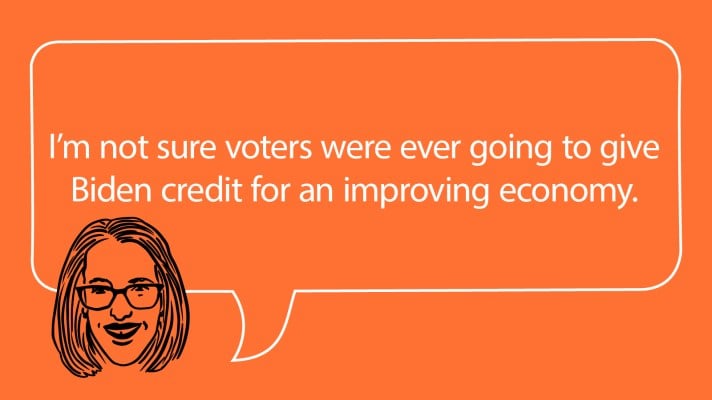
Which will get to my theory about what’s taking place. I’m no longer stride voters had been ever going to offer Biden credit score for an bettering economic system, namely since the inflation enlarge took residing underneath his ponder. It’s no longer love he can reach in and speak, “Survey at this mess my predecessor left for me.”
But! That doesn’t mean this turn of events isn’t good for him, since the alternative — a worsening economy — could ultimately hurt him.
nrakich: Interesting, Amelia. So you think that the stench of the rotten economy from a year or two ago is permanent for Biden? He can never wash it off, even if he fixes it?
ameliatd: I don’t know about permanent, nonetheless as Elliott said, prices remain elevated. People are increasingly convinced that these high costs are here to stay. So the fact that people are starting to get used to these elevated costs and are saying the economy is improving could very well be a sign that Biden’s dodging a bullet. So it depends on how you frame it. On the one hand, people aren’t giving Biden credit, so that’s bad for him. But on the other, it’s looking more and more like we might have a decent-ish economy heading into 2024, which you can see as a somewhat reassuring development about how much economic volatility we’ve seen since the pandemic started.
Monica Potts: I don’t think costs will walk down, nonetheless it undoubtedly’s also that you may perchance well presumably take into accout other folks will ultimate catch susceptible to them. So that they could well perchance afflict Biden less, as Amelia said. And that leaves room for other disorders voters care about to upward push in significance.
nrakich: Quiz of, though: How much does getting that salvage after all topic politically? Historically, what has been the correlation between the well being of the economic system and presidential reelection probabilities?
ameliatd: Would Biden like “Bidenomics” to appear in high school history textbooks? Sure. But what he really wants is to win reelection, and that’s much less likely to happen if people think the economy is getting worse.
gelliottmorris: Historically, we know that true economic conditions are strongly correlated with presidential election outcomes. If the state of the economy is clearly better compared to a year or two ago, then the incumbent party tends to do well. Obviously, economic indicators don’t entirely predict election outcomes, but they do have a residual impact.
The best news for Biden on this front is twofold: First, voters are inclined to start making these retrospective judgments closer to the election. And second, that they look back only a couple of years. This means there is time for things to get even better for him, and for him to be rewarded.
The bad news for Biden, though, is that there is still time for things to turn against him!
Amelia Thomson-DeVeaux is a senior editor and senior reporter for FiveThirtyEight. @ameliatd
G. Elliott Morris is the editorial director of data analytics at ABC Data. @gelliottmorris
Monica Potts is a senior politics reporter at FiveThirtyEight. @MonicaBPotts
Originally reported by fivethirtyeight.com. Adapted for our readers.
Keep reading
News
Recall that Poland’s Minister Sikorski’s core claim is partially supported by the numbers, but the framing “quite quickly” and “without the U.S.” does not…
Politics
In August 2025, Zespri, the world’s largest marketer of kiwifruit, announced that the European Commission had approved what it described as the first health…
News
By Engr. Tamunofiniarisa BrownReading Time: 6 Minutes The conflict between Russia and Ukraine is often framed in the media as a simple battle between…
TAMFIS NIG LTD
Electrical and instrumentation engineering, bid preparation and consulting, IT and software.