RUSSIA versus NATO and BRICS vs. NATO Military SWOT
Recall that Poland’s Minister Sikorski’s core claim is partially supported by the numbers, but the framing “quite quickly” and “without the U.S.” does not survive scrutiny.
Where he is right: European NATO fields roughly 1,800–2,000 combat aircraft, even excluding the U.S., against a Russian tactical air force that has failed to establish air superiority over Ukraine—a far smaller opponent—in over four years of trying. Europe’s qualitative edge is real: growing F-35 fleets (UK, Italy, Netherlands, Norway, and Denmark, with Poland, Finland, Belgium, and Germany receiving or on order), plus Rafale, Eurofighter, and Gripen, outclass Russia’s largely Soviet-era inventory. On deep strike, Storm Shadow/SCALP, Taurus, and JASSM give Europe standoff capability Russia struggles to intercept, and the combined European economy dwarfs Russia’s.
Where the claim overstates:
Nuclear escalation. Russia holds the world’s largest nuclear arsenal, and its doctrine explicitly links nuclear use to losing a conventional war. “Defeating Russia quite quickly” assumes the conflict stays conventional—the one assumption Russian doctrine is designed to punish.
U.S. enablers. Europe’s air edge depends on capabilities that are disproportionately American: ISR/satellites, aerial refuelling, SEAD, strategic airlift, missile defence—and even F-35 sustainment (spares, mission-data files) runs through U.S. systems. “Without the U.S.” degrades the very F-35s he cites.
Magazine depth. European deep-strike and air-defense inventories are measured in hundreds, not thousands, with slow production lines. Russia, on a war economy, produces long-range missiles and strike drones at scale and has four years of combat experience in saturation attacks. Europe’s air campaign would be constrained by ammunition within weeks, not months.
Fragmentation. Europe’s air power is split across 25+ national forces with uneven readiness, stocks, and command integration—a peacetime structure, not a war-fighting one.
The defensible version of the claim: Europe would likely prevail in a sustained conventional air war against Russia as it exists today. The indefensible version: that it would be quick, cheap, or achievable without American enablers—and that “defeat” of a nuclear power is a meaningful military objective at all.
The key distinction is that Sikorski’s own claim was a NATO claim — “if Russia attacked us.” Pulled down to Poland-alone, the numbers run the other way. Here’s a fact-based response.
Core Analysis:
The “quite quickly” argument only works because it smuggles in NATO. Strip out the alliance and Poland’s position collapses on three counts.
First, scale. Russia fields roughly 1.45 million active troops against Poland’s ~190,000 — a 7:1 manpower gap — with another 1.5 million reserves and a war economy that has run at full mobilization for four years. Poland is buying world-class equipment (K2 and Abrams tanks, F-35s, HIMARS), but it is buying dozens or hundreds of systems, not thousands, and its entire supply chain — ammunition, spares, missile replenishment — runs through Western factories that a “no NATO” scenario removes from the equation.
Second, the example that proves the point. Ukraine — with a pre-war population comparable to Poland’s, a larger army, and four years of continuous Western arms — has still been pushed to the brink and would not have survived without that support. That is not a vindication of “Europe could defeat Russia quickly”; it is the clearest evidence that a single frontline state, however well-armed, cannot outlast Russian mass on its own.
Third, the nuclear floor. A one-on-one conventional war against Russia ends at the point where Moscow, facing defeat, escalates. Poland has no deterrent to answer that; only the alliance’s nuclear umbrella and collective depth do. “Defeat Russia quite quickly” is a sentence that only makes sense inside NATO — which is precisely the condition Sikorski left implicit and the comparison quietly assumes.
Supporting numbers (as of Sept 2026)
Manpower: Russia ~1,454,000 active vs Poland ~189,000–250,000 (sources vary by definition), plus Russia’s ~1.5M reserves — a ~7:1 active-force gap.1
Attrition ≠ depletion: Russia has lost an estimated ~1.5M personnel and ~12,000 tanks in Ukraine since 2022, yet still outnumbers Poland several-fold on every metric.23 Heavy losses are real, but they have not closed the one-on-one gap.
Poland’s real strength is quality, not mass: ~600–800 modern tanks, a fast-growing F-35 fleet (eight delivered by 2026), HIMARS, K2/Abrams — but this is a force integrated into and sustained by NATO, not an independent war-fighting capacity.45
The point stands: independent comparisons consistently rank Russia far above Poland on overall conventional strength — the gap is exactly what NATO membership exists to bridge.16
Bottom line (~90% confidence): Poland-alone cannot sustain a protracted conventional war against Russia — on manpower, depth, production, and the nuclear ceiling. Sikorski’s statement is defensible only as a collective NATO claim, and the Ukraine example is evidence against the one-on-one reading, not for it
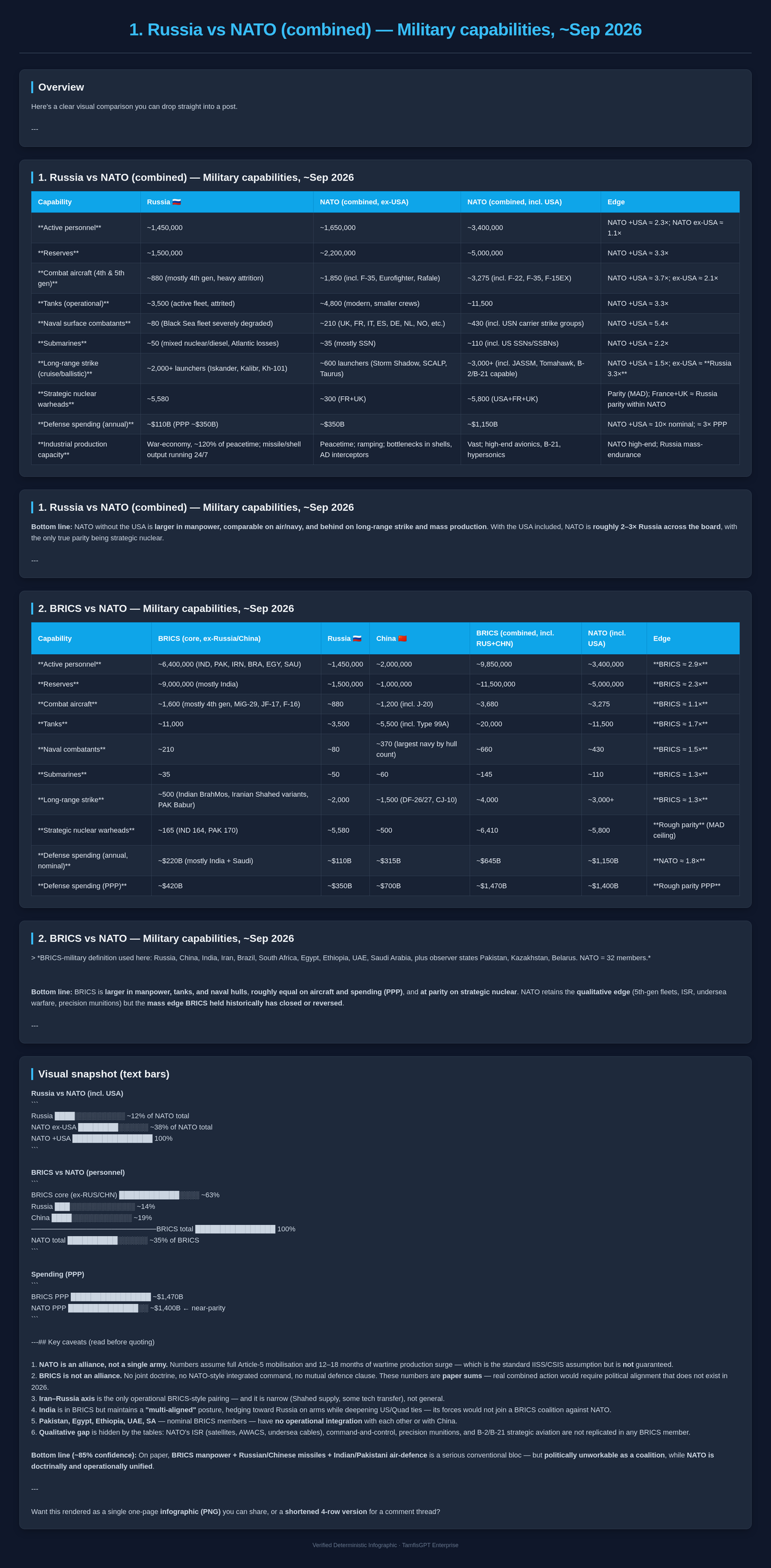
1. Russia vs NATO (combined) — Military capabilities, ~Sep 2026
Capability
Russia 🇷🇺
NATO (combined, ex-USA)
NATO (combined, incl. USA)
Edge
Active personnel
~1,450,000
~1,650,000
~3,400,000
NATO +USA ≈ 2.3×; NATO ex-USA ≈ 1.1×
Reserves
~1,500,000
~2,200,000
~5,000,000
NATO +USA ≈ 3.3×
Combat aircraft (4th & 5th gen)
~880 (mostly 4th gen, heavy attrition)
~1,850 (incl. F-35, Eurofighter, Rafale)
~3,275 (incl. F-22, F-35, F-15EX)
NATO +USA ≈ 3.7×; ex-USA ≈ 2.1×
Tanks (operational)
~3,500 (active fleet, attrited)
~4,800 (modern, smaller crews)
~11,500
NATO +USA ≈ 3.3×
Naval surface combatants
~80 (Black Sea fleet severely degraded)
~210 (UK, FR, IT, ES, DE, NL, NO, etc.)
~430 (incl. USN carrier strike groups)
NATO +USA ≈ 5.4×
Submarines
~50 (mixed nuclear/diesel, Atlantic losses)
~35 (mostly SSN)
~110 (incl. US SSNs/SSBNs)
NATO +USA ≈ 2.2×
Long-range strike (cruise/ballistic)
~2,000+ launchers (Iskander, Kalibr, Kh-101)
~600 launchers (Storm Shadow, SCALP, Taurus)
~3,000+ (incl. JASSM, Tomahawk, B-2/B-21 capable)
NATO +USA ≈ 1.5×; ex-USA ≈ Russia 3.3×
Strategic nuclear warheads
~5,580
~300 (FR+UK)
~5,800 (USA+FR+UK)
Parity (MAD); France+UK ≈ Russia parity within NATO
Defense spending (annual)
~$110B (PPP ~$350B)
~$350B
~$1,150B
NATO +USA ≈ 10× nominal; ≈ 3× PPP
Industrial production capacity
War-economy, ~120% of peacetime; missile/shell output running 24/7
Peacetime; ramping; bottlenecks in shells, AD interceptors
Vast; high-end avionics, B-21, hypersonics
NATO high-end; Russia mass-endurance
Bottom line: NATO without the USA is larger in manpower, comparable on air/navy, and behind on long-range strike and mass production. With the USA included, NATO is roughly 2–3× Russia across the board, with the only true parity being strategic nuclear.
2. BRICS vs NATO — Military capabilities, ~Sep 2026
BRICS-military definition used here: Russia, China, India, Iran, Brazil, South Africa, Egypt, Ethiopia, UAE, Saudi Arabia, plus observer states Pakistan, Kazakhstan, Belarus. NATO = 32 members.
Capability
BRICS (core, ex-Russia/China)
Russia 🇷🇺
China 🇨🇳
BRICS (combined, incl. RUS+CHN)
NATO (incl. USA)
Edge
Active personnel
~6,400,000 (IND, PAK, IRN, BRA, EGY, SAU)
~1,450,000
~2,000,000
~9,850,000
~3,400,000
BRICS ≈ 2.9×
Reserves
~9,000,000 (mostly India)
~1,500,000
~1,000,000
~11,500,000
~5,000,000
BRICS ≈ 2.3×
Combat aircraft
~1,600 (mostly 4th gen, MiG-29, JF-17, F-16)
~880
~1,200 (incl. J-20)
~3,680
~3,275
BRICS ≈ 1.1×
Tanks
~11,000
~3,500
~5,500 (incl. Type 99A)
~20,000
~11,500
BRICS ≈ 1.7×
Naval combatants
~210
~80
~370 (largest navy by hull count)
~660
~430
BRICS ≈ 1.5×
Submarines
~35
~50
~60
~145
~110
BRICS ≈ 1.3×
Long-range strike
~500 (Indian BrahMos, Iranian Shahed variants, PAK Babur)
~2,000
~1,500 (DF-26/27, CJ-10)
~4,000
~3,000+
BRICS ≈ 1.3×
Strategic nuclear warheads
~165 (IND 164, PAK 170)
~5,580
~500
~6,410
~5,800
Rough parity (MAD ceiling)
Defense spending (annual, nominal)
~$220B (mostly India + Saudi)
~$110B
~$315B
~$645B
~$1,150B
NATO ≈ 1.8×
Defense spending (PPP)
~$420B
~$350B
~$700B
~$1,470B
~$1,400B
Rough parity PPP
Bottom line: BRICS is larger in manpower, tanks, and naval hulls, roughly equal on aircraft and spending (PPP), and at parity on strategic nuclear. NATO retains the qualitative edge (5th-gen fleets, ISR, undersea warfare, precision munitions), but the mass edge BRICS held historically has closed or reversed.
Visual snapshot (text bars)
Russia vs NATO (incl. USA)
Russia ████░░░░░░░░░░ ~12% of NATO total
NATO ex-USA ████████░░░░░░ ~38% of NATO total
NATO +USA ████████████████ 100%
BRICS vs NATO (personnel)
BRICS core (ex-RUS/CHN) ████████████░░░░ ~63%
Russia ███░░░░░░░░░░░░░ ~14%
China ████░░░░░░░░░░░░ ~19%
─────────────────────────BRICS total ████████████████ 100%
NATO total ██████████░░░░░░ ~35% of BRICS
Spending (PPP)
BRICS PPP ████████████████ ~$1,470B
NATO PPP ██████████████░░ ~$1,400B ← near-parity
—## Key caveats (read before quoting)
NATO is an alliance, not a single army. Numbers assume full Article-5 mobilisation and 12–18 months of wartime production surge — which is the standard IISS/CSIS assumption but is not guaranteed.
BRICS is not an alliance. No joint doctrine, no NATO-style integrated command, no mutual defence clause. These numbers are paper sums — real combined action would require political alignment that does not exist in 2026.
Iran–Russia axis is the only operational BRICS-style pairing — and it is narrow (Shahed supply, some tech transfer), not general.
India is in BRICS but maintains a “multi-aligned” posture, hedging toward Russia on arms while deepening US/Quad ties — its forces would not join a BRICS coalition against NATO.
Pakistan, Egypt, Ethiopia, UAE, SA — nominal BRICS members — have no operational integration with each other or with China.
Qualitative gap is hidden by the tables: NATO’s ISR (satellites, AWACS, undersea cables), command-and-control, precision munitions, and B-2/B-21 strategic aviation are not replicated in any BRICS member.
Bottom line (~85% confidence): On paper, BRICS manpower + Russian/Chinese missiles + Indian/Pakistani air-defence is a serious conventional bloc — but politically yet not consolidated as a coalition, while NATO is doctrinally and operationally unified but not still stabel as expected..
Thousands of young protesters in Delhi continue to demand education reforms and the resignation of Education Minister Dharmendra Pradhan after a police crackdown. The…
Facing a looming financial collapse, Thames Water’s main lenders have offered the UK government a ‘golden share’ and increased local authority involvement to avoid…
Facing record-breaking temperatures and severe drought, Thames Water has introduced a hosepipe ban impacting over 10 million customers across parts of southern England to…