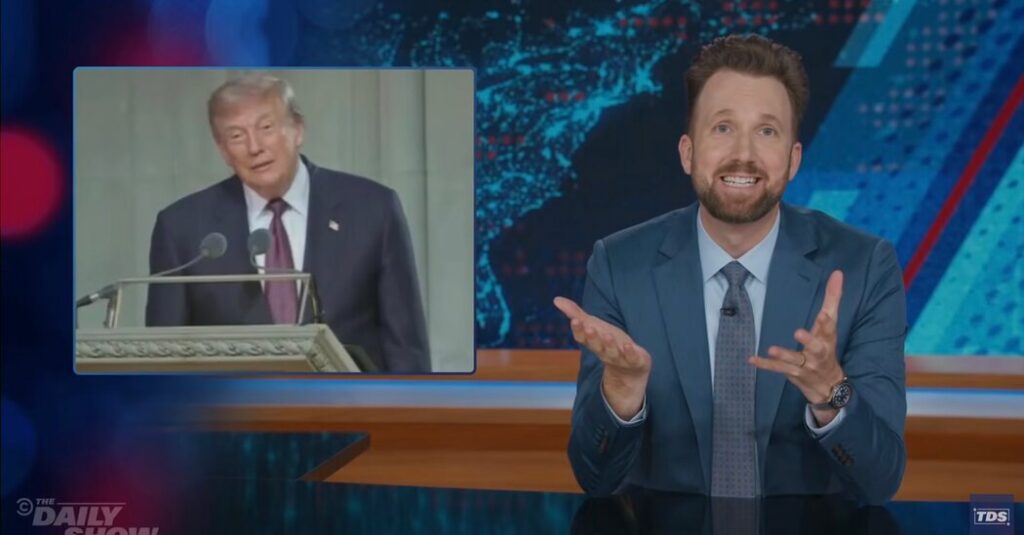
Late Night Comedy Reacts to Trump’s Unconventional Eulogy for Lindsey Graham
The memorial service for Senator Lindsey Graham in Washington brought together political figures and friends to honor his life and legacy. Among the speakers was former President Donald Trump, whose eulogy quickly became a focal point for late-night comedians. Rather than delivering a traditional, heartfelt tribute, Trump’s speech included anecdotes and candid admissions that prompted a mixture of amusement and critique from television hosts. This article explores how late-night comedy shows responded to Trump’s eulogy, the themes they highlighted, and the broader implications of such a public moment.
Late Night Comedy Reacts to Trump’s Unconventional Eulogy for Lindsey Graham
Trump’s Eulogy: An Unorthodox Tribute
Senator Lindsey Graham’s memorial services commenced in Washington, drawing attention from political leaders and the public alike. President Trump, a longtime acquaintance of Graham, was among the speakers tasked with honoring the late senator. However, his eulogy diverged from the expected tone of solemnity and reverence.
Instead of sharing warm anecdotes or emphasizing Graham’s virtues, Trump recounted a quarrel from 2016 and revealed his personal cellphone number to millions watching the service. This unusual choice of content left many viewers and commentators puzzled, as it neither highlighted Graham’s character nor provided comfort to mourners.
The speech also included candid remarks about Graham’s popularity across political parties, with Trump acknowledging that not everyone liked the senator. Such blunt honesty during a memorial service was seen as jarring and unconventional.
Late-Night Comedy’s Take: Humor Meets Critique
Late-night hosts quickly seized upon Trump’s eulogy, blending humor with pointed critique. Jordan Klepper of “The Daily Show” expressed incredulity that Trump struggled to find anything genuinely nice to say about Graham, joking that a heartwarming story about their friendship would have been more appropriate.
Klepper highlighted the oddity of Trump focusing on a past quarrel and the fallout from sharing his phone number, noting the influx of prank calls with humorous pseudonyms. This approach underscored the disconnect between the expected solemnity of a eulogy and Trump’s offbeat delivery.
Similarly, Seth Meyers commented on Trump’s rare moment of honesty, where he admitted that not everyone liked Graham. Meyers quipped that this was a moment when a little embellishment might have been more fitting, comparing it to how people typically speak kindly of the deceased regardless of imperfections.
Other comedians, such as Greg Gutfeld and Seth Meyers, also touched on Trump’s aggressive rhetoric in unrelated remarks about Iran, illustrating how his blunt style permeates both political discourse and public appearances.
The Role of Late-Night Comedy in Political Discourse
Late-night comedy has long served as a platform for political commentary, using humor to dissect and critique public figures and events. In the case of Trump’s eulogy, comedians balanced respect for the solemn occasion with a candid appraisal of the speech’s shortcomings.
By highlighting the incongruity between the expected tone of a memorial and Trump’s candid, sometimes awkward remarks, comedians invited viewers to reflect on the nature of political rhetoric and public mourning.
This approach also underscores the challenges of navigating moments of national significance when delivered by polarizing figures. Comedy becomes a tool to process discomfort, question norms, and engage audiences in critical thinking about leadership and legacy.
Additional Late-Night Highlights and Cultural Notes
Beyond the eulogy, late-night shows featured a range of other segments that balanced humor with cultural commentary. For instance, Mary Beth Barone appeared on “Late Night with Seth Meyers” alongside her dog nanny and friend Benito Skinner to discuss her new Netflix stand-up special, “Galaxy Brain.”
Upcoming episodes promised interviews with notable figures such as Zoe Saldaña, who was set to discuss the third season of her Paramount+ series “Lioness” on “The Tonight Show.”
In a nod to music history, a new boxed set celebrating blues legend Ma Rainey’s recording career was noted for its significance, highlighting how her powerful voice even distorted early recording equipment, a testament to her impact on American music.
What this means
President Trump’s eulogy for Senator Lindsey Graham provided an unexpected moment that late-night comedians eagerly dissected, blending humor with critical analysis. Their responses reveal the complexities of public mourning in a politically charged environment and the role of comedy in navigating such moments. As audiences continue to engage with these events through the lens of late-night television, the intersection of politics, humor, and cultural commentary remains a vital space for understanding contemporary public discourse.
Editor’s note: The following is AI-generated commentary and context on this topic, not original reporting.
Broader Context and Outlook
Fans and critics frequently diverge in their assessment of moments like this one, and that gap itself often becomes part of the broader cultural discussion that follows.
Social media reaction in the immediate aftermath of events like this tends to shape the broader narrative just as much as traditional press coverage.
Behind every high-profile public moment referenced here sits a much larger team — collaborators, crew, and support staff — whose work rarely receives the same level of visibility.
The entertainment industry’s promotional machinery — premieres, interviews, and public appearances — plays a significant role in shaping how audiences relate to a project long before, and after, its release.
Critics and audiences do not always align in their reception of major cultural moments, and that divergence is itself often treated as newsworthy.
Moments like the one captured in “Late Night Comedy Reacts to Trump’s Unconventional Eulogy for Lindsey Graham” tend to generate outsized public interest precisely because they offer a rare, informal glimpse into the personalities behind well-known public roles.
Merchandising, streaming rights, and licensing deals increasingly form a significant part of the commercial calculus behind projects and moments like this one.
Recognition and reaction in creative industries are often as much about the surrounding conversation and cultural moment as about any single, purely objective measure of merit.
Public interest in stories of this kind tends to spike sharply in the first 48 hours before gradually settling into a steadier stream of analysis and follow-up coverage over the following weeks.
Official inquiries or reviews, where they follow a story of this kind, typically take considerably longer to conclude than the news cycle that first brought the story to public attention, which can create a gap between public perception and the eventual documented record.
Comparisons to similar past events are a common feature of coverage like this, offering readers useful context even though no two situations unfold in exactly the same way.
Originally reported by nytimes.com. Adapted for our readers with AI assistance.
Thousands of young protesters in Delhi continue to demand education reforms and the resignation of Education Minister Dharmendra Pradhan after a police crackdown. The…
Facing a looming financial collapse, Thames Water’s main lenders have offered the UK government a ‘golden share’ and increased local authority involvement to avoid…
Facing record-breaking temperatures and severe drought, Thames Water has introduced a hosepipe ban impacting over 10 million customers across parts of southern England to…