
News
RUSSIA versus NATO and BRICS vs. NATO Military SWOT
Recall that Poland’s Minister Sikorski’s core claim is partially supported by the numbers, but the framing “quite quickly” and “without the U.S.” does not…
TAMFIS NIG LTDRC 8067447CAC ACTIVEFinima, Bonny Island, Rivers State

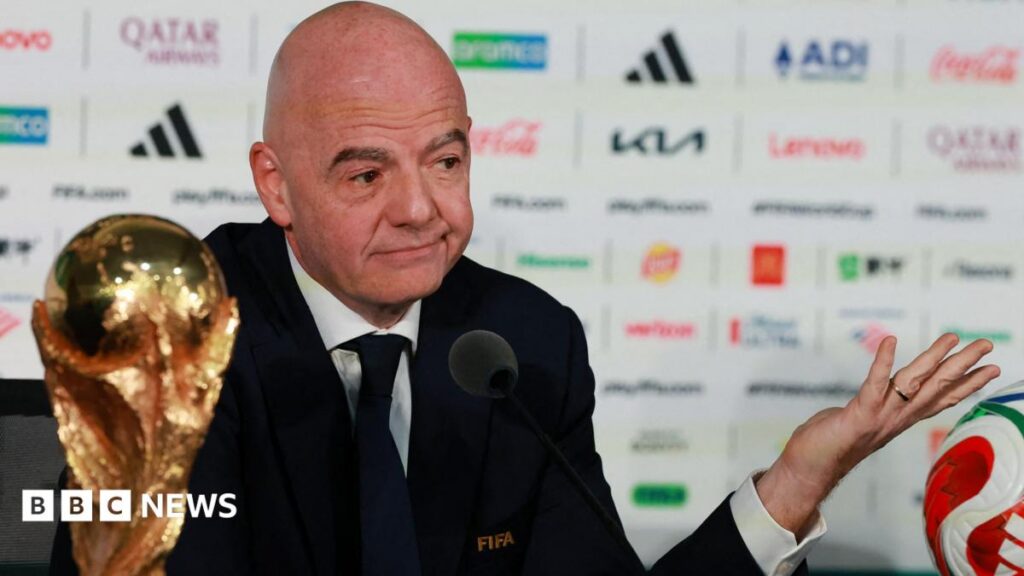
The FIFA World Cup stands as the pinnacle of international football, captivating billions worldwide every four years. The 2022 tournament in Qatar was the largest ever, featuring more teams and matches than previous editions, and the upcoming 2026 event promises to be even bigger with an expanded roster of 48 teams hosted across the United States, Canada, and Mexico. While the spectacle on the pitch creates unforgettable moments, the financial implications off the field reveal a complex landscape of winners and losers. This article delves into the economic impacts of the World Cup, examining how various stakeholders—from FIFA and broadcasters to fans and host cities—fare financially during this global event.
FIFA, the governing body of world football, emerges as the primary financial beneficiary of the World Cup. The 2022 tournament in Qatar generated a record $7.6 billion in revenue, an unprecedented figure in the history of the event. This income stems from multiple streams, including broadcasting rights, licensing, hospitality packages, sponsorship deals, and ticket sales.
Experts like Marion Laboure, senior strategist at Deutsche Bank Research, emphasize FIFA's dominant position, estimating that its revenues over the four-year World Cup cycle approach $13 billion. Additionally, FIFA has innovated by entering the secondary ticket market, operating an official resale platform that charges a 15% fee to both buyers and sellers, thereby capturing additional revenue.
Looking ahead, FIFA plans to expand the tournament further to 64 teams, potentially including football powerhouses like China and India. This expansion aims to tap into vast new audiences, promising even greater financial returns. The 2026 World Cup, hosted across three North American countries, is expected to surpass Qatar's revenue, reinforcing FIFA's role as the tournament's biggest financial winner.
While fans experience the thrill of witnessing world-class football, their financial burden has increased significantly. Ticket prices have soared, fueled by FIFA's dynamic pricing strategy that raises costs in response to high demand. For instance, tickets for the 2026 final at New Jersey's MetLife Stadium were officially priced as high as $32,970, with resale tickets sometimes exceeding $2 million.
This pricing approach has drawn criticism and even public acknowledgment of its steepness, with former US President Donald Trump admitting he would not pay $1,000 for a match ticket. Beyond ticket costs, fans face inflated expenses for flights, accommodation, and local transportation. A notable example was the surge in New Jersey Transit train fares to MetLife Stadium, which jumped from a typical $12.90 return fare to $150 during the tournament, although prices were later reduced following public backlash.
These elevated costs have made attending the World Cup a costly endeavor for many supporters, highlighting a significant financial disadvantage for fans despite their passion and commitment.
Broadcasters have invested heavily to secure rights to televise the World Cup, with Fox Sports reportedly paying $485 million for US broadcast rights in 2022. Despite the high upfront costs, broadcasters benefit from massive viewership, enabling them to command premium advertising rates.
An innovative commercial opportunity arose from the introduction of hydration breaks during matches, which FIFA described as a sporting necessity. These breaks, lasting about 90 seconds, have been monetized by broadcasters as sponsored advertising slots, especially in the US where sports broadcasts traditionally include frequent commercial breaks. Ads during these intervals can cost between $200,000 and $750,000 for 30 seconds, potentially generating $250 million in advertising revenue in the US alone.
In contrast, UK broadcasters like the BBC and ITV have limited or no advertising during matches, shielding UK viewers from such commercial interruptions. Official sponsors, including Adidas and Coca-Cola, invest tens of millions to associate their brands with the World Cup, gaining extensive global exposure. Adidas, for example, spent around £50 million on a high-profile advertising campaign featuring football stars and even an AI-generated David Beckham image, underscoring the lucrative branding opportunities tied to the tournament.
David Beckham exemplifies a unique financial winner from the World Cup ecosystem, despite never winning the tournament as a player. As the UK's first billionaire sportsman, Beckham remains a prominent figure in advertising, representing various brands across sectors from home improvement to banking.
His continued influence in US soccer is significant, particularly through his co-ownership of Inter Miami, which is valued at approximately $1.45 billion and is considered Major League Soccer's most valuable franchise. Beckham's commercial appeal and business ventures highlight how former athletes can leverage their fame into sustained financial success beyond their playing careers.
The 2026 World Cup will be hosted across 16 cities in the US, Canada, and Mexico, each anticipating an influx of tourists and fans. While short-term boosts in hospitality, hotel occupancy, and local business revenues are expected, the long-term economic benefits for host cities are less certain.
FIFA estimated the tournament would add $41 billion to the global economy, with $17 billion benefiting the US alone and creating around 185,000 jobs, primarily in hospitality and accommodation sectors. However, experts like Alexander Budzier from Oxford University caution that such mega-events rarely generate lasting wealth. Instead, many visitors avoid host cities during the tournament to escape congestion, leading to declines in regular tourism.
Moreover, job creation tends to be temporary and concentrated in lower-wage service roles. Unlike events such as the 2012 London Olympics, which spurred urban regeneration, the 2026 World Cup relies heavily on existing infrastructure, limiting opportunities for development-driven economic gains.
Contrary to optimistic forecasts, hotel bookings in host cities have underperformed. The British Columbia Hotel Association reported that June and July 2022 bookings lagged behind previous years, despite Vancouver hosting multiple matches. Similarly, many US hotel operators, including those in New York and Seattle, experienced softer-than-expected bookings, with some describing the tournament as a 'non-event' for their businesses.
The American Hotel and Lodging Association criticized FIFA for block-booking excessive hotel rooms for tournament use, which artificially inflated perceived demand and crowded out regular guests. FIFA has denied these claims. This pattern mirrors experiences from previous tournaments, such as the 1998 World Cup in France, where anticipated hotel demand failed to materialize fully.
Sports betting is emerging as one of the biggest financial winners linked to the World Cup, particularly with the 2026 expansion promising even greater betting volumes. Financial firm Macquarie estimates that around $50 billion will be wagered during the 2026 tournament, averaging $500 million per match due to the increased number of games.
Operators like Flutter Entertainment, which owns Paddy Power, Betfair, and Sky Bet, predict betting volumes could double compared to previous tournaments, driven by growth in the US and Brazil. A significant trend is the rise of in-play betting, where bettors place wagers during matches based on live developments, contrasting with traditional pre-match bets.
The legalization of sports betting in many US states since 2018 has fueled this growth, although some states like California and Texas still prohibit it. In these areas, prediction markets—fast-growing platforms popular among younger demographics—offer alternative ways to engage with sports betting without legal restrictions.
The FIFA World Cup remains a global sporting spectacle that generates enormous financial activity. However, the distribution of economic benefits is uneven. FIFA and commercial partners reap substantial profits, while fans and host cities often face financial strains or limited gains. The evolving landscape, including tournament expansion and innovations like in-play betting and new advertising formats, suggests that the commercial footprint of the World Cup will continue to grow. Understanding these dynamics is crucial for stakeholders aiming to balance the sport's cultural significance with its economic realities.
Originally reported by bbc.co.uk. Adapted for our readers with AI assistance.
Keep reading
News
Recall that Poland’s Minister Sikorski’s core claim is partially supported by the numbers, but the framing “quite quickly” and “without the U.S.” does not…
News
Thousands of young protesters in Delhi continue to demand education reforms and the resignation of Education Minister Dharmendra Pradhan after a police crackdown. The…
News
Facing a looming financial collapse, Thames Water’s main lenders have offered the UK government a ‘golden share’ and increased local authority involvement to avoid…
TAMFIS NIG LTD
Electrical and instrumentation engineering, bid preparation and consulting, IT and software.