
News
KFF Health News’ ‘What the Health?’: LIVE From KFF: Health Care and the 2024 Election
Health News tamfitronics [Editor’snote:[Editor’snote: This transcript was generated using both transcription ...
TAMFIS NIG LTDRC 8067447CAC ACTIVEFinima, Bonny Island, Rivers State

Politics tamfitronics
“We spend our time immersed in loss of life,” Ruth said of the couple’s COVID-19 Wall of Memories which went online when graveyards were widening and effort was spreading in January 2021. The wall holds more than 21,000 photos and histories of those who died. “It gives us perspective. We’ve seen an arc of change in COVID response and distress.”
The pandemic is fading and American citizens need to forget, said Mohammed. However, people are still dying and the fallout from the virus is shaping attitudes about the divisive state of the country and its politics.
The coronavirus is seldom talked about by the campaigns of President Biden and Donald Trump, though its impact on voters and the way the pandemic altered how we live, work, die and mourn has been profound. It accelerated distrust in government and institutions, emptied downtowns of workers, sparked fights over masks and science, turned school board meetings into political blood sport, hardened the strains between red and blue states and ignited a mental health crisis.
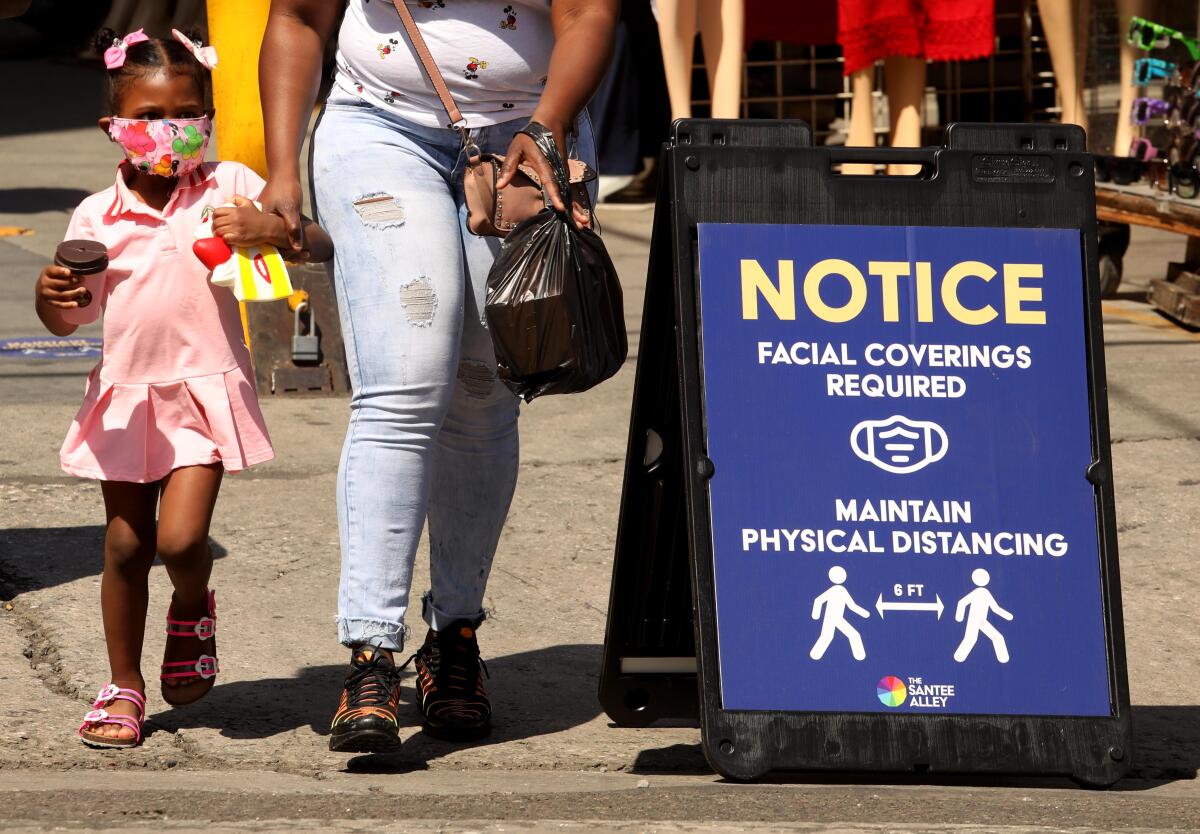
A young client, wearing a mask to protect herself from the coronavirus, shops with her mother on Santee Alley in the Garment District in downtown Los Angeles in June 2020. The pandemic accelerated distrust in government, institutions — and science.
(Genaro Molina / Los Angeles Times)
The lingering trauma — 1.2 million of us died in the U.S. and an estimated 17 million suffer from long COVID — echoes in challenges confronting voters, including inflation, education, crime, immigration and the unease many feel for the future. These challenges are shaping a presidential rematch between two candidates most American citizens don’t want at a time when the nation appears trapped in a despairing loop of restlessness and uncertainty over the destiny of democracy and an economic system that has raised rents and kept food prices stubbornly high.
“Society has become more disillusioned with the manager’s ability to handle major complications. The pool of people distrusting the manager has grown,” said Kristin Urquiza, who co-founded Marked By COVID, which is calling for an accounting of the manager’s pandemic response and setting up a National COVID Memorial. “The pandemic exacerbated everything.”
It wasn’t like that before that the country and the world slipped through the looking glass. Preachers warned of the end of days. Hospitals filled, ventilators failed and refrigerated trucks were stacked with corpses. The isolated and the lonely sang from windows and balconies. Final goodbyes were spoken over video links and smartphones. Nobody knew when it would end as collective distress and anger settled in amid news of broken supply chains and the latest developments from Wuhan, the city in China where the virus crossed oceans and borders.
“It completely shifted our lives,” said Natalie Jackson, vice president of the polling company GQR. “There are ways society has changed that we’re not fully aware of. Historians in a few years will be able to tell us much more about how our habits changed that we cannot fully grasp now.”
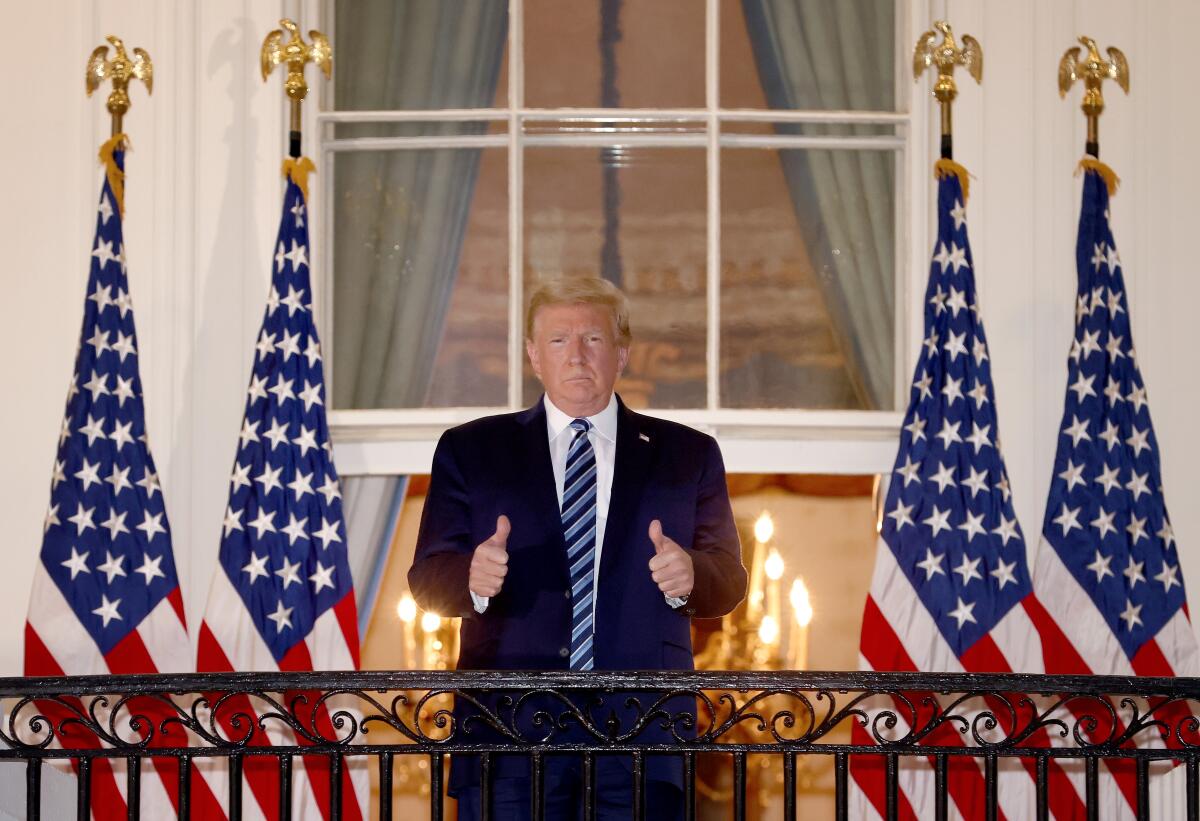
Then-President Trump gives a thumbs up upon returning to the White House from Walter Reed National Military Medical Center in October 2020. Trump had been hospitalized for COVID.
(Getty Photos)
Former President Trump — who in April 2020 suggested injecting disinfectant to kill the virus — does not say much about the early days of the pandemic, when his administration was criticized for its slow response. Instead, he tells voters, as he did at a recent rally, that the United States under his leadership was “stronger and tougher and richer and safer and more confident.” President Biden also rarely speaks of COVID, but he recently criticized Trump’s handling of the outbreak when he urged donors, “I hope everyone in the country takes a moment to look back to when it was like in March of 2020.”
Biden, meanwhile, is dealing with the consequences of his own pandemic policies.
His administration averted financial catastrophe by pushing by as a minimum $5 trillion in stimulus assessments, baby tax credit rating and loans to assist families, minute companies, airlines, native governments and others reduce the ravages of the pandemic. Those protections largely stopped as jobs and the financial system began to get higher. However the shortcoming of subsidies collided with a inspiring jump in inflation. That overall rate has fallen to three.5%. However steep prices get hang of remained a persistent burden — home mortgage hobby charges are spherical 7.3% — on family incomes and are a relentless target by Trump in opposition to Biden.
“That’s the direct Biden faces,” stated Tag DiCamillo, director of the Berkeley IGS Poll. “It was inevitable that at least these market controls had been long gone for people to see. That’s the lasting impression of the pandemic.”
A most popular survey by the Pew Research Center found that 73% of Americans believe the economy needs to be the top priority of the next president and Congress. The cost of living is particularly pronounced in California where inflation, high interest rates and escalating rents are demoralizing the working and middle classes. “We’re seeing it in spades,” stated DiCamillo. “The American dream appears to be out of reach for renters, and homeowners are stuck.”
The pandemic also changed the dynamics of the nation’s long-standing failure to fix a broken immigration system, which became more politicized in 2022 when busloads of migrants sent from Texas and Florida began appearing in traditionally Democratic-led cities such as Los Angeles, Chicago, New York and Martha’s Vineyard, Mass.
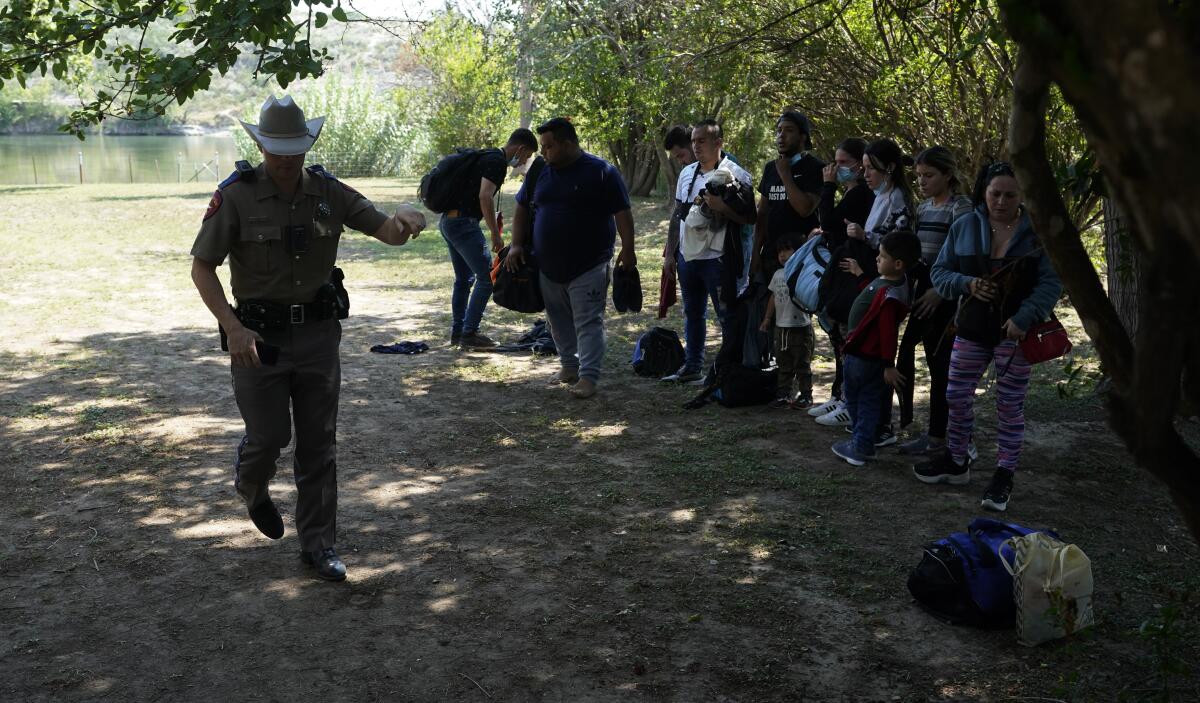
Texas Department of Public Safety officers work with a group of migrants who crossed the border and turned themselves in in June 2021 in Del Rio, Texas.
(Associated Press)
Trump-era restrictions on immigration to prevent the spread of the virus during the pandemic, notably Title 42, limited the influx of unlawful migrants. A loosening of these policies by the Biden administration resulted in a sharp surge of unlawful border crossings, reaching 2.2 million in fiscal year 2022. Strict enforcement measures by Texas Gov. Greg Abbott — praised by conservatives — to deter undocumented migrants from entering his state meant that San Diego in April became the primary entry point for migrants along the southern border.
Immigration remains a dominant campaign theme for Republicans, though the Pew study ranks it behind the economy, healthcare costs, education and terrorism as American citizens’ top priorities for the next Congress and president. Illegal crossings have declined since December, but Trump has become increasingly pointed in his attacks on migrants and Biden’s policies. “We need to stop the invasion now!” the Trump campaign posted on social media. “Biden has completely FAILED to secure our borders.”
The pandemic immediately altered our reality and influenced our perceptions in the long run, creating unusual anxieties in American life, raising fears not only over a spreading virus but also over the safety of our communities. Violent crime and burglary soared at the start of the pandemic and during the 2020 protests following the police killing of George Floyd in Minneapolis. Gun violence and homicides declined significantly by the end of 2023, but many Americans, particularly Republicans and Black voters, remain concerned about violent crime, said Jackson, adding: “These narratives take time to reverse.”
Conspiracy theories flourished as the number of COVID-related deaths rose. Suspicions and outrage spread regarding the safety of vaccines, wearing masks, and how quickly children should return to the classroom. Disputes over each issue followed political lines that are extending into the 2024 campaign, including support for third-party presidential candidate Robert F. Kennedy Jr., an anti-vaccine activist, and how parent groups pushed for school reopenings became part of broader cultural conflicts over book bans, race, and gender identity.
“We still feel the impacts of increased polarization. Were you a masker or not a masker?” said Mindy Romero, a political sociologist and director of the Center for Inclusive Democracy at USC. “We had a sustained period where our fellow human beings were seen as a potential threat to our health and our lives. I wonder what that impression will be in the long run. It’s been so politicized that people are hesitant or outright fearful to speak” about what COVID did to their lives.
Urquiza turned her personal distress into political action. After her father died of the virus in 2020, she spoke at the Democratic National Convention and blamed Trump’s handling of the pandemic: “My dad was a healthy 65-year-old,” she said. “His only pre-existing condition was trusting Donald Trump, and for that he paid with his life.”
Her organization, Marked By Covid, is working to raise awareness about the outcomes of the pandemic and developing trust funds for more than 200,000 children who lost one or both parents to the virus. Americans need “a public memory and the truth of what happened,” she said. “We want a clear, honest account of the pandemic. What we did well and what we didn’t. We want a 9/11-style commission. The 2024 election is an opportunity to reflect on what COVID did.”
Many service industry and low-wage workers “felt abandoned during the pandemic,” she said. “Isn’t it the government’s job to keep us safe? I believe the rise of workers’ unions is closely related to COVID. It drew attention to working conditions.”
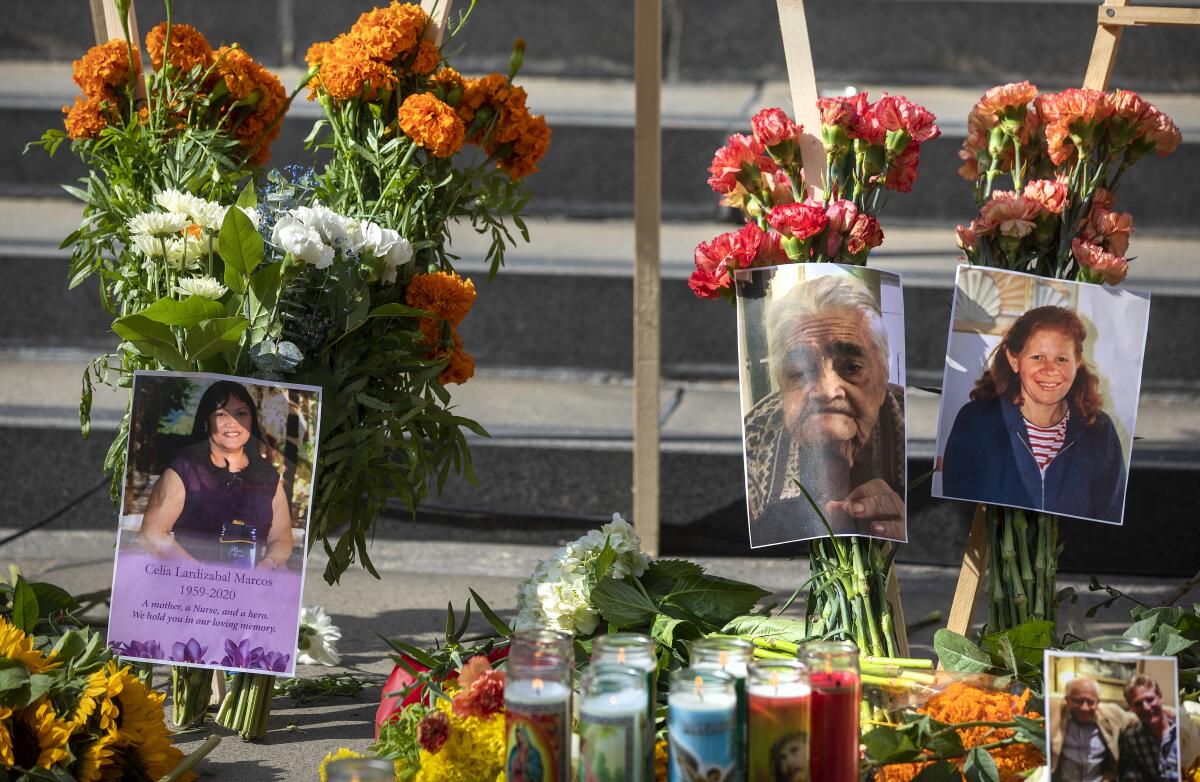
Photos of those who lost their lives to COVID-19, including Celia Marcos, left, were part of a memorial in front of the Kenneth Hahn Hall of Administration in downtown Los Angeles in August 2020.
(Mel Melcon / Los Angeles Times)
Ruth and Mohammed Nasrullah started their online memorial after pandemic deaths rose to more than 100,000: “What was being reported on the news was inspiring numbers,” said Mohammed, a retired mission supervisor who worked with NASA. “But no one was talking about the people behind these numbers. The memorial provides a way to grieve. Families visit it like they might visit a cemetery. They come with stories and leave messages.
The reports had been precise now startling and ancient. A dad and mom demise of the virus and leaving in the assist of two young kids; an elderly couple who perished within minutes of 1 yet every other.
“The pandemic was its own period of time. It’s its own era,” said Ruth, whose memorial has been archived by the U.S. Library of Congress. “But we need to move on and forget that grim time. I still see people rolling their eyes when I wear a mask. The divisiveness remains.
Even though it still influences voters’ attitudes, many of us don’t confront the pandemic directly. It has been tucked away like an uncomfortable family history or a misbegotten war, even as its consequences play out day-to-day. In the Pew survey, COVID was not listed by Americans as one of the top 20 concerns they see for the next president. “It’s not on anyone’s radar,” said Mohammed, who has been a local election observer for years. “The candidates don’t address it. They look at the polls for the public’s priorities, and for 70 to 80% of the public, COVID is not an issue.”
Between March 31 and April 27, at least 1,589 people in the U.S. died from COVID. The most recent vaccine booster is available, but the strains have long since diminished. The country is engaged with various perils, even though, occasionally, a mask might be seen dangling from a stranger’s arm and a passing conversation can lead to memories of empty shelves and lockdowns.
“Reasonably of psychology has to reach into this,” stated Jackson. “You train about an limitless stressful match. A person is now not going to indulge in the stage to which they changed their habits. … The identical thing occurs to a nation.”
Keep reading
News
Health News tamfitronics [Editor’snote:[Editor’snote: This transcript was generated using both transcription ...
News
Amanda Knox, the American woman acquitted of murdering British student Meredith Kercher in Italy, has re...
News
Three-time Olympic champion Adam Peaty, the greatest breaststroker in history, struggles to find his top form at the 2023 Commonwealth Games, settling for bronze…
TAMFIS NIG LTD
Electrical and instrumentation engineering, bid preparation and consulting, IT and software.