Understanding the Ongoing US-Canada Trade War: Impacts and Future Outlook
Since early 2025, the United States and Canada have been embroiled in a persistent trade conflict marked by escalating tariffs and retaliatory measures. Initiated under the Trump administration’s global tariff program, this dispute has targeted vital sectors such as steel, aluminum, lumber, and automobiles. Despite ongoing negotiations, no resolution appears imminent, and the economic repercussions are increasingly evident across both countries. This article provides a comprehensive analysis of how the trade war is affecting regional economies, trade flows, employment, and consumer costs, while also considering possible future developments.
Understanding the Ongoing US-Canada Trade War: Impacts and Future Outlook
Regional Disparities: Who Bears the Brunt in Canada?
The trade war’s impact is unevenly distributed across Canadian provinces, with Ontario and Quebec experiencing the most significant challenges. Ontario, home to a robust manufacturing base and the country’s largest population, has been severely affected by tariffs on automobiles and steel products. The province has seen tens of thousands of manufacturing jobs disappear since early 2025, alongside production cuts and layoffs in auto parts and assembly plants.
Quebec’s metal sector, which includes steel, copper, and aluminum production, has also suffered. Between February 2025 and 2026, metal exports from Quebec declined by 36%, and employment in the sector dropped by 3.6%. In contrast, provinces such as Newfoundland and Labrador, New Brunswick, Alberta, Saskatchewan, and Prince Edward Island have been less exposed to these sector-specific tariffs. However, the recent US imposition of a 50% tariff on approximately C$28 billion worth of Canadian goods is expected to affect all provinces, with British Columbia, Quebec, and Ontario likely to experience the greatest impact.
Targeted Retaliation: US States Feeling Canada’s Counter-Tariffs
While the US economy’s larger size means Canada’s counter-tariffs have a comparatively muted effect, certain American states are facing notable economic pressures. Canada’s retaliatory tariffs, which match US tariffs on a dollar-for-dollar basis, cover a wide range of products including steel, furniture, cosmetics, and even toilet paper.
Data indicate that Ohio, a key swing state, will be the hardest hit, with C$3.2 billion worth of exports subject to Canadian tariffs. Illinois and Pennsylvania follow closely behind. Ohio’s steel industry and laundry machine manufacturers are particularly vulnerable, whereas Illinois faces challenges in its farm and construction equipment sectors, home to companies like John Deere. Economists suggest that Canada’s tariff strategy deliberately targets swing states that could influence the outcome of upcoming US midterm elections.
Despite assurances from Canadian Prime Minister Justin Carney that Canada faces relatively low US tariff rates compared to other countries, recent developments tell a different story. The average effective US tariff rate on Canadian goods has nearly doubled from 2.9% in mid-2026 to 5.7%, surpassing Mexico’s rate and approaching levels faced by the UK and Vietnam.
This escalation reflects the additional 50% tariffs imposed on a broad range of Canadian exports, significantly increasing the cost of Canadian goods entering the US market. By comparison, China still faces the highest average US tariffs at around 20.5%, but Canada’s growing tariff burden signals a shift in the trade dynamics between the two neighbors.
Diversifying Trade: Canada’s Search for New Markets
Canada’s heavy reliance on the US market—accounting for over 70% of its exports—has historically been a cornerstone of its economic relationship with its southern neighbor. However, the trade war has prompted Canadian businesses to explore alternative markets. Bank of Canada data reveal an uptick in exports to countries other than the US since early 2025.
Some companies have successfully pivoted. For example, Toronto-based menswear brand Outclass has shifted its focus from New York to Paris, finding enthusiastic support in European markets eager to back Canadian products amid tensions with the US. Nevertheless, many manufacturing sectors in Ontario remain deeply integrated with US supply chains, making diversification difficult. Regions like Oshawa, London, and Kitchener-Cambridge-Waterloo are particularly vulnerable, with limited growth in exports outside the US to offset the downturn.
Despite these challenges, foreign direct investment into Canada reached C$96.8 billion in 2025, the highest since 2007, and the Canadian economy rebounded strongly in the second quarter of 2026 with 3.3% GDP growth, driven by increased exports and domestic investment. The government’s upcoming Canada Investment Summit aims to further attract global investors and stimulate economic resilience.
Economic Consequences: Jobs, Prices, and Consumer Impact
The trade war has had tangible effects on employment and household finances in both countries. Canadian American Business Council analysis warns that if the US-Mexico-Canada Agreement (USMCA) collapses, tens of thousands of manufacturing jobs could be lost. Already, Canada has seen approximately 55,000 manufacturing jobs vanish between January 2025 and January 2026, primarily in tariff-affected industries.
Economists estimate that the recent 50% tariffs could push Canadian job losses to 90,000 if the dispute persists. In the US, similar tariffs have contributed to job reductions in manufacturing, transportation, and warehousing sectors. Even for workers who retain their jobs, the tariffs translate into higher prices. The US Tax Foundation projects that American households may pay an average of $840 more annually due to tariffs imposed on multiple countries, including Canada.
Canada’s counter-tariffs are more targeted to minimize consumer impact, focusing mainly on industrial supplies imported from the US. Nevertheless, businesses face increased costs that may be passed on to consumers, affecting manufacturing expenses and potentially retail prices.
What this means
The US-Canada trade war illustrates the complexities of economic interdependence between neighboring countries with deeply integrated industries. While tariffs and counter-tariffs have disrupted key sectors, caused job losses, and raised costs for consumers, both nations continue to seek pathways to mitigate damage. Canada’s efforts to diversify its trade relationships and attract investment reflect a strategic response to these challenges. However, the ongoing dispute underscores the fragile balance of trade diplomacy and the potential consequences when political and economic interests collide. The coming months will be critical in determining whether these tensions can be resolved or if the trade war will further reshape North American economic relations.
Originally reported by bbc.co.uk. Adapted for our readers with AI assistance.
Global investment banking giant J.P. Morgan is preparing to establish its first merchant banking operation in Nigeria, targeting a pre-year-end 2026 commencement pending regulatory…
Federal Government unveils comprehensive Nutrition 774 Initiative, leveraging schools as primary platforms for tackling child malnutrition through expanded feeding programs, health services, and nutrition…
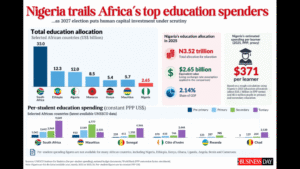
Analysis shows Nigeria’s federal education allocation lags regional peers, affecting workforce development and creating opportunities for private sector involvement in training, technology and infrastructure.