Unique NASA Visualization Shows Supermassive Sunless Hole’s Tournament Horizon
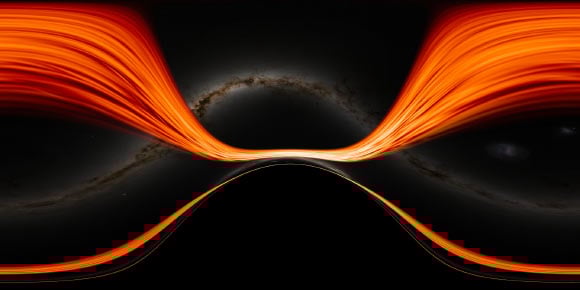
Black holes have long fascinated scientists and the public alike, representing some of the most extreme environments in the universe. Among these, supermassive black holes — millions of times the mass of our Sun — pose unique challenges for observation and understanding. Thanks to a novel visualization created using NASA’s powerful supercomputing resources, we now have a detailed glimpse into the event horizon, the critical boundary beyond which nothing can escape a black hole’s gravitational grip. This article explores the simulation’s insights, the physics behind the phenomena, and what it means for our understanding of black holes.
Simulating the Edge of a Black Hole
NASA astrophysicist Dr. Jeremy Schnittman, alongside scientist Brian Powell, utilized the NASA Center for Climate Simulation’s supercomputer, known as Discover, to create a detailed visualization of a supermassive black hole’s event horizon. This simulation involved processing approximately 10 terabytes of data over five days, using a fraction of Discover’s 129,000 processors. Such a task would take over a decade on a conventional computer, highlighting the immense computational power required.
The simulation tracks a virtual camera acting as a proxy for an astronaut approaching the black hole. Two scenarios were modeled: one where the camera narrowly avoids crossing the event horizon and escapes, and another where it crosses the boundary, sealing its fate. This approach helps bridge the complex mathematics of general relativity with tangible, visual phenomena that can be understood in the context of our universe.
Understanding the Event Horizon and Spaghettification
The event horizon is often described as the point of no return around a black hole. For the supermassive black hole simulated — with a mass 4.3 million times that of the Sun, similar to the one at the center of the Milky Way — this boundary spans about 16 million miles (25 million kilometers), roughly 17% of the distance from Earth to the Sun.
Unlike smaller stellar-mass black holes, which have stronger tidal forces that can rip apart objects before they reach the event horizon, supermassive black holes have gentler gradients at their horizons. This means an object approaching the event horizon of a supermassive black hole would not be torn apart immediately but would experience extreme gravitational effects closer to the singularity at the center.
One such effect is spaghettification, where the difference in gravitational pull between the near and far ends of an object stretches it into a long, thin shape. This phenomenon is a direct consequence of the intense gravitational gradient near black holes.
Visual Distortions Near the Black Hole
The simulation vividly illustrates how light behaves near the event horizon. Surrounding the black hole is a bright, swirling accretion disk composed of hot gas emitting intense radiation. This disk serves as a visual reference point as the camera approaches.
Additionally, the simulation shows photon rings — light that has orbited the black hole one or more times before reaching the observer. These rings create complex and multiple images of the accretion disk and background stars, distorted by the extreme warping of spacetime.
As the camera moves closer at speeds approaching that of light, the glow from the accretion disk and stars intensifies and shifts in color, becoming brighter and whiter due to relativistic effects similar to the Doppler shift experienced with sound. This effect enhances the visual experience, making the black hole’s surroundings appear dramatically altered.
Time Dilation and the ‘Frozen Star’ Illusion
One of the most intriguing aspects of black holes is the distortion of time near their event horizons. From the perspective of a distant observer, the camera approaching the black hole appears to slow down and eventually freeze just outside the event horizon. This is because time itself is increasingly warped by the black hole’s gravity, a phenomenon known as gravitational time dilation.
This effect led early astronomers to describe black holes as “frozen stars,” since objects seemed to hover indefinitely at the edge rather than crossing over. In reality, from the camera’s own frame of reference, it crosses the event horizon without noticing any sudden change in the flow of time.
Once inside the event horizon, both the camera and the flow of time move inexorably toward the singularity — a point where known physics breaks down. In the simulation, the camera’s destruction by spaghettification occurs just 12.8 seconds after crossing the horizon, with the journey to the singularity spanning 128,000 kilometers (79,500 miles) and lasting only a fraction of a second.
Implications for Space Travel and Relativity
The simulation also explores the hypothetical scenario of an astronaut orbiting near the event horizon. If such a journey lasted about six hours from the astronaut’s perspective, observers far from the black hole would see the astronaut return roughly 36 minutes younger due to time dilation effects.
Dr. Schnittman notes that if the black hole were rotating — as is believed to be the case with many real black holes, including the one depicted in the film Interstellar — the time dilation effects could be even more pronounced, potentially allowing the astronaut to return years younger than their counterparts.
These insights not only deepen our understanding of black hole physics but also illustrate the profound implications of Einstein’s theory of relativity in extreme gravitational fields.
What this means
NASA’s groundbreaking visualization offers an unprecedented window into the mysterious environment surrounding a supermassive black hole’s event horizon. By combining advanced computational power with the principles of general relativity, scientists have transformed abstract mathematical concepts into vivid, comprehensible imagery. This not only enhances our understanding of black hole physics but also underscores the fascinating interplay between gravity, light, and time in the cosmos. As computational capabilities continue to advance, such simulations will be invaluable tools for exploring the universe’s most extreme phenomena and inspiring future research into the nature of space and time.
Originally reported by sci.news. Adapted for our readers with AI assistance.
Author of the article: Published Sep 18, 2026 11 minute read Article content Kyndryl Canada has been engaged to deliver a commercialization strategy and…
The National Agency for Science and Engineering Infrastructure (NASENI) on Friday 4th September 2026, marked three years of institutional transformation under its Executive Vice…
Municipal Administration Minister P. Narayana speaks to residents after laying the foundation stone for the slum redevelopment project at Velampeta, near Lakshmi Nagar in…