In May 2017, NASA’s Curiosity rover observed higher-than-usual amounts of manganese in the lakebed rocks within Gale crater, Mars. These sedimentary rocks contain larger grain sizes than is typical for the lakebed rocks in the crater. This suggests that the original sediments were formed in a river, delta, or near the shoreline of the ancient lake. In a new paper, Dr. Patrick Gasda from Los Alamos National Laboratory and his colleagues explain how manganese may have been enriched in these rocks—for example, by percolation of groundwater through the original sediments or through the rock later—and what oxidant could have been responsible for the precipitation of manganese in the rocks. On Earth, manganese becomes enriched due to oxygen in the atmosphere, and this process is often accelerated by the presence of microbes. Microbes on Earth can use the various oxidation states of manganese as an energy source for metabolism; if life existed on ancient Mars, the elevated amounts of manganese in these rocks along the lake shore could have been a significant energy source for life.

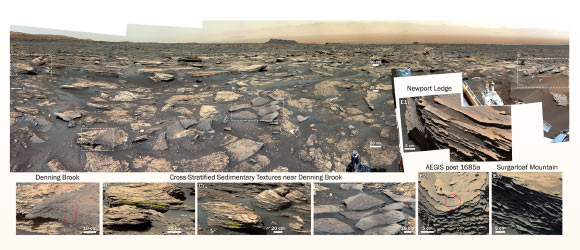
Mastcam mosaic from the Sol 1686 rover location looking behind the rover (downslope) at the transition point between the Sutton Island and Blunts Point Murray members. Images from Sols 1685-1689 show sedimentary textures of dark-toned manganese-rich sandstones and nearby rocks. Dashed line boxes in the full mosaic are shown as insets along the bottom of the figure. Small red outlines indicate the approximate areas and extent of ChemCam observations. During this transition feature, dark-toned sandstones (likely manganese-rich based on ChemCam observations at three locations) overlie light-toned materials. Insets from left to right: (a) Denning Brook, a manganese-rich fine-grained dark-toned sandstone ChemCam observation; (b) and (c) two light-toned blocks with poorly stratified textures, highlighted with yellow lines, 6 m away from Denning Brook and to the upper left in the full mosaic; (d) dark-toned materials (center of mosaic); and (E1) Newport Ledge, (E2) AEGIS post 1685a, (E3) Sugarloaf Mountain, three thin planar laminated dark-toned sandstones. Image credit: NASA / Caltech-JPL / MSSS.
“It is unusual for manganese oxide to accumulate on the surface of Mars, so we did not expect to find it in such high concentrations in a shoreline deposit,” Dr. Gasda said.
“On Earth, these types of deposits occur frequently due to the high oxygen in our atmosphere produced by photosynthetic life, and from microbes that help catalyze those manganese oxidation reactions.”
“On Mars, we have no evidence for life, and the mechanism to produce oxygen in Mars’ ancient atmosphere is unclear, so how the manganese oxide formed and became concentrated here is truly puzzling.”
“These findings suggest ongoing processes occurring in the Martian atmosphere or surface water and indicate that more work needs to be done to understand oxidation on Mars.”
To measure manganese abundances in lakebed rocks within Gale crater, Dr. Gasda and co-authors used the ChemCam instrument onboard NASA’s Curiosity rover.
“ChemCam is an atomic emission spectroscopy instrument that uses laser-induced breakdown spectroscopy (LIBS) to quantify elemental abundances present in a target,” they explained.
“The ChemCam LIBS uses a pulsed laser emitting a 1,067 nm beam that is focused onto a target up to 7 m from the rover, which produces an analytical footprint of 350-550 μm.”
“Every laser pulse ablates and ionizes a small (nanograms to micrograms) amount of material.”
“Gentle emitted from the plasma fashioned by every laser pulse is smooth by the ChemCam telescope, and spectra are recorded by the ultraviolet, violet, and considered to attain infrared spectrometers.”
The sedimentary rocks explored by the Curiosity rover are a mix of sands, silts, and muds.
The sandy rocks are more porous, and groundwater can flow more easily through sands compared to the muds that make up much of the lakebed rocks in Gale crater.
The researchers examined how manganese might have been enriched in these sands — for example, by percolation of groundwater through the sands at the shore of a lake or mouth of a delta — and what oxidant could very well be responsible for the precipitation of manganese in the rocks.
On Earth, manganese becomes enriched because of oxygen in the atmosphere, and this process is mostly accelerated by the presence of microbes.
Microbes on Earth can use the multiple oxidation states of manganese as an energy source for metabolism; if life existed on ancient Mars, the increased amounts of manganese in these rocks along the lake shore would have been a significant energy source for life.
“The Gale lake environment, as revealed by these ancient rocks, gives us a window into a habitable setting that appears to be surprisingly similar to places on Earth today,” said ChemCam principal investigator Dr. Nina Lanza, a researcher at Los Alamos National Laboratory.
“Manganese minerals are common in the shallow, oxic waters found on lake shores on Earth, and it’s encouraging to find such recognizable features on ancient Mars.”
The team’s paper was published in the Journal of Geophysical Research: Planets.
_____
PJ Gasda et al. 2024. Manganese-Rich Sandstones as an Indicator of Ancient Oxic Lake Water Conditions in Gale Crater, Mars. JGR: Planets 129 (5): e2023JE007923; doi: 10.1029/2023JE007923