
Business News
NDLEA Intensifies Operations Against Narcotic Trade and Illegal Trafficking
The National Drug Law Enforcement Agency has arrested multiple suspects and seized significant drug consignments in recent operations across Nigeria.
TAMFIS NIG LTDRC 8067447CAC ACTIVEFinima, Bonny Island, Rivers State

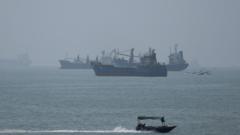
In late August 2026, US forces conducted their first known strikes on Iranian territory since July, targeting rocket launchers on Larak Island in the Strait of Hormuz. This action has intensified the already volatile situation in the region, prompting retaliatory missile attacks by Iran on US military bases in Jordan and drone strikes targeting the United Arab Emirates (UAE). The Strait of Hormuz, a crucial maritime chokepoint for global energy supplies, remains at the center of this escalating confrontation, raising concerns about the security of international shipping lanes and the stability of global oil markets.
The Strait of Hormuz is a narrow waterway separating Iran from the Arabian Peninsula, specifically the UAE and Oman. At its narrowest point, the strait spans approximately 21 miles (33 kilometers), with shipping lanes that lie entirely within the territorial waters of Iran and Oman. This narrow passage is critical for global energy transportation, as around 20% of the world's oil and liquefied natural gas (LNG) shipments historically pass through it.
Since the conflict between the US and Iran intensified in early 2026, the Strait of Hormuz has effectively been closed to marine traffic, severely disrupting global energy supplies. Iran has imposed stringent controls over tanker movements, demanding that vessels pass near Larak Island for inspections and reportedly charging fees as high as $2 million per crossing. These actions have contributed to wild fluctuations in oil prices and heightened concerns about the security of global energy markets.
The US Central Command (Centcom) carried out a 'limited, precise' attack on two Iranian rocket launchers located on Larak Island, a small island just offshore from the port city of Bandar Abbas. This strike resulted in the deaths of two individuals and injuries to two others, according to Iran's Islamic Revolutionary Guard Corps (IRGC). The US justified the operation by citing intelligence that Iran was preparing to launch rockets and deploy sea mines into the Strait of Hormuz, which could further threaten maritime security.
Iranian state media reported that the US attack was executed using drones, marking a significant escalation as it was the first known US strike on Iranian soil since President Donald Trump paused a renewed military campaign in late July. The strike underscores the strategic importance the US places on preventing Iran from disrupting the flow of maritime traffic through the strait.
In response to the US strikes, the IRGC launched ballistic missile attacks on US military bases in Jordan, specifically targeting King Hussein and al-Azraq bases. Jordanian authorities confirmed intercepting eight missiles early on Monday morning, mitigating potential damage. Additionally, Iranian state television claimed that drones targeted the Al-Minhad Air Base in the UAE, although the UAE Ministry of Defence denied any successful strikes, confirming only the interception of a drone.
Iran’s foreign ministry condemned the US military action as aggression and framed its missile attacks as legitimate defense. Iranian President Masoud Pezeshkian emphasized that while Iran does not seek war, it is prepared to deliver decisive responses to any aggressors. These developments highlight the risk of further escalation, with multiple regional actors now directly involved.
The ongoing conflict and the effective closure of the Strait of Hormuz have caused significant volatility in global oil markets. The strait’s closure disrupts the transit of a substantial portion of the world’s oil and LNG supplies, leading to price spikes and uncertainty in energy markets worldwide. The US and its allies have expressed concerns about Iran’s control over tanker traffic and the imposition of exorbitant fees for passage, which exacerbate tensions and complicate maritime logistics.
President Trump’s social media posts, including AI-generated videos depicting explosions at Iranian oil infrastructure such as Kharg Island—a major oil terminal—have further heightened fears of a broader military confrontation that could severely impact global energy supplies. While these posts did not provide detailed context, they signal the US administration’s willingness to apply pressure on Iran’s energy assets.
The US strikes and Iran’s retaliatory actions occur amid a broader context of renewed economic sanctions and a naval blockade imposed by the US on Iran. Washington’s recent sanctions campaign aims to isolate Tehran further and target its allies, although Iranian officials dismiss these measures as extensions of previous efforts following what they describe as US military failures.
The naval blockade has hindered Iran’s ability to export oil, with Centcom reporting the disabling of three vessels, boarding of two, and redirection of 82 ships as part of enforcement operations. This blockade, combined with military strikes and missile exchanges, underscores the intensifying proxy and direct confrontations in the region.
The situation remains fragile, with the potential for miscalculations leading to wider conflict. The involvement of regional states such as Jordan and the UAE, along with the strategic significance of the Strait of Hormuz, means that any escalation could have far-reaching consequences for regional stability and global economic security.
The recent US strikes on Iranian military assets in the Strait of Hormuz and Iran’s swift retaliatory missile and drone attacks underscore the fragile and volatile nature of security in this strategically vital region. The Strait of Hormuz’s importance as a global energy transit route means that any escalation has immediate ramifications for international markets and geopolitical stability. While both sides express a reluctance to engage in full-scale war, the cycle of action and retaliation highlights the persistent risks of miscalculation. Continued diplomatic efforts, alongside careful military posturing, will be essential to prevent further destabilization and to ensure the free flow of commerce through one of the world’s most critical maritime corridors.
Originally reported by bbc.co.uk. Adapted for our readers with AI assistance.
Keep reading
Business News
The National Drug Law Enforcement Agency has arrested multiple suspects and seized significant drug consignments in recent operations across Nigeria.
Business
Nigerian shoppers are increasingly turning to AI assistants like ChatGPT, Claude and Gemini for product ...
Business
The global developer workforce has undergone a transformative expansion over the past five years, fundam...
TAMFIS NIG LTD
Electrical and instrumentation engineering, bid preparation and consulting, IT and software.