
News
RUSSIA versus NATO and BRICS vs. NATO Military SWOT
Recall that Poland’s Minister Sikorski’s core claim is partially supported by the numbers, but the framing “quite quickly” and “without the U.S.” does not…
TAMFIS NIG LTDRC 8067447CAC ACTIVEFinima, Bonny Island, Rivers State

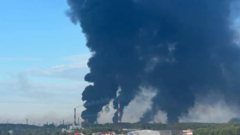
The war between Ukraine and Russia, now extending over four years since Russia’s full-scale invasion in February 2022, continues to evolve with new strategic targets and intensified attacks. Recently, Ukraine claimed responsibility for strikes on two vital oil refineries located hundreds of kilometers inside Russia, alongside attacks on vessels in the Black Sea. These operations represent a bold move to undermine Russia’s economic resources fueling its military campaign. Meanwhile, Russia has responded with drone attacks on Ukrainian infrastructure and cities, leading to casualties and widespread disruptions. This article analyzes the recent developments, their implications for the conflict, and the broader strategic context.
On 6 August 2026, Ukraine announced successful strikes on two major oil refineries within Russian territory: the Bashneft-Novoil refinery in Bashkortostan and the Slavneft-Yanos refinery in Yaroslavl. These facilities are located approximately 1,300 km and 700 km from the Ukrainian border, respectively, highlighting the reach and precision of Ukrainian military capabilities.
President Volodymyr Zelensky emphasized that these attacks aim to curtail the oil revenues Moscow relies on to finance its ongoing war efforts. The Bashneft-Novoil refinery, situated in the Bashkortostan republic, and the Slavneft-Yanos refinery, which caught fire following what local authorities described as the largest enemy drone attack in the Yaroslavl region, are critical components of Russia’s energy infrastructure.
Yaroslavl regional governor Mikhail Evraev reported that 93 drones were intercepted overnight during the assault, but debris from downed drones caused fires at the refinery’s storage tanks. Emergency services are actively working to contain the blaze. The attack resulted in injuries to four people but no confirmed fatalities at the refinery site.
The targeting of such deep inland facilities marks a significant escalation, signaling Ukraine’s intent to strike at the economic underpinnings of Russia’s war machinery. By disrupting oil refining capacity, Ukraine aims to reduce Russia’s ability to generate revenue from oil exports, particularly those circumventing international sanctions. This approach seeks to choke off critical funding streams that Moscow uses to sustain its military operations and prolong the conflict.
In addition to the refinery strikes, Ukraine reported attacks on two military patrol boats and several 'shadow fleet' vessels in the Black Sea. These shadow fleet vessels are tankers used by Russia to export sanctioned oil illegally, circumventing international restrictions.
By targeting these vessels, Ukraine is attempting to choke off illicit oil exports, further squeezing Russia’s financial resources. The Black Sea remains a critical maritime corridor for Russia’s oil shipments, and Ukraine’s naval operations demonstrate a strategic effort to disrupt this lifeline.
Russian President Vladimir Putin’s forces have responded with intensified drone strikes on Ukrainian cities and infrastructure, particularly focusing on fuel, energy, and transportation facilities. The reciprocal nature of these attacks underscores the ongoing tit-for-tat dynamic that characterizes much of the conflict’s military engagements.
These maritime attacks highlight Ukraine’s expanding operational reach and its strategic focus on undermining Russia’s economic lifelines beyond land-based targets. The Black Sea’s significance as a conduit for Russian oil exports makes it a vital front in the economic warfare accompanying the physical conflict.
While Ukraine targets Russian economic infrastructure, Russia has escalated drone attacks on Ukrainian territory, resulting in civilian casualties and widespread damage. Overnight drone strikes in northeastern Ukraine’s Kharkiv region killed at least three people in the town of Balakliya, with fires reported in residential buildings.
Additional drone attacks targeted the train station in Lozova, killing two more people and injuring eight. In the central Dnipropetrovsk region, Russian strikes claimed five lives. The southern city of Kherson experienced a total blackout after a critical infrastructure facility was hit, severely disrupting electricity and internet connectivity.
Internet monitoring group NetBlocks reported a significant drop in connectivity in Kherson, with levels falling to as low as 31% overnight before partially recovering. These attacks highlight the ongoing humanitarian toll of the conflict and the vulnerability of civilian infrastructure to military operations.
The targeting of civilian infrastructure such as power grids and transportation hubs not only disrupts daily life but also hampers Ukraine’s ability to sustain its defense and recovery efforts. The widespread blackouts and connectivity losses further isolate affected populations, compounding the war’s human cost.
The front line between Ukraine and Russia remains largely static, with neither side achieving decisive breakthroughs. Both countries have intensified attacks on major cities, energy facilities, and warehouses, reflecting a war of attrition and economic disruption.
Efforts at mediation and diplomacy have so far failed to produce a breakthrough, with President Zelensky asserting that Ukraine’s recent strikes are intended to strengthen the chances for peace by pressuring Russia economically and militarily.
Russia’s military claims of intercepting over 600 Ukrainian drones overnight indicate the scale and intensity of ongoing hostilities. Both sides continue to deploy drones extensively, underscoring the increasing role of unmanned systems in modern warfare.
The attacks on oil refineries and maritime assets represent a shift toward targeting economic infrastructure critical to sustaining military operations. This approach may prolong the conflict by increasing economic strain but also risks escalating retaliatory strikes on civilian areas.
As the conflict endures, the strategic calculus involves balancing military gains with the potential for escalation and humanitarian consequences. Ukraine’s targeting of economic infrastructure aims to weaken Russia’s war effort, while Russia’s retaliatory strikes seek to undermine Ukrainian resilience and morale.
The recent Ukrainian strikes on Russian oil refineries and Black Sea vessels mark a significant escalation in the ongoing conflict, targeting the economic foundations of Russia’s war effort. While these operations demonstrate Ukraine’s growing military capabilities and strategic reach, they also increase the risk of intensified retaliatory attacks on Ukrainian cities and infrastructure. The conflict’s persistence underscores the challenges of achieving a diplomatic resolution amid deepening hostilities and mutual attempts to weaken each other’s war-sustaining capacities. As the war continues, the humanitarian impact on civilians remains severe, highlighting the urgent need for renewed efforts toward peace.
Originally reported by bbc.co.uk. Adapted for our readers with AI assistance.
Keep reading
News
Recall that Poland’s Minister Sikorski’s core claim is partially supported by the numbers, but the framing “quite quickly” and “without the U.S.” does not…
News
By Engr. Tamunofiniarisa BrownReading Time: 6 Minutes The conflict between Russia and Ukraine is often framed in the media as a simple battle between…
World News
Following a tragic crash on the A66 near Middlesbrough that killed two police officers and five young men, Cleveland Police have arrested three more…
TAMFIS NIG LTD
Electrical and instrumentation engineering, bid preparation and consulting, IT and software.