News
RUSSIA versus NATO and BRICS vs. NATO Military SWOT
Recall that Poland’s Minister Sikorski’s core claim is partially supported by the numbers, but the framing “quite quickly” and “without the U.S.” does not…
TAMFIS NIG LTDRC 8067447CAC ACTIVEFinima, Bonny Island, Rivers State

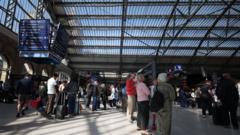
On August 6, 2026, a power failure at the Manchester Rail Operating Centre led to major disruptions across the rail network in northern England. Thousands of passengers experienced delays, cancellations, and lengthy journeys as the outage affected signalling and train operations over a wide area. This incident underscores the critical role of centralized control centres in modern rail systems and the challenges posed when such infrastructure encounters technical failures.
Just before 2:00 PM BST on August 6, 2026, an electrical failure occurred at the Manchester Rail Operating Centre (ROC), located in the Ardwick area. This centre is a key control hub responsible for managing signalling and train operations across a vast region in northern England, spanning from Crewe in the south to Carlisle in the north, and from Todmorden in the east to the Welsh border in the west.
The power outage disrupted the signalling systems, causing immediate delays and cancellations. Transport for Greater Manchester (TfGM) confirmed the failure was part of a broader power supply issue in the Ardwick area. The disruption was significant enough that Transport Secretary Heidi Alexander issued a public advisory warning passengers to check train services before travelling, as delays were expected to continue throughout the day.
The outage affected at least eight rail operators, including major services running through key hubs such as Liverpool Lime Street, Manchester Piccadilly, and stations across Greater Manchester and northern England. The disruption extended beyond the immediate area, with trains travelling north from Birmingham New Street and London Euston also experiencing delays and cancellations due to the ripple effect of the outage.
BBC Transport correspondent Katy Austin described the incident as causing a 'ripple effect,' where the failure in Manchester's signalling centre impacted services far beyond the local network. This included delays in the Midlands and other regions not directly connected to the power failure.
Adding to the day's challenges, Network Rail reported that a wartime bomb discovered near the railway line between Tamworth and Burton-on-Trent temporarily blocked all lines between the two stations, further complicating travel for passengers in the Midlands.
Thousands of passengers faced significant inconvenience. Sarah Nelson, a remedial massage therapist, described her journey as a 'nightmare,' enduring a five-hour round trip to get home to Blackpool after her train was stuck for over 90 minutes at Horwich Parkway.
Chris, a technology consultant travelling from Scotland to Manchester for business, expressed frustration over the delays, noting the financial and logistical impact of having to book a hotel overnight due to the lack of train services.
Other passengers, like Matt and Sarah who returned from a trip to Gibraltar, found themselves forced to take costly alternative transport such as Uber rides due to cancelled trains. Stacey, an office worker, was among those evacuated from a train that stopped prematurely in Manchester when signalling failed. She praised the staff for their calm and professional handling of the evacuation, despite paying £60 for a taxi home.
These personal accounts highlight the broader human impact of infrastructure failures on daily commuters and travelers, emphasizing the importance of reliable rail services.
The Manchester Rail Operating Centre, opened in July 2014, is a crucial facility that consolidates control of signalling and train operations across northern England. By centralizing these functions, the ROC aims to improve efficiency and safety across a complex network.
However, this centralization also creates a single point of failure. The power outage at the ROC demonstrated how a technical fault in one location can cascade across a large geographic area, disrupting services for thousands of passengers and multiple train operators.
Network Rail's operational control boundary managed from the ROC covers a vast region, making the centre indispensable for coordinating rail traffic. The incident raises questions about the resilience and redundancy of such critical infrastructure.
Transport Secretary Heidi Alexander publicly acknowledged the disruption and expressed regret for the inconvenience caused to passengers. She urged travelers to check train statuses before planning journeys and stay informed about ongoing developments.
National Rail provided regular updates and advised passengers on affected routes. As of 8:00 PM BST, several operators, including Avanti West Coast, CrossCountry, East Midlands Railway, London Northwestern Railway, Lumo, Northern, TransPennine Express, and Transport for Wales, reported ongoing delays, cancellations, or service suspensions.
Passengers impacted by delays or cancellations may be eligible for compensation through various schemes offered by train companies. The amount and eligibility depend on factors such as ticket type and length of delay. Claims can be submitted online, by post, or through the nationwide Delay Repay scheme.
This framework aims to provide some financial relief to travelers affected by such disruptions, although it does not mitigate the inconvenience experienced.
The power failure at the Manchester Rail Operating Centre on August 6, 2026, exposed vulnerabilities in the rail network’s centralized control systems and underscored the wide-reaching impact such failures can have on passengers and train operators alike. While the disruption was eventually resolved, the incident serves as a reminder of the importance of robust infrastructure resilience and contingency planning in public transport. For passengers, staying informed and understanding compensation options can help mitigate the effects of unexpected travel disruptions. Moving forward, rail authorities may need to assess how to enhance system redundancies to prevent similar incidents from causing widespread chaos.
Originally reported by bbc.co.uk. Adapted for our readers with AI assistance.
Keep reading
News
Recall that Poland’s Minister Sikorski’s core claim is partially supported by the numbers, but the framing “quite quickly” and “without the U.S.” does not…
News
By Engr. Tamunofiniarisa BrownReading Time: 6 Minutes The conflict between Russia and Ukraine is often framed in the media as a simple battle between…
World News
Following a tragic crash on the A66 near Middlesbrough that killed two police officers and five young men, Cleveland Police have arrested three more…
TAMFIS NIG LTD
Electrical and instrumentation engineering, bid preparation and consulting, IT and software.