
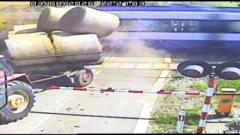
A dramatic collision recently unfolded in Poland when a passenger train struck a trailer carrying bales of straw obstructing the railway tracks. Captured on CCTV, the footage revealed that the trailer driver had stopped on the tracks despite active warning signals and descending barriers. Authorities confirmed the driver was intoxicated at the time, raising serious concerns about safety compliance and risk management at railway crossings. Fortunately, no passengers or crew members were injured, but the event underscores the grave dangers posed by human error and impaired judgment near rail infrastructure, where seconds can mean the difference between life and death.
The Incident: What Happened on the Tracks?
The collision occurred when a passenger train traveling through Poland encountered a trailer loaded with straw bales obstructing the railway tracks. CCTV footage shows the train approaching as the trailer remained stationary on the rails. Despite the train’s efforts, it was unable to stop in time, resulting in a collision.
Polish railway authorities reported that the trailer driver had stopped in the middle of the tracks while warning lights were flashing and barriers were descending, signaling an approaching train. This breach of safety protocols directly led to the collision.
Remarkably, the crash did not result in any injuries to the passengers or train crew, a fortunate outcome given that approximately 500 people were on board the train at the time. The absence of casualties highlights both the train’s safety features and the quick response of the crew in managing the emergency.
Human Error and Intoxication: A Dangerous Combination
Investigations revealed that the trailer driver was intoxicated when he stopped on the railway tracks. This factor significantly contributed to the dangerous situation, as impaired judgment likely prevented the driver from recognizing or responding appropriately to the warning signals and barriers.
Driving under the influence near railway crossings not only violates traffic laws but also puts countless lives at risk. In this case, the driver’s condition endangered the safety of hundreds of train passengers and crew members, creating a potentially catastrophic scenario.
Authorities have emphasized the seriousness of the offense, noting that such behavior could have led to a tragic accident with severe injuries or fatalities. This incident serves as a stark warning about the consequences of impaired driving, especially in high-risk areas such as railway crossings.
Railway Crossing Safety: Challenges and Preventive Measures
Railway crossings are inherently risky points where road and rail traffic intersect, requiring heightened attention and strict adherence to safety protocols. Safety measures such as barriers, flashing lights, and audible warnings are designed to prevent accidents by alerting drivers and pedestrians to approaching trains.
Despite these precautions, accidents continue to occur, often due to human error, distraction, or deliberate disregard for safety signals. Intoxication, as demonstrated in this incident, exacerbates these risks by impairing decision-making abilities and reaction times.
To enhance safety, authorities recommend increased public awareness campaigns about the dangers of crossing railway tracks improperly, stricter enforcement of traffic laws, and technological improvements such as advanced detection systems that can automatically halt trains if an obstruction is detected on the tracks.
Additionally, targeted training for drivers, especially those operating heavy or commercial vehicles, on the critical importance of adhering to railway crossing signals can reduce the likelihood of such incidents. Emphasizing the severe consequences of non-compliance may foster more responsible behavior.
The Role of Technology and Infrastructure in Preventing Collisions
Modern railway systems increasingly incorporate technology to improve safety at crossings. For example, sensors can detect obstacles on tracks and communicate with train operators to initiate emergency braking, potentially preventing collisions before they occur.
In some regions, grade separation projects—such as overpasses or underpasses—eliminate the intersection of road and rail traffic altogether, significantly reducing collision risks by physically separating vehicles from trains.
Poland, like many countries, continues to invest in upgrading its railway infrastructure to enhance safety. However, technology alone cannot eliminate accidents without responsible behavior from road users. Infrastructure improvements must be complemented by compliance with safety regulations and sober, attentive driving.
This incident serves as a reminder that while technological advances and infrastructure upgrades are vital, they are not substitutes for vigilance and adherence to safety protocols by all road users.
Legal and Safety Implications Following the Incident
Following the collision, Polish authorities launched an investigation into the circumstances surrounding the incident, focusing on the trailer driver’s intoxication and decision to stop on the tracks during active warnings.
Legal consequences for the driver may include charges related to endangering public safety, driving under the influence, and obstructing railway operations. Such charges underscore the gravity of the offense and serve as a deterrent against similar behavior.
The incident has also prompted calls for reviewing current safety protocols and penalties to deter reckless behavior at railway crossings in the future. Railway companies and government agencies are likely to reassess their safety communication strategies and enforcement mechanisms to prevent recurrence.
This event may catalyze broader discussions on improving cross-sector cooperation between traffic authorities, law enforcement, and railway operators to enhance overall safety.
What this means
The collision between a passenger train and a trailer carrying straw bales in Poland serves as a stark reminder of the dangers posed by impaired and irresponsible behavior at railway crossings. While the absence of injuries in this incident is fortunate, the potential for tragedy was significant. Ensuring safety at these critical intersections requires a combination of robust infrastructure, advanced technology, strict enforcement of traffic laws, and ongoing public education. Ultimately, the responsibility lies with all road users to adhere to safety protocols and remain vigilant, especially around railway tracks where the margin for error is minimal. This event underscores the urgent need for continued efforts to prevent similar incidents and protect the lives of passengers and drivers alike.
Source: Watch: Moment passenger train crashes into trailer carrying straw bales via www.bbc.co.uk.
This article was curated with AI assistance and reviewed according to Tamfis editorial settings.