
News
RUSSIA versus NATO and BRICS vs. NATO Military SWOT
Recall that Poland’s Minister Sikorski’s core claim is partially supported by the numbers, but the framing “quite quickly” and “without the U.S.” does not…
TAMFIS NIG LTDRC 8067447CAC ACTIVEFinima, Bonny Island, Rivers State

In the early hours of August 8, 2026, Russian ballistic missile strikes targeted areas east of Kyiv, Ukraine’s capital, causing multiple casualties and significant damage. Among the victims was a child, highlighting the tragic human cost of the conflict. These attacks come amid a broader escalation in hostilities between Russia and Ukraine, with both sides conducting strikes deep into each other’s territories. Ukrainian President Volodymyr Zelensky’s diplomatic efforts to secure stronger international backing, particularly in missile defense capabilities, have become increasingly urgent as the war intensifies. This article examines the recent missile strikes near Kyiv, their implications for civilian safety, Ukraine’s defense needs, and the geopolitical landscape surrounding the conflict.
In the early hours of Saturday, Russian forces launched ballistic missiles targeting areas east of Kyiv. The strikes resulted in the deaths of at least three people, including a child, and injured three others, according to Timur Tkachenko, head of the Kyiv regional military administration. The impact of the missiles caused debris to fall on residential buildings and vehicles, igniting fires in separate locations.
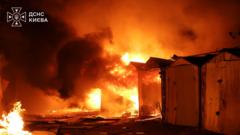
Emergency services responded promptly to the attacks, battling fires at a building and a fuel tank within Kyiv. The Ukraine State Emergency Service (DSNS) released images showing garages, a business, and other structures engulfed in flames in Kyiv’s Holosiivskyi district. The number of casualties was still being clarified as rescue operations continued.
These strikes follow a recent wave of Russian attacks across Ukraine that killed 21 people, indicating a pattern of intensified bombardments targeting civilian areas and infrastructure. The scale and frequency of these missile strikes demonstrate a deliberate strategy to destabilize urban centers and undermine civilian morale.
The death of a child among the casualties starkly illustrates the severe humanitarian toll of the conflict. Missile strikes in populated areas not only cause immediate loss of life but also disrupt daily life, damage homes, and create long-term trauma for survivors.
Falling debris damaged apartment buildings and cars, compounding the destruction and endangering residents. Fires triggered by the strikes threaten further damage and complicate emergency response efforts. Such attacks contribute to the displacement of civilians and strain local resources, highlighting the ongoing vulnerability of non-combatants in the war zone.
The psychological impact on communities living under constant threat of missile attacks cannot be overstated, with many residents facing anxiety, loss of livelihood, and uncertainty about the future. Humanitarian organizations continue to call for increased protection measures and aid to support those affected by the violence.
President Volodymyr Zelensky has emphasized the critical need for improved missile interception systems to protect Ukrainian civilians and infrastructure. In recent statements, he attributed 'horrific casualties and destruction' to delays in receiving advanced anti-ballistic missile systems from international partners.
Zelensky noted that a stronger interceptor capability could have saved lives during recent deadly assaults, underscoring the strategic importance of missile defense in the conflict. However, he also revealed that the supply of such interceptors from allies has been 'significantly reduced' this year, posing challenges for Ukraine’s defensive operations.
The urgency of this need is underscored by the ongoing missile attacks and the increasing sophistication of Russian strikes, which target critical urban areas and energy infrastructure. Enhanced missile defense systems would not only reduce civilian casualties but also help maintain essential services and infrastructure, which are vital for the country’s resilience amid war.
In response to Russian aggression, Ukraine has conducted its own offensive operations deep inside Russian territory. Notably, Ukrainian forces targeted two oil refineries—Ilsky and Syzran—causing significant fires. These strikes aim to disrupt Russia’s oil revenues, which are believed to finance its military operations in Ukraine.
Additionally, Ukraine attacked vessels linked to Moscow in the Black Sea, further intensifying the conflict. These counterstrikes reflect a strategic shift as Ukraine seeks to pressure Russia economically and militarily, attempting to weaken its capacity to sustain the war effort.
The escalation follows a breakdown in recent mediation talks between the two countries, signaling a hardening of positions and a continuation of hostilities. This tit-for-tat dynamic increases the risk of further escalation, complicating prospects for a negotiated settlement.
Amid the conflict, President Zelensky visited Belgrade, Serbia, marking his first trip to the Serbian capital during the war. The visit aims to strengthen economic ties, discuss security issues, and explore Serbia’s relationship with the European Union.
Serbia occupies a complex position in the conflict. While it has provided aid to Ukraine and pledged support for post-war reconstruction, Serbian President Aleksandar Vučić has resisted imposing sanctions on Russia. Serbia’s aspirations to join the EU add another layer of complexity to its diplomatic stance, balancing between Western integration and traditional ties with Russia.
Zelensky’s engagement with Serbia reflects Ukraine’s broader strategy to build wider international support, particularly from countries that have not fully aligned with Western sanctions against Russia. Such diplomatic outreach is crucial for Ukraine to diversify its alliances and secure the resources needed for defense and recovery.
The missile attacks near Kyiv underscore the brutal reality of the ongoing war in Ukraine, where civilians remain at grave risk amidst escalating military operations. The tragic loss of life, including that of a child, emphasizes the urgent need for improved defensive capabilities to protect non-combatants. Ukraine’s strategic counterstrikes and diplomatic outreach reflect a multifaceted approach to confronting Russian aggression. However, the conflict’s persistence and the complexities of international alliances suggest that a resolution remains elusive. Continued global attention and support for Ukraine’s defense and humanitarian needs are critical as the war enters a new and dangerous phase.
Originally reported by bbc.co.uk. Adapted for our readers with AI assistance.
Keep reading
News
Recall that Poland’s Minister Sikorski’s core claim is partially supported by the numbers, but the framing “quite quickly” and “without the U.S.” does not…
News
By Engr. Tamunofiniarisa BrownReading Time: 6 Minutes The conflict between Russia and Ukraine is often framed in the media as a simple battle between…
World News
Following a tragic crash on the A66 near Middlesbrough that killed two police officers and five young men, Cleveland Police have arrested three more…
TAMFIS NIG LTD
Electrical and instrumentation engineering, bid preparation and consulting, IT and software.