
NASA spacecraft touches Sun’s atmosphere, breaking record
Science & Technology

NASA spacecraft touches Sun’s atmosphere, breaking record

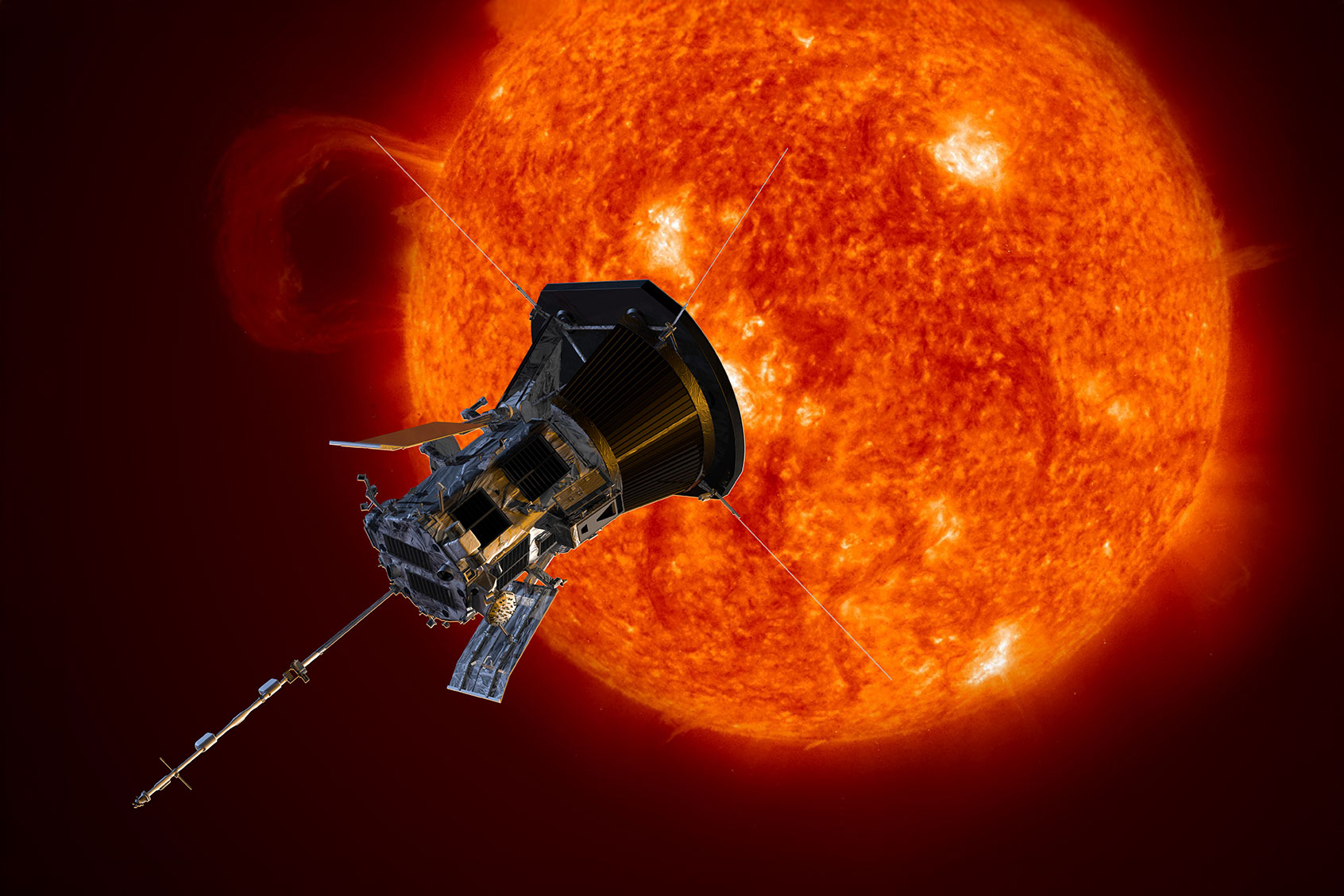
On Dec. 24, 2024, NASAs Parker Solar Probe made history with the closest ever approach to the Sun Published December 24, 2024 5:46PM (EST) Artists concept of the Parker Solar Probe spacecraft approaching the sun.(NASA/Johns Hopkins APL/Steve Gribben)The concept of touching the Sun can be traced back to the ancient Greek myth of Icarus, but scientists at NASA have turned that idea into a reality. On Dec. 24th, their Parker Solar Probe managed to travel to just within 3.86 million miles (6.1 million kilometers) of the Sun’s surface, a new record. The probe, which is roughly the size of a small car, has now become the human-made object to come closest to touching the Sun among everything our species has created. “Moving at up to 430,000 miles per hour (692,017 km per hour), the spacecraft...
Continue reading
NASA spacecraft launched toward Jupiter’s Europa to see if ice-covered moon could host life
Science & Technology

NASA spacecraft launched toward Jupiter’s Europa to see if ice-covered moon could host life

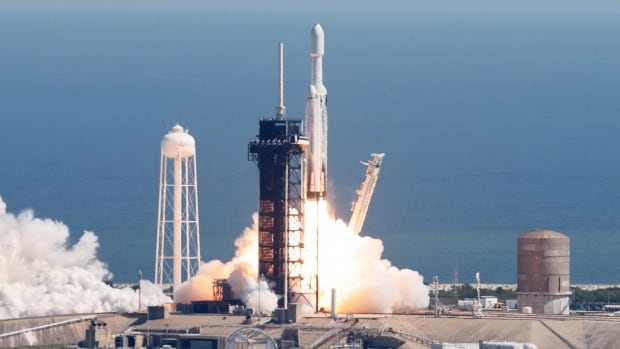
Science NASA spacecraft launched toward Jupiter's Europa to see if ice-covered moon could host life NASA finally launched a spacecraft from Florida on Monday on a mission to examine whether Jupiter's moon, Europa, has conditions suitable to support life. The launch had been delayed a week due to Hurricane Milton. Europa Clipper launch Monday the start of a mission expected to last nearly 10 years Thomson Reuters · Posted: Oct 14, 2024 1:32 PM EDT | Last Updated: October 14 A SpaceX Falcon Heavy rocket launches at Kennedy Space Center in Cape Canaveral, Fla., on Monday for the Europa Clipper mission to study one of Jupiter's 95 moons. (Joe Skipper/Reuters) NASA launched a spacecraft from Florida on Monday on a mission to examine whether Jupiter's moon Europa has conditions suitable to support life, with a focus on the large subsurface ocean believed to be lurking beneath its thick...
Continue reading
NASA Astronauts, SOHO Spacecraft Snap New Images of Comet Tsuchinshan-ATLAS
Science & Technology

NASA Astronauts, SOHO Spacecraft Snap New Images of Comet Tsuchinshan-ATLAS

NASA Space Technology A bright comet from the Oort cloud named C/2023 A3 (Tsuchinshan-ATLAS) is passing by Earth and will be visible through the second half of October 2024.This image, taken by the ESA/NASA Solar and Heliospheric Observatory (SOHO) on October 10, 2024, shows comet Tsuchinshan-ATLAS and its bright tail streaming from the upper left to the right; Mercury appears as a bright dot on the left. Image credit: ESA / NASA.Comet Tsuchinshan-ATLAS was discovered by astronomers at the Purple Mountain Observatory in China on January 9, 2023.Otherwise known as C/2023 A3, the comet was independently spotted by ATLAS in South Africa on February 22, 2023.It orbits the Sun on a retrograde orbit, lying at an inclination of 139°.It had its perihelion on September 27, 2024, at a distance of 0.391 AU; the closest approach...
Continue reading
This workhorse ISS spacecraft has never looked so beautiful
Science & Technology

This workhorse ISS spacecraft has never looked so beautiful

NASA Space Technology NASANorthrop Grumman’s Cygnus spacecraftdeparted the International Space Station (ISS) on July 12 after arriving there in February with 8,200 pounds of supplies, scientific investigations, commercial products, hardware, and other essential cargo.NASA has just shared some stunning images of the Cygnus ahead of its release from the orbital outpost, after which it descended to burn up in Earth’s atmosphere.The images show the spacecraft from various angles and in extraordinary detail while still attached to the station via the Canadarm2 robotic arm.????: @northropgrumman's Cygnus space freighter is pictured attached to the Canadarm2 robotic arm ahead of its release from the space station. Cygnus was released on July 12 at 7:01am ET, ending its five-and-a-half month stay at the orbiting lab. More pix: https://t.co/2k1R6AqEMs pic.twitter.com/EU8FoXPtQE— International Space Station (@Space_Station) July 17, 2024Cygnus began its journey...
Continue reading