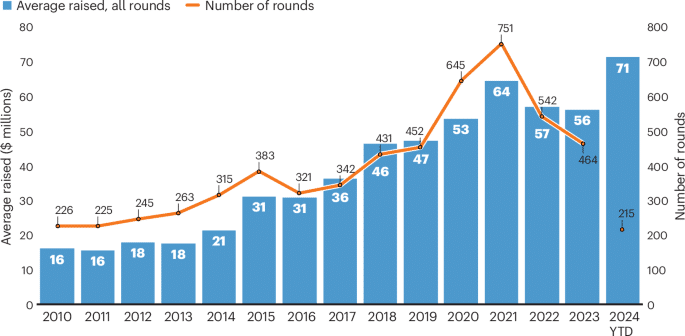
Biotech financing rounds are fewer, but larger: the average private financing round so far in 2024 (excluding seed rounds) is almost $90 million (Fig. 3a), and at least 50 companies have raised rounds worth $100 million so far this year, according to Endpoints.
One reason for this winner-takes-all landscape is investors’ preference for later-stage programs. This mirrors big pharma’s chase for assets in large, competitive markets like obesity, autoimmune diseases and neurology, big enough to fill revenue holes left by older drugs. Pharma buyers want clear evidence of clinical differentiation, forcing VCs to fund companies for longer, and more generously. “We are now in a world where more VC is going into clinical than preclinical assets,” says Tim Haines, executive partner at VC firm Abingworth — a trend likely to continue if public markets remain fragile. (In 2019, it was the reverse: more VC went to preclinical and platforms than clinical-stage companies.) Growing VC fund sizes also encourage bigger rounds: managing dozens of smaller deals is too resource intensive.
So far in 2024, a quarter of all series A rounds are worth over $100 million, and the average A round is $80 million — more than double the average five years ago (Fig. 3b). This takes pressure off raising additional money in a series B or C, says Haines.
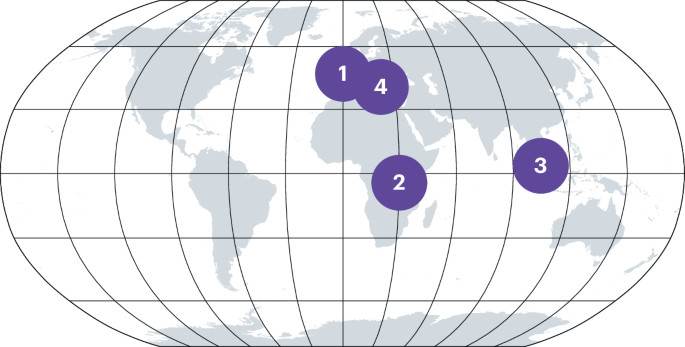
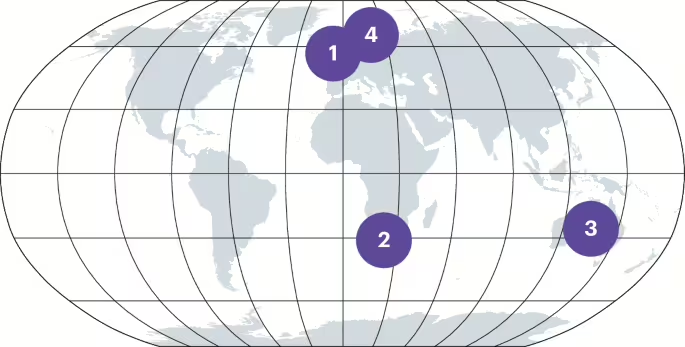
Many of these series A rounds support companies that have in-licensed clinical assets in attractive therapy areas and are helmed by experienced management teams. Cancer still dominates the VC totals, but “those in areas like obesity, neurology, immunology or AI can get oversubscribed rounds” says Naveed Siddiqi, senior partner of venture investments at Novo Holdings (Fig. 4).
The obesity gold rush spearheaded by Novo and Lilly’s GLP-1 agonist-based therapies semaglutide and tirzepatide is luring investors: Metsera emerged in April 2024 with a pipeline of in-licensed obesity assets and $290 million seed and series A funding led by Arch Venture Partners and Population Health Partners. Hercules CM NewCo attracted $400 million from Bain, RTW and Atlas Venture for a pipeline of GLP-1-based assets in-licensed from China. Third Rock Ventures-incubated Marea Therapeutics launched in mid-June, attracting $190 million (series A and B) to progress a ANGPTL4-targeting antibody licensed from Novartis that is already in phase 2 for metabolic dysfunction.
Newly listed Rapport emerged in 2023 with a clinical asset from Johnson & Johnson for seizure disorders; it raised a $100 million series A and a further $150 million series B within weeks, capitalizing on resurgent interest in CNS drugs. The founding team came from Cerevel Therapeutics, now part of AbbVie. Amsterdam-based VectorY Therapeutics raised a $138 million series A to progress its adeno-associated virus (AAV)-delivered antibody into the clinic for the rare neurodegenerative condition amyotrophic lateral sclerosis. VectorY is run by co-founder Sander van Deventer, who also co-founded gene therapy company uniQure and VC firm Forbion, which built VectorY and co-led the financing.
Immunology is another jackpot area for potential buyers. London-based VC firm Medicxi assembled six immunodermatology-focused portfolio companies plus $100 million to create Alys Pharmaceuticals in February 2024. Inflammation and immunology are “attracting huge interest from pharma,” says partner Francesco de Rubertis, given the multiple indications and pathways in the space. “Obesity is hot, but much harder to break into” if you’re not already a player, he says.