Webb Reveals Hidden Layers of Uranus’ Upper Atmosphere
Science & Technology

Webb Reveals Hidden Layers of Uranus’ Upper Atmosphere

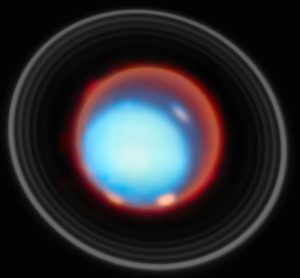
For the first time, astronomers have mapped the vertical structure of Uranus’ ionosphere, uncovering unexpected temperature peaks, weakened ion densities, and puzzling dark regions shaped by the planet’s extreme magnetic field. The results, made possible by nearly a full day of observations with the NIRSpec instrument onboard the NASA/ESA/CSA James Webb Space Telescope, confirm that Uranus’ upper atmosphere has been cooling for decades and offer a rare glimpse into how the ice giant interacts with space in ways unlike any other world in the Solar System.Tie rods et al. mapped the vertical structure of Uranus’ upper atmosphere, uncovering how temperature and charged particles vary with height across the planet. Image credit: NASA / ESA / CSA / Webb / STScI / P. Tiranti / H. Melin / M. Zamani, ESA & Webb.The upper atmosphere of...
Continue reading
NASA space telescope gets 1st clear X-ray image of sun-like star blowing a bubble
Science & Technology

NASA space telescope gets 1st clear X-ray image of sun-like star blowing a bubble

Astronomers have captured the first views of a young sun-like star blowing bubbles, offering a rare glimpse at how our solar neighborhood might have behaved in its youth. Using NASA's Chandra X-ray Observatoryresearchers observed HD 61005 — a young star located about 120 light-years from Earth with roughly the same mass and temperature as our sun — and detected a vast bubble of hot gas surrounding it. This wind-blown bubble, known as an "astrosphere," forms when a star's powerful stellar wind slams into surrounding interstellar gas and dust, carving out a protective cavity much like the sun's heliosphere that shields our solar system from galactic cosmic rays, according to a statement from NASA. This marks the first X-ray evidence of an astrosphere around a star like our sungiving astronomers their clearest look yet at one of these...
Continue reading
Astronomers Find Early Fast-Feeding Black Hole Using NASA Telescopes
Science & Technology

Astronomers Find Early Fast-Feeding Black Hole Using NASA Telescopes

NASA Space Technology A rapidly feeding black hole at the center of a dwarf galaxy in the early universe, shown in this artist’s concept, may hold important clues to the evolution of supermassive black holes in general.Using data from NASA’s James Webb Space Telescope and Chandra X-ray Observatory, a team of astronomers discovered this low-mass supermassive black hole just 1.5 billion years after the big bang. The black hole is pulling in matter at a phenomenal rate — over 40 times the theoretical limit. While short lived, this black hole’s “feast” could help astronomers explain how supermassive black holes grew so quickly in the early universe.Supermassive black holes exist at the center of most galaxies, and modern telescopes continue to observe them at surprisingly early times in the universe’s evolution. It’s difficult to understand how these...
Continue reading
Astronomers Detect Enormous Bipolar Outflow from NGC 4383
Top Stories

Astronomers Detect Enormous Bipolar Outflow from NGC 4383

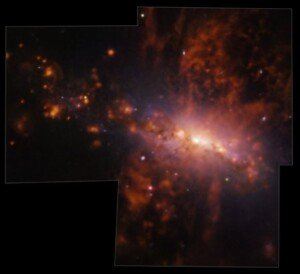
Top Stories Tamfitronics Enormous quantities of stars are being born at the heart of NGC 4383a uncommon galaxy located 74 million gentle-years away within the constellation of Coma Berenices. Potentially the most huge ones lose mass over their lifetimes by powerful winds, and finish up in violent supernova explosions. These stellar winds and supernovae poke away about a of NGC 4383’s gasoline reservoir: the intellectual red filaments show veil hydrogen gasoline ejected out to at the very least 20,000 gentle-years from the galaxy. Since this gasoline is carried away from the galactic core as a replace of ultimate to invent the next generation of stars, this direction of regulates the price at which stars can invent within the galaxy.Watts et al. mapped out the chemical composition and circulation of NGC 4383’s outflow in extensive detail,...
Continue reading