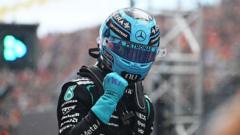
The Dutch Grand Prix sprint race at Zandvoort delivered intense competition and strategic intrigue, with Mercedes driver George Russell asserting his dominance by leading every lap to claim victory. This win marks Russell's third sprint race triumph from pole position this season and significantly tightens the Formula 1 championship standings. Behind him, a fierce battle unfolded between Ferrari's Charles Leclerc and McLaren's Lando Norris, while the threat of late-race rain added an extra layer of tension. This article breaks down the key moments and implications of the sprint race, offering insights into team strategies, driver performances, and the evolving championship landscape.
George Russell Dominates Dutch GP Sprint to Narrow Championship Gap
Russell’s Commanding Performance from Pole Position
George Russell maintained control throughout the 24-lap sprint race, leading a closely packed group of four cars but never allowing his pursuers to get within striking distance. Starting from pole, Russell managed his tyres carefully in the early stages, aware of Ferrari’s pace and the likelihood of late-race overtakes. His strategy paid off as he conserved enough grip to respond effectively when Charles Leclerc closed in after passing Lando Norris.
Russell’s ability to balance tyre management with maintaining a strong pace was crucial. He commented on the race approach, noting that he anticipated overtakes in the latter phase and adjusted his driving accordingly. The Mercedes driver’s focus on tyre preservation and tactical pacing underlined his maturity and racecraft, key factors in his sprint race success.
Tyre Choices and Their Impact on Race Dynamics
Tyre strategy played a pivotal role in shaping the sprint race’s outcome. Unlike most front-runners who opted for medium tyres, Charles Leclerc chose the softer compound, aiming for a performance advantage in the closing laps. Contrary to typical expectations that soft tyres degrade quickly, Leclerc’s tyres improved in effectiveness as the race progressed, enabling him to close the gap on Lando Norris and execute a decisive overtake into the first corner, Tarzan, on lap 18.
Lando Norris, meanwhile, struggled with rear grip issues after eight laps, which hampered his pace and allowed Leclerc to catch up. Norris admitted that his McLaren was strong in high-speed corners but lacked competitiveness in slower sections, which contributed to his difficulties in defending second place. This highlights the nuanced balance teams must strike between car setup and tyre management to optimize performance across varying track conditions.
Late-Race Battles and Weather Concerns
As the race neared its conclusion, Norris faced pressure from Mercedes’ Kimi Antonelli, who was just 0.3 seconds behind entering the final lap. Antonelli attempted a move into Tarzan corner but was unable to close the gap sufficiently to overtake. Norris’s defensive driving secured third place, but his comments about lacking pace suggest McLaren still has work to do to close the gap to the leading teams.
Adding to the race drama was the forecast of rain expected two laps from the end. Although the rain arrived only after the chequered flag during the slowing down laps, its timing could have dramatically altered the race’s final moments. The heavy downpour would have introduced significant challenges, potentially reshuffling positions and testing driver skill under changing grip conditions.
Championship Implications and Driver Standings
Russell’s sprint race victory reduces his points deficit to championship leader Kimi Antonelli to 56 points, tightening the battle at the top. Lewis Hamilton, the seven-time world champion, remains second in the standings, three points ahead of Russell after finishing seventh in the sprint behind McLaren’s Oscar Piastri and Red Bull’s Max Verstappen.
Oscar Piastri’s race was marked by a gradual loss of pace relative to the front runners, but he managed to hold off Verstappen by a narrow margin of 0.3 seconds at the finish line. Hamilton’s position just behind Verstappen indicates a competitive midfield battle that could influence the championship’s trajectory in the coming races.
The points awarded in the sprint race reflect the tight competition among the top drivers: Russell earned 8 points for first place, Leclerc 7 for second, and Norris 6 for third, with Antonelli, Piastri, Verstappen, and Hamilton also scoring valuable points.
Team Strategies and Areas for Improvement
The sprint race exposed strengths and weaknesses across several teams. Mercedes demonstrated strong tyre management and race control through Russell’s performance, while Ferrari’s bold tyre choice for Leclerc paid dividends in the latter stages. McLaren’s Norris highlighted the need to improve car balance in slower corners to complement their high-speed cornering advantage.
McLaren’s feedback about losing out in the first three corners throughout the weekend underscores a critical area for development. Optimizing car setup to enhance traction and pace in these sections could be decisive in future races, especially when defending positions against aggressive challengers like Antonelli.
Meanwhile, Red Bull’s Max Verstappen, despite finishing outside the top three in the sprint, remains a consistent presence in the points and continues to be a formidable competitor in the championship fight.
What this means
The Dutch Grand Prix sprint race at Zandvoort highlighted the intense competition and strategic depth characterizing the 2026 Formula 1 season. George Russell’s controlled and calculated victory from pole position not only demonstrated his growing maturity as a race leader but also tightened the championship battle. Ferrari’s tactical tyre choice and McLaren’s ongoing challenges in slow corners underscore the fine margins that separate the top teams. With championship leader Kimi Antonelli maintaining a lead yet facing increasing pressure, the upcoming races promise to deliver further excitement and tactical intrigue. Teams and drivers will need to continue refining their strategies and car performance to capitalize on every opportunity as the season progresses.
Originally reported by bbc.co.uk. Adapted for our readers with AI assistance.
Etihad Airways is considering legal steps against the Premier League after an independent commission found Manchester City guilty of 114 financial rule breaches. The…