
Business
Nigeria’s Economic Performance: Domestic Debt Rise and Agriculture Trade Shift in Q2 2026
Nigeria's economic landscape in the second quarter of 2026 presents a mixed picture of fiscal press...
TAMFIS NIG LTDRC 8067447CAC ACTIVEFinima, Bonny Island, Rivers State

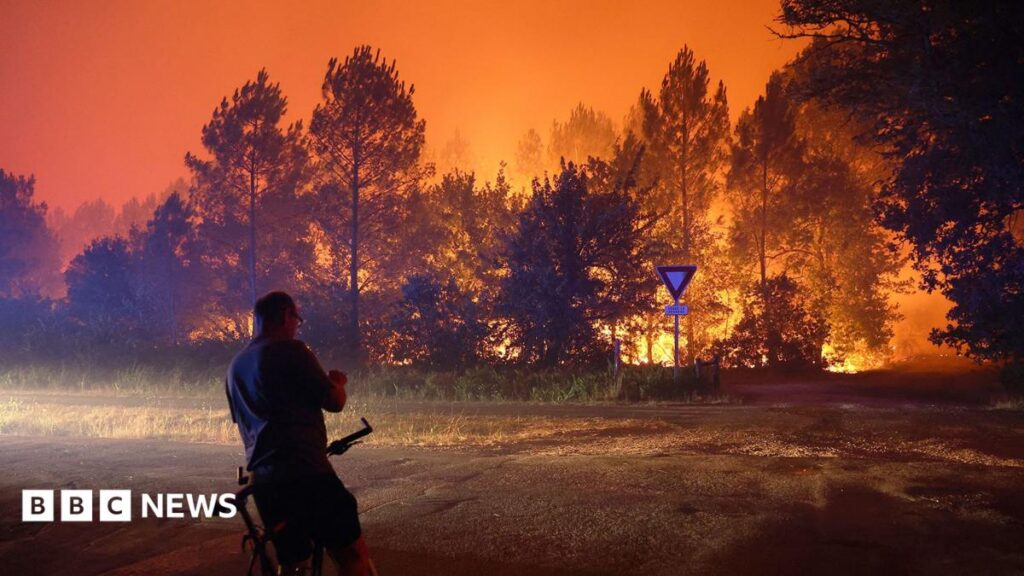
Europe's fastest-warming continent status is no longer a projection—it is a lived reality unfolding across the Mediterranean this summer. Wildfires tearing through France's Gironde region, Sicily's parched landscapes, and the hills surrounding Madrid have forced mass evacuations, claimed the lives of frontline firefighters, and laid bare the vulnerability of infrastructure, tourism, and supply chains to extreme heat. For shoppers, business consumers, and procurement professionals monitoring global risk, these events are not distant tragedies but leading indicators of the operational disruptions that climate acceleration will bring to markets from Lagos to London.
Southwestern France has become the epicentre of this season's crisis. Approximately 12,000 people—including an estimated 10,000 tourists—have been evacuated from the Gironde region since the fires ignited, disrupting one of the country's most valuable summer tourism corridors. Over 2,000 hectares of forest and scrubland have been consumed, an area roughly equivalent to 4,000 acres or nearly 3,000 football pitches.
Authorities have imposed a red alert across the department, banning both internal combustion and electric engines in forested zones to eliminate ignition sources. Major road arteries have been closed to clear routes for firefighting convoys and protect civilians. While no new civilian injuries were reported as of the latest briefing, the economic ripple effects are already evident: campsites, hotels, and leisure operators in exposed forest areas face indefinite closure, and insurers are bracing for a surge in business interruption claims.
The crisis has exacted a devastating price on emergency responders. Two French firefighters died near Bordeaux airport while battling the Gironde blaze, prompting national mourning and a formal tribute from Interior Minister Laurent Nuñez. In Sicily, firefighter Alessandro Marchi lost his life at San Cataldo, with a colleague hospitalised. President Renato Schifani and Interior Minister Matteo Piantedosi both honoured the sacrifice, underscoring the growing danger of wildfire suppression in extreme heat.
These fatalities highlight a systemic challenge: as fire seasons lengthen and intensity escalates, the physical limits of human endurance are being tested. European fire services, historically structured for shorter, cooler campaigns, now face protracted deployments in temperatures that routinely exceed 40°C. Recruitment, training, and equipment procurement budgets will need radical uplift if response capacity is to keep pace with risk.
Sicily alone has recorded over 350 fire outbreaks in recent weeks, with authorities attributing a significant proportion to human activity—whether negligence or arson—raising public order concerns alongside environmental ones. Ten major incidents triggered precautionary evacuations, stretching regional civil protection resources.
Spain's capital region has not been spared. Fires near Madrid forced evacuations in Villa del Prado, with nearly 90 personnel and aerial assets deployed in direct attack operations. The state meteorological agency AEMET has forecast peaks of 36°C, maintaining an extreme fire risk rating across central and southern provinces. Social media updates from emergency services—including video footage of hose-line advances—reflect a new transparency doctrine aimed at keeping populations informed in real time.
The Copernicus Climate Change Service's April report provides the scientific backbone for what policymakers and risk managers are witnessing on the ground. At least 95% of Europe experienced above-average annual temperatures in 2025, confirming the continent as the fastest-warming on the planet. Wildfire-burnt area and associated carbon emissions both reached record highs last year, creating a feedback loop: more fires release more carbon, which drives further warming.
For procurement and supply chain leaders, the data signals a structural shift. Agricultural yields in Mediterranean breadbaskets face heightened volatility. Energy grids, already strained by cooling demand, must contend with fire-related transmission outages. Insurance markets are repricing property and business interruption cover in exposed zones, with some underwriters withdrawing capacity altogether.
While the flames burn in Europe, the lessons are universal. Nigerian importers reliant on European agricultural produce, wine, timber, and specialised manufactures should anticipate price spikes and delivery delays as harvests are lost and transport corridors disrupted. The Gironde fires, for instance, threaten vineyard output in Bordeaux's hinterland—a direct input for hospitality and retail buyers in West Africa.
Logistics operators must factor fire-related road and rail closures into routing algorithms. The engine bans in French forested zones, while necessary, illustrate how regulatory responses to climate emergencies can cascade into freight restrictions with little notice. Business continuity plans that treat wildfire as a low-probability, high-impact event need recalibration: probability is rising, and impact is broadening beyond the immediate burn zone.
On the procurement side, tender specifications for infrastructure projects—whether in Lagos, Abuja, or Port Harcourt—should now mandate climate-resilient design standards: fire-resistant materials, defensible space landscaping, and redundant water supplies. The European experience demonstrates that reactive spending dwarfs preventive investment.
The crisis is also catalysing innovation. Drone-based early detection, AI-driven fire spread modelling, and autonomous suppression systems are attracting venture capital across Europe. Nigerian tech entrepreneurs and investors should monitor these developments: solutions proven in Mediterranean conditions are often transferable to savannah and forest margins in the Niger Delta or Cross River basins.
Parametric insurance—payouts triggered by satellite-measured burn indices rather than loss adjusters—is gaining traction among European municipalities and agribusinesses. This model could revolutionise risk transfer for Nigerian cooperatives and SMEs lacking access to traditional indemnity cover. Procurement officers evaluating insurance tenders should request parametric options alongside conventional policies.
The wildfires scorching France, Italy, and Spain are not isolated disasters—they are the visible edge of a continental climate trajectory that the Copernicus Service has quantified with brutal clarity. For business consumers, procurement specialists, and investors in Nigeria and beyond, the message is unambiguous: climate resilience is no longer a corporate social responsibility garnish but a core operational requirement. Supply chains must be stress-tested against fire, heat, and regulatory disruption scenarios. Insurance programmes must evolve from indemnity to parametric triggers. Capital allocation must prioritise adaptive infrastructure over reactive recovery. The European summer of 2025 is a preview of the global norm; those who treat it as a case study rather than a warning will find their margins—and in some cases their licences to operate—consumed by the next fire season.
Originally reported by bbc.co.uk. Adapted for our readers with AI assistance.
Keep reading
Business
Nigeria's economic landscape in the second quarter of 2026 presents a mixed picture of fiscal press...
Business
Liverpool manager Andoni Iraola is confronting a significant selection headache as two key forwards, Cod...
News
Health News tamfitronics [Editor’snote:[Editor’snote: This transcript was generated using both transcription ...
TAMFIS NIG LTD
Electrical and instrumentation engineering, bid preparation and consulting, IT and software.

